Skip to content

Get a Service Quote Now!

Get a Service Quote Now!

Fast response · No obligation

Step 1 of 2

Your contact info

Next: the service, address and details. Under a minute.

Call
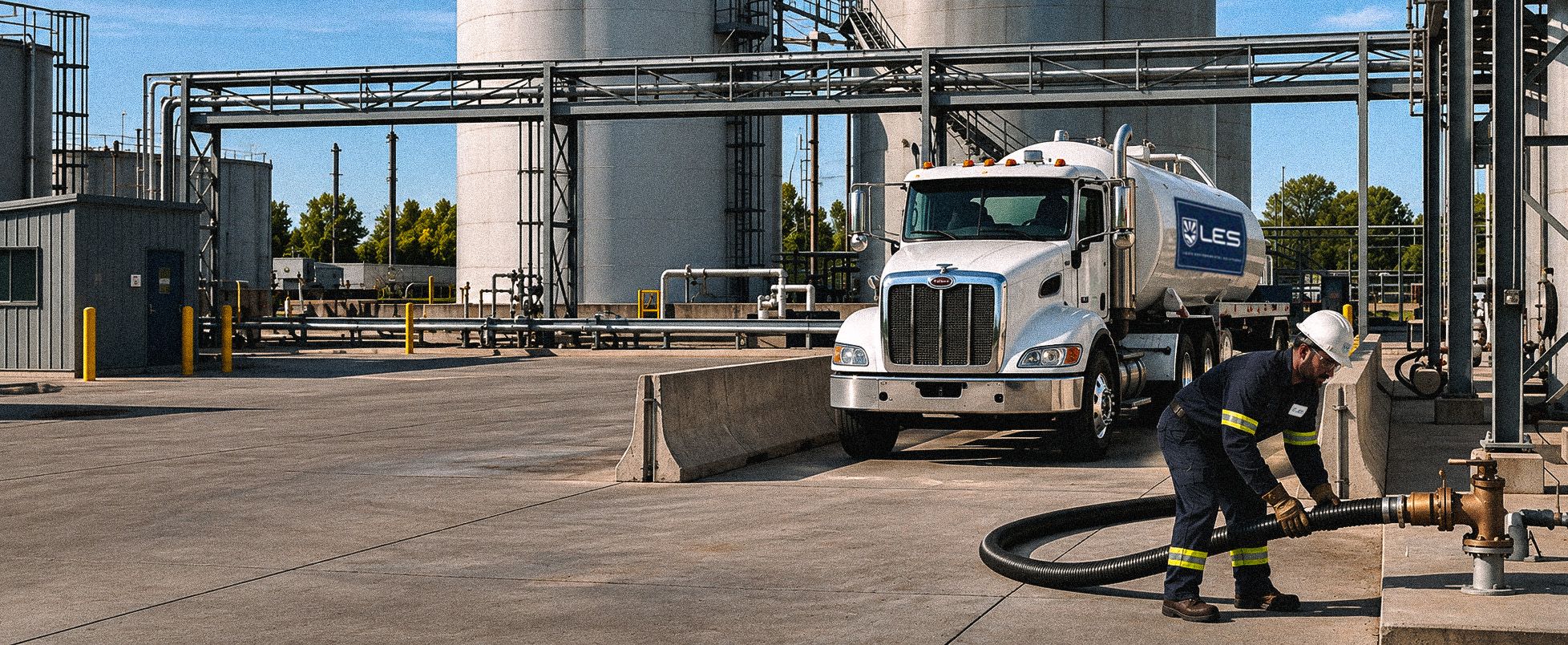
LES technician in a hi-vis vest connecting a hose from a tanker truck to a receiving line at a treatment plant, with storage tanks and pipe racks behind.

Industrial wastewater disposalApproved Fast. Processed Nationwide. Documented to the Gallon.

Industrial wastewater, commercial wastewater, hauled loads and landfill leachate. All non-hazardous. All profiled, approved, processed and reported by one company that owns the whole chain.

When a load has nowhere to go, production waits with it. LES clears the step that usually causes the wait. We test the sample, approve the profile and take the volume before it backs up your operation.

Trusted by leading multi-site operators nationwide

The Waste Is Not the Problem.Waiting for Someone to Accept It Is.

Your lagoon is filling. Your frac tanks are staged. Your leachate keeps building up, whether or not a disposal facility has looked at your sample.

Most of that wait has nothing to do with treatment capacity. It's the testing, the profile review and the approval — sitting in someone else's queue.

LES turns samples and profiles around faster than most options. Testing and approval are usually done in a few days. From there, approved streams move straight into scheduled receiving.

Most profiles are approved quickly. The one variable is whether we can check a stream's likely contaminants up front. For a new customer, one of three things happens:

  • Quick.

    The customer sends its own lab results, and LES is comfortable with them.

  • Quick.

    The customer has no lab results, so LES tests for the likely contaminants in its own lab.

  • Can add two to five days.

    The customer has no lab results, and one likely contaminant is something LES can't test for. LES sends that test to an outside lab. The third case is rare. It's why turnaround is a few days rather than one fixed number. Most streams clear on the first two paths.

Four Streams.One Intake Process.

Faster approval means the volume moves before it slows production, raises permit questions or turns into an emergency.

129,500+

Customer locations served

90+

Facilities nationwide

1,000+

Trucks and tankers

6

Centralized waste treatment facilities

525M+

Gallons recycled annually

94%

Landfill diversion

A few days

Typical testing and profile approval

Documented to the Gallon

Manifests and receipts by load

The Chain of Custody Is Not Handed Off.Because Nothing Is Subcontracted.

Most high-volume disposal deals involve a broker, a hauler and a processor who have never met. When something goes wrong, each one blames the other two.

LES owns collection, hauling, processing, recycling and the records that prove it.

Six LES plants are centralized waste treatment facilities. They're permitted to receive non-hazardous liquid industrial waste hauled in from other sites. Our other plants don't accept this type of waste.

  • One accountable operator.

    Sample, approval, transport, treatment, and reporting sit with the same company.

  • One record.

    Every gallon is tracked from pickup or gate receipt through final disposition.

  • One answer.

    When your environmental manager or a regulator asks where the volume went, there is a document, not a phone tree.

The six centralized waste treatment facilities

Every LES plant takes bulk loads. What sets the six centralized waste treatment facilities apart isn't how much they take. It's what they're permitted to accept.

Every LES plant accepts fats, oils, grease, grit and lint. So an outside grease, used cooking oil or oil water separator service provider can unload at any LES FOG plant.

Liquid industrial waste is different. Only the six CWT facilities are permitted to receive it. So a collector of non-hazardous liquid industrial waste can unload only at a CWT.

If you're a landfill, a manufacturer or a hauler moving industrial volume, that's the difference that matters. The drive time to the nearest CWT drives the cost of the whole deal.

A national fleet of 1,000+ trucks and tankers backs those six facilities.

Each of these markets also has an LES location page with local contact and hours.

What each plant accepts

Every LES plant handles fats, oils and grease. The six centralized waste treatment (CWT) facilities do all of that and more. They're the only plants also permitted to receive liquid industrial waste.

That gives the network two ways in, based on the waste stream and the rules behind it.

Fats, oils and grease

Accepted at every plant, including the six CWTs


FOG streams can come in at any LES location. The plant does the first round of treatment and separation on site. Then it sends the water to the local POTW (public treatment plant) for final treatment under permit.

  • Grease trap waste
  • Lint trap waste
  • Grit trap waste
  • Food-related waste

Liquid industrial waste

Accepted only at the six CWTs


Industrial streams are received and treated exclusively at the centralized waste treatment facilities. The EPA defines them under 40 CFR Part 437, the Centralized Waste Treatment Point Source Category, which sets the numeric criteria and named waste types for each:

  • Subcategory A: Metal-bearing wastes
  • Subcategory B: Oily wastes
  • Subcategory C: Organic wastes

Federally regulated

These streams are federally regulated, so they can only go to a permitted CWT. That's why a collector of liquid industrial waste has to reach one of the six.

From Sample to Scheduled Receiving

We review profiles from time to time as your process changes. So an approved stream stays approved without starting over.

  1. 01Profile

    Send the LES waste profile with a description of the stream and how much you produce.

  2. 02Sample

    Send a sample that represents the stream. LES tests it in a few business days.

  3. 03Approve

    LES confirms we can accept it, picks the receiving facility and sends pricing.

  4. 04Schedule

    Repeat volume moves to a standing schedule. Spot loads are received first come, first served — no appointment needed. Plants receive loads 5 a.m. to 7 p.m., Monday through Saturday.

  5. 05Document

    Manifests, receipts and recycling reports are issued for each load and combined by site.

Extend Your Disposal Capacity Without Building a Plant.

Environmental service companies, haulers and industrial contractors bring approved non-hazardous loads to LES receiving facilities. Some use LES as their main outlet. Others use us to take work in markets where they collect but have no disposal.

LES is fully permitted and insured, and we run our own treatment and recycling network. Partnering with us doesn't mean handing your customer to a competitor for grease trap or separator work. It means buying disposal capacity from the company that owns the plants.

What you get

  • Profile approval in a few days, not weeks
  • Six centralized waste treatment facilities — Phoenix, Houston, Mobile, Jacksonville, Chicago and Kansas City
  • First come, first served receiving — no appointments to plan around. Plants are open 5 a.m. to 7 p.m., Monday through Saturday
  • Scale ticket and receipt at the gate, with records to follow
  • Disposal capacity you can count on when bidding work outside your own area

A disposal outlet that approves fast and unloads fast keeps your routes profitable.

The Volume Leaving Is Only Half the Program.

Many plants that send LES high-volume wastewater also have grease traps, separators and drains on site. LES services both, on one program with one set of records.

Every Gallon Accounted For, in a Format Your Auditor Accepts.

LES manages waste from collection through processing. So we can show how much volume came from each site and how it was handled.

LES recycles 525M+ gallons a year and keeps 94% of collected material out of landfills. Water, oil, grease and other materials are sent for reuse whenever possible. Where others see waste, LES sees tomorrow’s resources.

Manifests and receipts by load

Combined reports by site and by time period

Recycling records for sustainability and ESG reporting

Why Industrial Operators Choose LES

  • Fast Approval

    Sample testing and profile approval in days, so volume moves before it slows production.

  • Production Continuity

    Scheduled receiving and contracted capacity, so disposal isn't a guessing game in your plans.

  • One Responsible Operator

    We own collection, hauling, processing and recycling from start to finish. No broker, no handoff, no finger-pointing.

  • Documented Recovery

    Chain-of-custody records and recycling reports that support permits, audits and ESG reporting.

Stop Planning Production Around Disposal Capacity.

Send us the profile. LES will test the sample, confirm we can accept it, pick a receiving facility and quote the program.

Industrial wastewater, commercial wastewater, hauled loads and landfill leachate.

Submit a Waste Profile

Step 1 of 2

Your contact info

Next: the service, address and details. Under a minute.

Frequently Asked Questions

What types of liquid waste does LES accept at its processing facilities?

LES accepts non-hazardous industrial wastewater, commercial wastewater, hauled wastewater from outside haulers and landfill leachate.

How quickly can LES approve a waste profile?

Most profiles clear in a few business days. If you send lab results we accept, or LES can test the likely contaminants in our own lab, approval is quick. If an outside lab has to check a contaminant, that can add two to five days. LES runs its own testing and approval. So your review isn't stuck behind an outside processor or passed through a broker.

Can LES handle landfill leachate?

Yes. LES processes landfill leachate under steady contracts, during seasonal spikes and as spot loads. We can haul it with our own tankers or receive loads brought in by your hauler.

Does LES accept loads from other environmental service companies?

Yes. Outside haulers can set up an account, profile their streams and bring approved loads to LES receiving facilities. Receiving is first come, first served. Plants are open 5 a.m. to 7 p.m., Monday through Saturday.

Can a waste collection company use LES as a disposal outlet?

Yes. Environmental service companies and haulers can set up an account and bring approved non-hazardous loads to LES receiving facilities. Many use LES to serve markets where they collect but have no disposal of their own.

How much volume can LES process?

Six LES plants are centralized waste treatment facilities: Phoenix, Houston, Mobile, Jacksonville, Chicago and Kansas City. Across the whole network, LES runs 90+ facilities and 1,000+ trucks and tankers. We recycle more than 525 million gallons a year.

Where are your centralized waste treatment facilities?

Phoenix, Houston, Mobile, Jacksonville, Chicago and Kansas City. A CWT facility is permitted to receive non-hazardous liquid industrial waste from other sites and haulers. Those are the streams a collector of industrial liquid waste needs a place for. Every LES plant accepts fats, oils and grease from outside providers. But only the six CWT facilities are permitted to take liquid industrial waste.

What records do I get?

You get manifests and receipts for every load and combined reports by site and time period. You also get recycling records you can use for permit files, audits and ESG reporting.

Does LES haul the waste, or do I have to?

Either. LES can haul it with our own fleet or receive loads brought in by your hauler. Many customers use both, depending on the site and season.

What happens to the waste that LES processes?

LES removes oil, fats, grease, dirt, metals, plastics and other contaminants from the wastewater. Then we send the water to the local POTW (public treatment plant) for more treatment. The grease, oils and fats we pull out are sent to special recyclers. They turn them into biofuels, biodiesel or sustainable aviation fuel. On average, LES keeps 94% of collected material out of landfills.

How do I get started?

Send a waste profile with a sample that represents your stream. LES tests it, confirms we can accept it, picks a receiving facility and quotes the program.