One Backhoe Bucket Can Take Out Your Gas Line, Your Fiber, or Your Drive-Thru. Water Can't.
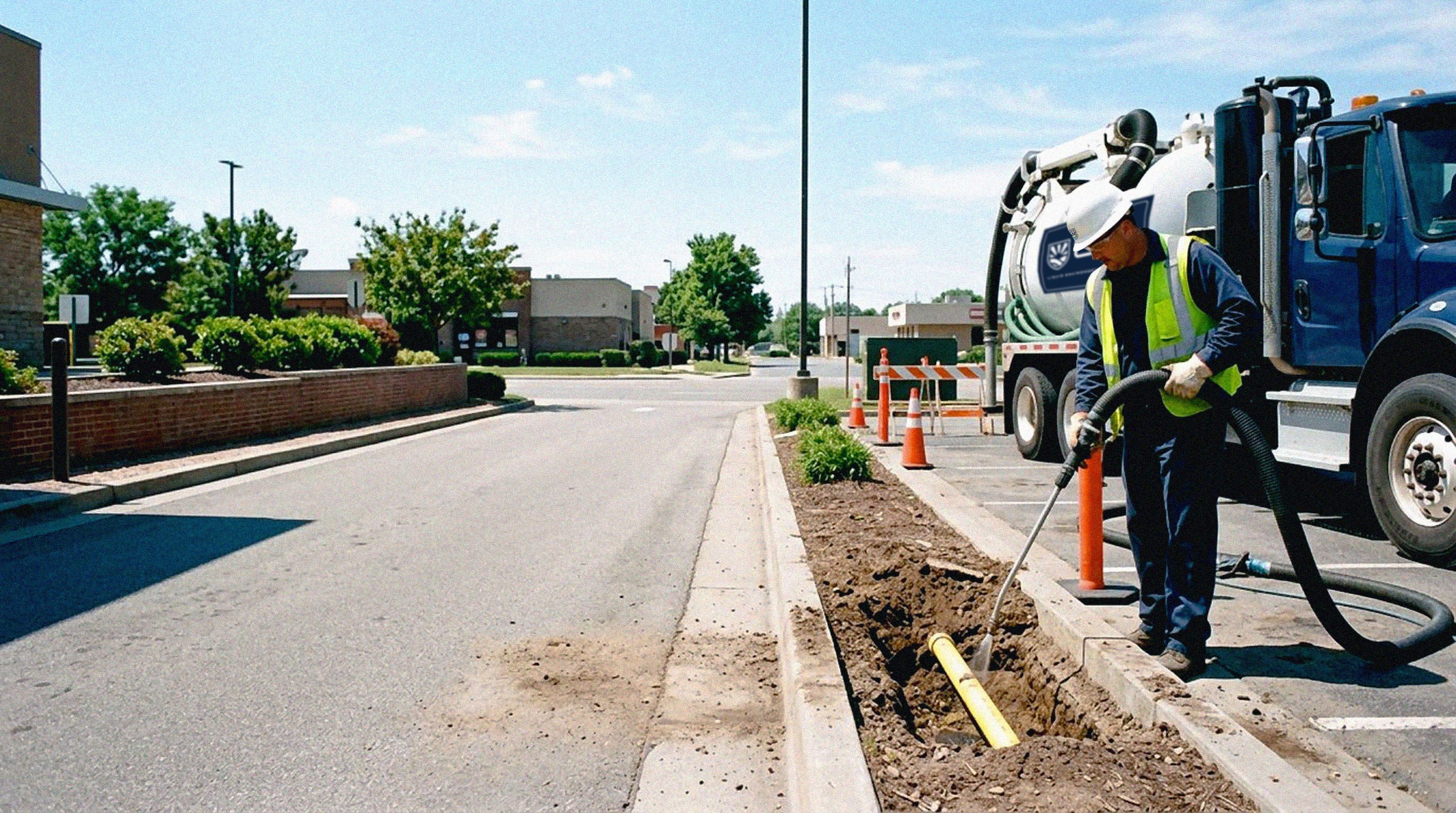
Hydro excavation uses water pressure and vacuum instead of steel. It digs exactly where you need it, flows safely around live utilities and keeps your business open.











Under Every Commercial Property Is a Web of Lines
Gas, water, electric, fiber, vapor recovery and storm drains, laid by different contractors over decades. They are rarely mapped as well as the drawings suggest.
A digging bucket can’t tell soil from a conduit. It finds out what’s down there by hitting it. And the real cost is almost never the repair. It’s the gas shutdown, the fiber cut that stops card payments or the outage that closes the store for a day.
Hydro excavation removes that risk, because water can’t cut what steel would.
Where LES Offers Hydro Excavation
Hydro excavation is not a nationwide LES service. It runs only in markets where LES has an eductor truck. Today that’s seven states: Alabama, Illinois, Michigan, Ohio, Washington, Wisconsin and Missouri. The LES brands with the right equipment do the work.


- customer locations served
- 129,500+
- facilities nationwide
- 90+
- trucks & tankers
- 1,000+
- in liquid waste
- 24+ years
- mechanical strike risk
- Zero
- precise water cutting
- 1,500–3,000 PSI
- hose reach from the truck
- 100+ ft
- onboard water heating
- All-weather
A Line Strike Isn't a Repair Bill. It's a Closure.Water Flows Around Utilities Instead of Through Them.
That’s the whole argument, and it’s about physics, not process. A hydrovac crew isn’t just more careful than a backhoe operator. It uses a tool that can’t cause the failure.
Hydro excavation utilizes controlled water pressure and vacuum equipment to remove soil and expose underground utilities. When performed using appropriate operating procedures, this method can significantly reduce the risk of utility damage compared with conventional mechanical excavation.
You Don't Have a Lot to Close.We Park Hundreds of Feet Away and Reach Over.
A backhoe has to sit at the hole. That means it takes over your parking lot, drive-thru lane or loading area for the whole job.
A hydrovac truck can sit several hundred feet from the dig and work through a hose. It parks at the back of the lot, on a side street or wherever it’s out of the way. The digging happens where it needs to, not where a truck can fit.
Indoor Digging Means Silica Dust and a Closed Department. Hydrovac Produces None.
Cutting a slab indoors with machines creates silica dust in the air, shaking that cracks nearby tile and noise that carries through the building.
In a food business, that’s not just unpleasant. It’s a health code problem and exposed inventory.
Hydro excavation is dust-free.
Water dampens and traps every particle, and the vacuum pulls the mud out to a truck outside. The hose runs indoors and the trench opens under the slab. The departments on either side stay open and stay clean.
A Backhoe Digs a Crater You Pay to Repave.We Dig the Shape You Actually Need.
Surgical footprint
A hole the exact width of a pole, or a slot trench six inches wide. What you dig is what you refill, and what you refill is what you repave.
Less restoration
Patching concrete and asphalt is often the biggest line on a backhoe job’s invoice. A smaller opening cuts that cost to match.
Less backfill and disposal
A smaller dig means less dirt to haul away and less fill to bring back.
Cleaner handover
A precise opening is faster to close, so the area is back in use sooner.
Some Sites Can’t Be Dug the Normal Way.Here Are Four We Solved.
Four cases from food service and retail where machine digging was either impossible or far too risky.
Replacing a grease interceptor in a live drive-thru
A busy restaurant needs a bigger outdoor interceptor, or has a collapsed vault, in the middle of an active drive-thru lane. A backhoe means tearing out large sections of concrete and closing the lane. It also means digging blind through the gas, water and fiber lines that circle every building. Slot trenching and precise digging open the exact footprint of the new vault. The truck parks at the back of the lot and the boom reaches over. The lane keeps running, and the risk of cutting the card-processing line drops to zero.
Exposing a blocked interceptor tie-in under pavement
A grocery store’s main sewer line backs up where it joins the city main. The joint is buried under thick pavement and surrounded by high-voltage conduit. That conduit feeds the outdoor refrigeration units and lot lights. We use potholing and daylighting instead of a jackhammer. Water cuts the soil and washes around the live conduit without touching it. That exposes the junction so plumbers can cut and clear it safely.
New drainage at a fuel island
A c-store is upgrading a canopy or adding a grit-and-oil separator near the pumps. Underground are fiberglass fuel lines, pump wiring, vapor recovery pipes and storm drains, all layered together. One bucket strike means a spill or a fire. Lower, controlled water pressure melts soil away from fiberglass fuel lines without being able to puncture or crack them. So holes can be dug to full depth with no machine contact.
Relocating plumbing during an interior remodel
A grocery store moves its deli and seafood departments across the building. New floor and trench drains must be cut into the indoor slab. That usually means silica dust, shaking that cracks tile and open food exposed to both. Crews cut a narrow line in the slab and run vacuum hose inside from a truck parked outside. Trenches are dug under the slab with no dust in the air. Nearby departments stay open the whole time.
Frozen Ground Doesn't Postpone the Job.Onboard Heaters Do the Thawing.
Digging frozen ground with machines is slow, damaging and sometimes impossible. Hydrovac trucks carry onboard water heaters that quickly heat the stream to cut frozen soil. That keeps winter work moving in markets where the other option is waiting for a thaw.
Nobody Publishes What This Costs.Here’s What Really Drives the Price.
Hydro excavation is usually quoted by the job, not by the yard. The honest answer is that it depends on things a price list can’t capture. Here’s what moves the price:
Depth and volume
How much material has to be loosened and lifted, and how deep the crew has to go.
Soil conditions
Clay, rock and frozen ground all change cutting time. Onboard heat helps, but winter still isn’t the same as summer.
Access and hose distance
A truck that can park close works faster than one running several hundred feet of hose across a lot.
Utility density
More live lines underground means slower, more careful work. That’s exactly what you’re paying for.
Disposal
The dug-out soil is mud, and it has to be hauled and disposed of properly. LES does this in-house instead of subcontracting it.
Restoration scope
Whether the job includes closing and repaving, or hands back an open hole for another trade.
Don’t compare hydrovac to machine digging by the hour. Compare the total: patching, refill, disposal and the cost of the risk of a strike. Machine digging often looks cheaper until you add the pavement repair. And it always looks cheaper until something gets hit.
You’ll Need Another Provider for Some of This.Here’s What.
LES handles
- Utility potholing and daylighting
- Slot trenching
- Excavation for interceptor and separator installation
- Debris removal from valve boxes, catch basins and tight spaces
- Indoor slab trenching with vacuum hose
- Mud hauling and disposal
LES does not
- Directional drilling and boring
- Utility locating and line marking on its own
- Pipe, conduit or cable installation
- Concrete and asphalt restoration
- Structural or civil construction
- Excavation spoil classed as hazardous
Hydro Excavation Near You
LES runs 90+ facilities and 1,000+ trucks and tankers nationwide. Find service and local rules for your area:
Dig exactly where you need to. Hit nothing you didn't plan to.
Potholing, daylighting, slot trenching and interceptor digs. The truck parks out of your way, and your business stays open.