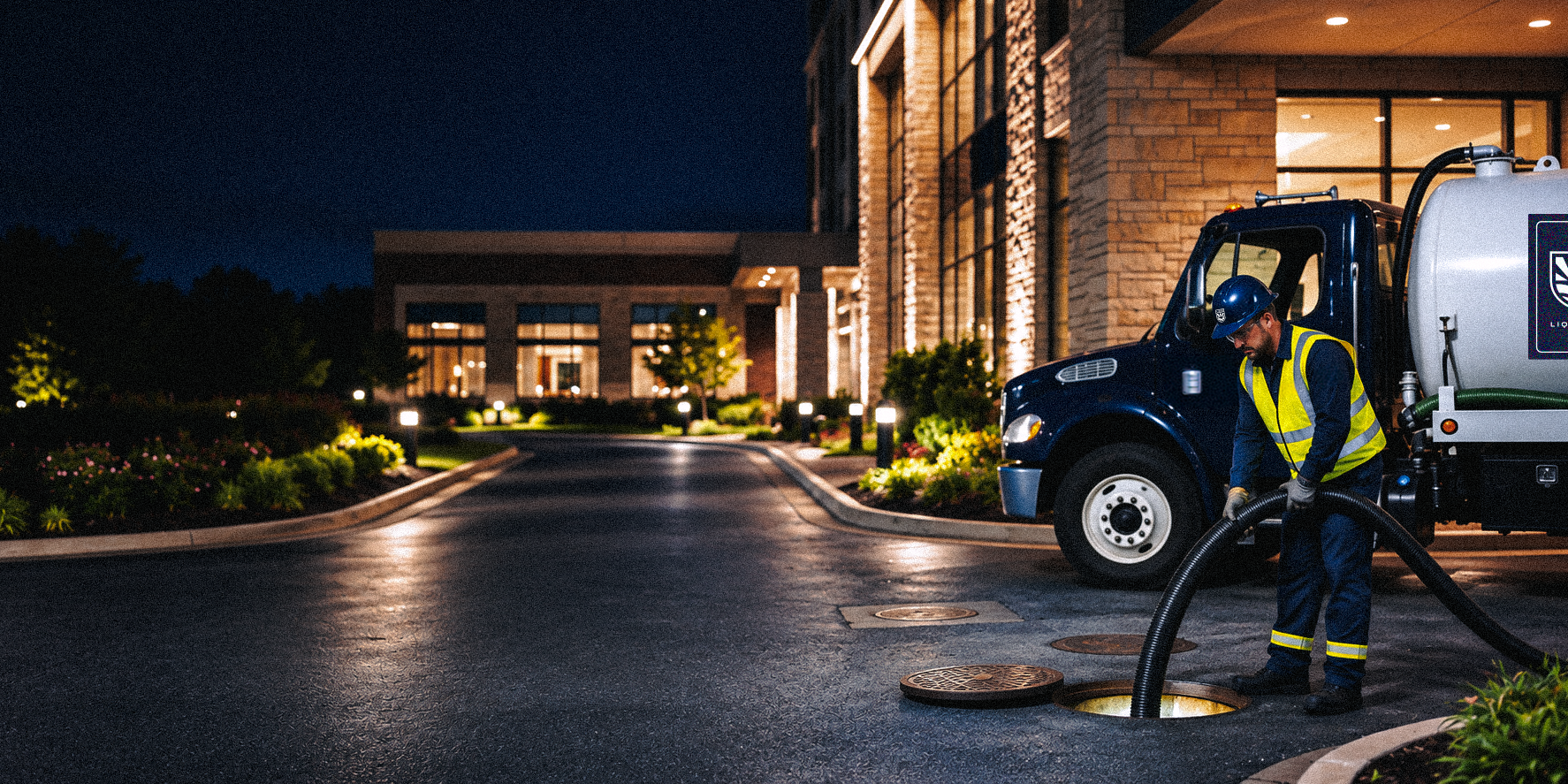
Hotel, Stadium and Venue Grease Trap and Wastewater Service Built Around Your Busiest Night
LES services grease interceptors, concourse washdown and laundry graywater at hotels, resorts, stadiums, arenas, convention centers and theaters. We work between events and after checkout, and document every visit for inspection.









An arena pushes a month of food service volume through its concession stands in four hours.
Then it goes quiet for a week. A hotel does the same thing more slowly, on the night a full house and a banquet land together.
Systems serviced for an average day handle the average day. The failure comes on the night that matters most: the sold-out show, the conference, the full weekend. And it comes in front of the biggest crowd the building will see all year.
LES services liquid waste equipment across your whole property. Then we haul, process and recycle what we collect at facilities LES owns. One company, one chain of custody, one record.
Request a Property Assessment

- customer locations served
- 129,500+
- facilities nationwide
- 90+
- trucks and tankers
- 1,000+
- in liquid waste
- 24+ years
- on-time service
- 95%
- of material recycled
- 94%
- route coverage
- Day & night
- Compliance™ Guarantee
- TripleLock
A Sold-Out Night Puts a Month of Volume Through Your Interceptor in Four Hours.We Plan for That, Not the Average.
Event venues don’t produce waste on a smooth curve. They produce it in spikes, with quiet periods in between. Those quiet periods make the average look fine, right up until it isn’t.
LES sets your schedule by interceptor size, the waste you actually produce and your real event and occupancy calendar. Then we service after the big loads, not on a cycle that ignores them.
There Is No Good Time to Service a Building Full of Guests.There Is a Window, and We Work It.
Every property like yours has a short window when work is possible and a much longer stretch when it isn’t. Your program has to be built around that window, not fought over each time.
Scheduled to your event and occupancy calendar
We book service after load-out, between checkout and check-in, or between the last show and the first matinee. Not whenever a truck happens to be nearby.
Day and night routes
LES runs both. So work can happen overnight after an event instead of during the next day’s business.
Staffed for the size of the job
A multi-day event or a full concourse system is not a one-truck visit. If a property needs several trucks and technicians over more than one night, we plan it that way from the start.
Access issues handled in advance
Dock traffic, load-in, secure-venue credentials and badges are arranged during onboarding, not discovered at the gate.
Nine Streams, Nine Vendors, and No Single Record.Here Is Everything We Cover.
Full pump-out of kitchen, banquet and concession interceptors.
Broken baffles, structural damage, and resizing when food service has outgrown the original unit.
From hotel kitchens, banquets and concession stands, recycled at LES facilities.
Kitchen and concourse drain lines cleaned before buildup blocks them.
Kitchen exhaust systems in hotel and venue food operations.
Concourse washdown and laundry graywater.
Separators and catch basins at parking lots, plazas and loading areas, where car fluids, rubber and litter collect.
Hauled to LES facilities, with 94% of what we collect recovered for reuse. Manifests and service records are kept in an online portal.
Your Sustainability Report Needs a Destination, Not a Gesture.Here Is Where the Material Actually Goes.
Hotel brands and venue operators publish sustainability goals and get asked to prove them. “Responsibly disposed of” doesn’t hold up to that question. A named destination does.
LES owns collection, transport and processing. So the chain of custody never breaks partway through, and where it goes is documented, not just claimed.
A record on site and online
We leave a manifest copy at every visit. Final manifests with disposal details stay in an online portal your team can access. Every visit also creates an inspection record covering the interceptor, baffles, structure and separator status.
A named destination for the material
LES owns collection, transport and processing, so the chain of custody never breaks. Used cooking oil is screened and heat-separated, then used to make biodiesel and sustainable aviation fuel. Washdown and graywater are treated before they reach the city sewer. 94% of everything we collect is recycled.
Reporting by site or portfolio
Manifests record what we collected and how we handled it, in a form your ESG team can use.
Rules tracked for every property
FOGLaw® tracks the rules that apply to each property, including local pretreatment codes, and keeps your program current as they change.
When LES is the cause of an emergency service or a Notice of Violation, LES covers the associated cost under the TripleLock Compliance™ Guarantee.
Each Property Runs Its Own Vendors.LES Brings the Whole Portfolio Into One Record.
One service standard, one chain of custody
The same documented process at every property, performed by LES team members in LES trucks for core liquid waste service. Every gallon is tracked to an LES processing facility.
Portfolio-wide reporting
Service history, volumes and compliance records across every property. No piecing them together from vendor invoices when an audit starts.
Schedules set for each property
A convention center hotel, a resort and an arena need different schedules, even in one portfolio. One vendor means one accountable team, not one schedule.
Built for how portfolios are owned
The owner, the brand and the operator are often three different parties. Service and billing should reflect that.
Running a single property? Find your local branch.
You'll Need Another Provider for Some of This.Here Is Exactly What.
LES is a non-hazardous liquid waste company, and everything in the coverage table above is in scope. It's faster to state the limits here than to let a buying team find them halfway through a bid.
Beverage waste: three different answers, depending on what it is
-
Flushing the lines. Rinse water from clearing drink lines is a dilute liquid. LES handles it.
-
Concentrated liquid in quantity. Large amounts of syrup usually go to a bio-digester, which needs different processing.
-
Packaged product. Anything still in its packaging needs a facility that can unpack it. LES doesn't, and we'll say so rather than take the load and hand it to a subcontractor.
LES also does not handle:
- Solid waste, refuse and recycling hauling, including seating bowl and concourse refuse
- Food waste and organics diversion
- Hazardous waste of any classification
- Concentrated pool and spa chemicals
- Janitorial, laundry and cleaning services
Keep the doors open and the record clean.
Interceptors and washdown. Serviced between events, documented before anyone asks, and recycled at facilities LES owns.