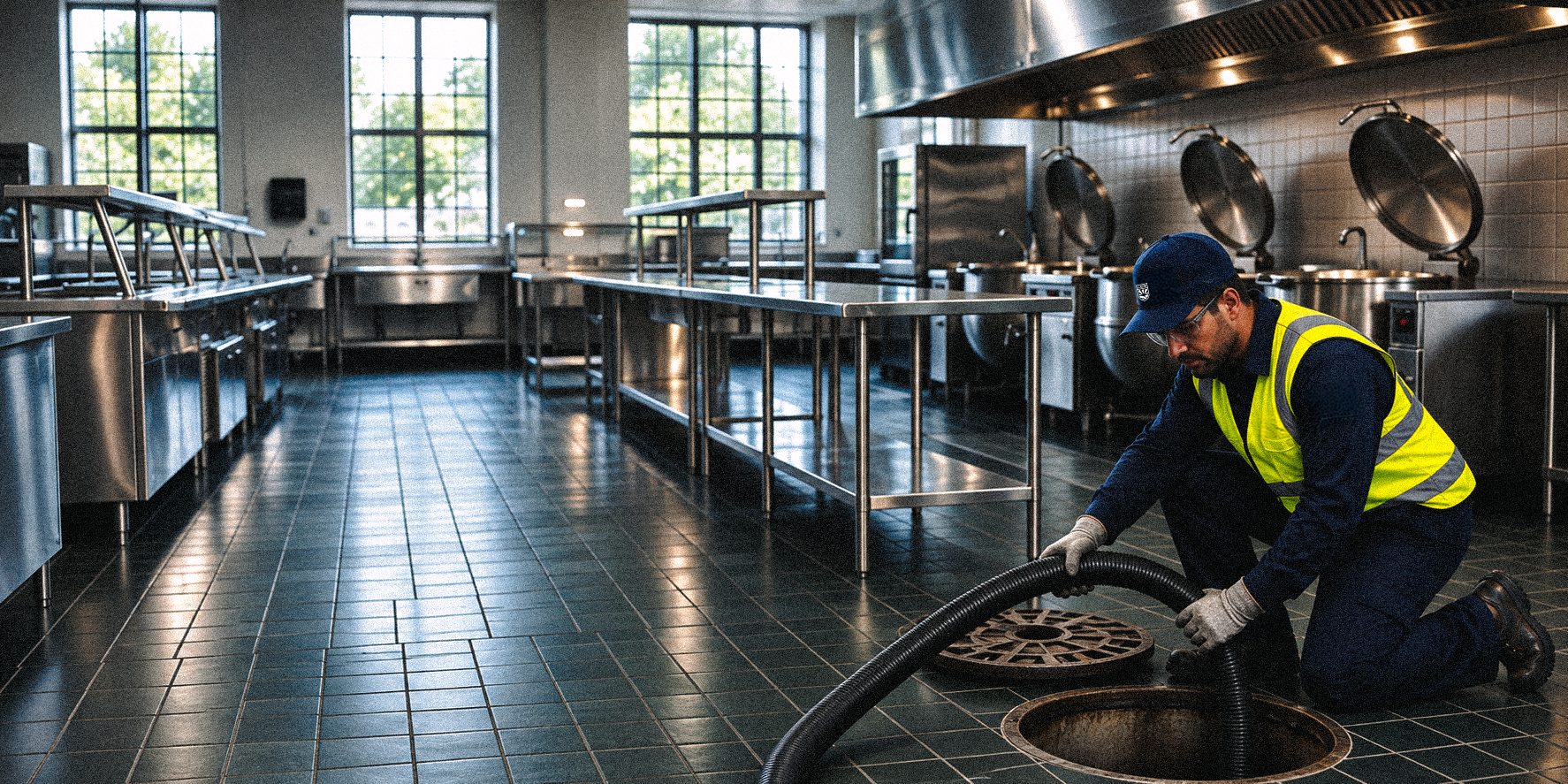
Campus and School Grease Trap and Wastewater Service Built Around the Academic Calendar
LES services grease interceptors, drain lines, separators and campus wastewater at universities and school districts. We use the summer window for heavy work, document every visit for inspection, and turn used cooking oil into fuel you can report on.










A restaurant can be serviced any Tuesday. A campus can’t.
The school year runs nine months at full load. Heavy work waits for summer because there is no other time to do it.
So the list of put-off repairs grows against a deadline. Anything missed in June waits until the next June. Unless it fails first, in October, with the dining halls full.
LES services liquid waste equipment across your campus. Then we haul, process and recycle what we collect at facilities LES owns. One company, one chain of custody, one record.
Request a Campus Assessment

- customer locations served
- 129,500+
- facilities nationwide
- 90+
- trucks and tankers
- 1,000+
- in liquid waste
- 24+ years
- on-time service
- 95%
- of material recycled
- 94%
- route coverage
- Day & night
- Compliance Guarantee™
- TripleLock
You Get One Real Maintenance Window a Year.We Build the Whole Program Around It.
Campus liquid waste systems run hard for nine months. Then they are free for twelve weeks. A standard commercial service plan almost never allows for that.
LES schedules by interceptor size, real output and your school calendar. We inspect early in the year and keep a running issue list, so problems found in spring are fixed in summer, not discovered in September.
Your Dining Contractor Makes the Grease.You Own the Interceptor and the Violation.
Campus food service is rarely one operation. There is the main dining program, retail chains in the student union, athletic dining and catering. Often there are Greek houses with their own kitchens too.
Each one uses the same system. None of them owns it. When the interceptor backs up or the city writes the notice, it goes to the school.
Service tied to the school, not the contractor
The program, the records and the responsibility stay with your facilities office. So they carry over when your dining company changes.
One schedule per system, set by actual load
Your schedule reflects everything that flows into the system from every kitchen. Not what any single operator assumes about its own share.
Findings reported to the school
Inspection results and growing issues go straight to your facilities team. Nothing depends on a contractor passing the word along.
Dining Halls, Residence Halls, Central Plant, Stadium, Parking.Here Is Everything We Cover.
Full pump-out of interceptors that serve dining halls, student unions, retail food outlets and catering kitchens.
Collection and recycling from dining and retail food operations across your campus or district.
Cleaning kitchen and facility drain lines before buildup blocks them. Best booked in the summer window.
Broken baffles, structural damage, and resizing when dining has outgrown the original unit. Found in spring, fixed in summer.
Kitchen exhaust systems across dining and retail food operations.
Separators and catch basins at commuter lots, stadium parking, service yards and grounds buildings.
Removing sediment from campus drains before it cuts their capacity.
Cooling tower and boiler blowdown, HVAC condensate.
Lift stations clog quietly. When they fail, everything upstream backs up.
We haul to LES facilities, recovering 94% of what we collect for recycling. Manifests and service records are kept in an online portal.
The Cheapest Grease to Handle Is the Grease That Never Reaches the Drain.Here Is What Actually Cuts It.
Campus sustainability offices put most of their effort into bins and signs. The kitchen changes that matter for FOG are simpler, and they rarely get made. Every LES visit includes an inspection, so we flag them early.
Scrape food into the bin before pots reach the sink
It's the cheapest place to stop grease, and it takes training and policy, not new equipment.
Skip enzymes and emulsifiers
They push grease downstream into the sewer line past your property and make the oil impossible to recycle.
Size interceptors to today's dining volume
Many campus units were sized for a dining program that has since grown, added chains or stayed open later.
Send floor and mop water to the right drain
It should go only to drains connected to an interceptor. Water often skips the interceptor by mistake.
Your Sustainability Report Needs a Destination, Not a Gesture.Here Is Where the Material Actually Goes.
Campuses publish sustainability goals. Students, trustees and rating groups hold them to it. “Responsibly disposed of” doesn’t hold up to that. A named destination does.
LES owns collection, transport and processing. So the chain of custody never breaks partway through, and where it goes is documented, not just claimed.
Used cooking oil becomes fuel
High-speed centrifuges at LES plants produce ultra-pure yellow grease. It is processed into a pure, ready-to-sell product. That product is used to make renewable fuel, including biodiesel and sustainable aviation fuel.
Wastewater is treated, not just moved
Dissolved air flotation lifts solids and soaps out of the collected water so they can be removed. The rest is treated to remove harmful material before it goes into the city sewer. Then the local treatment plant cleans it further. Where a community has a water reuse program, it can become non-drinking water for irrigation or industry.
Sediment is dewatered
Grit trap and stormwater sediment is dried into a solid product. Grease trap solids go to composting where it is available.
94% of everything collected is recycled
Across all streams and all customers. Water, oil, grease and other usable materials are sent for reuse wherever possible.
Documented per building and per campus
Manifests record what we collected and how we handled it. You can report by site or across a district or system, in a form your sustainability office can actually cite.
Each Building Runs Its Own Vendors.LES Brings the Whole Campus or District Into One Record.
One service standard, one chain of custody
The same documented process at every building, performed by LES team members in LES trucks for core liquid waste service. Every gallon is tracked to an LES processing facility.
Reporting across the district or system
Service history, volumes and compliance records across every school or campus, with no piecing together separate invoices when a question comes up.
Schedules set for each building
A residential dining hall and an elementary school kitchen are different sites, even in one system. One vendor means one accountable team, not one schedule.
New buildings join the existing program
New construction and newly acquired buildings are assessed, measured and added to the same standard.
You'll Need Another Provider for Some of This.Here Is Exactly What.
LES is a non-hazardous liquid waste company, and everything in the coverage table above is in scope. Your campus may also have teaching labs, research labs, art studios and a student health center, so we state the line up front, not mid-contract.
LES does not handle:
- Lab and studio liquids, including diluted rinses and neutral compounds
- Hazardous waste of any classification (RCRA Subtitle C)
- Medical, biohazard and sharps waste from student health or veterinary programs
- Solid waste, refuse and recycling hauling
- Food waste and organics collection for composting
- Move-out bulk items, furniture and electronics
- Janitorial and cleaning services
Two Ways to Start, Depending on How You Buy.
- 01
If you are running an RFP
Send us the RFP. We'll respond to your exact documentation, insurance, reporting and service requirements, not send a generic brochure.
- 02
If you just need a number
For a single school or a smaller institution, LES will assess your buildings, set the right schedules and quote the program directly, with no bidding process. To start with one school, find your local branch.
Walk into August with nothing deferred.
Interceptors, drains, separators and campus wastewater. Inspected all year, repaired in the window, documented before anyone asks, and turned into fuel you can report on.