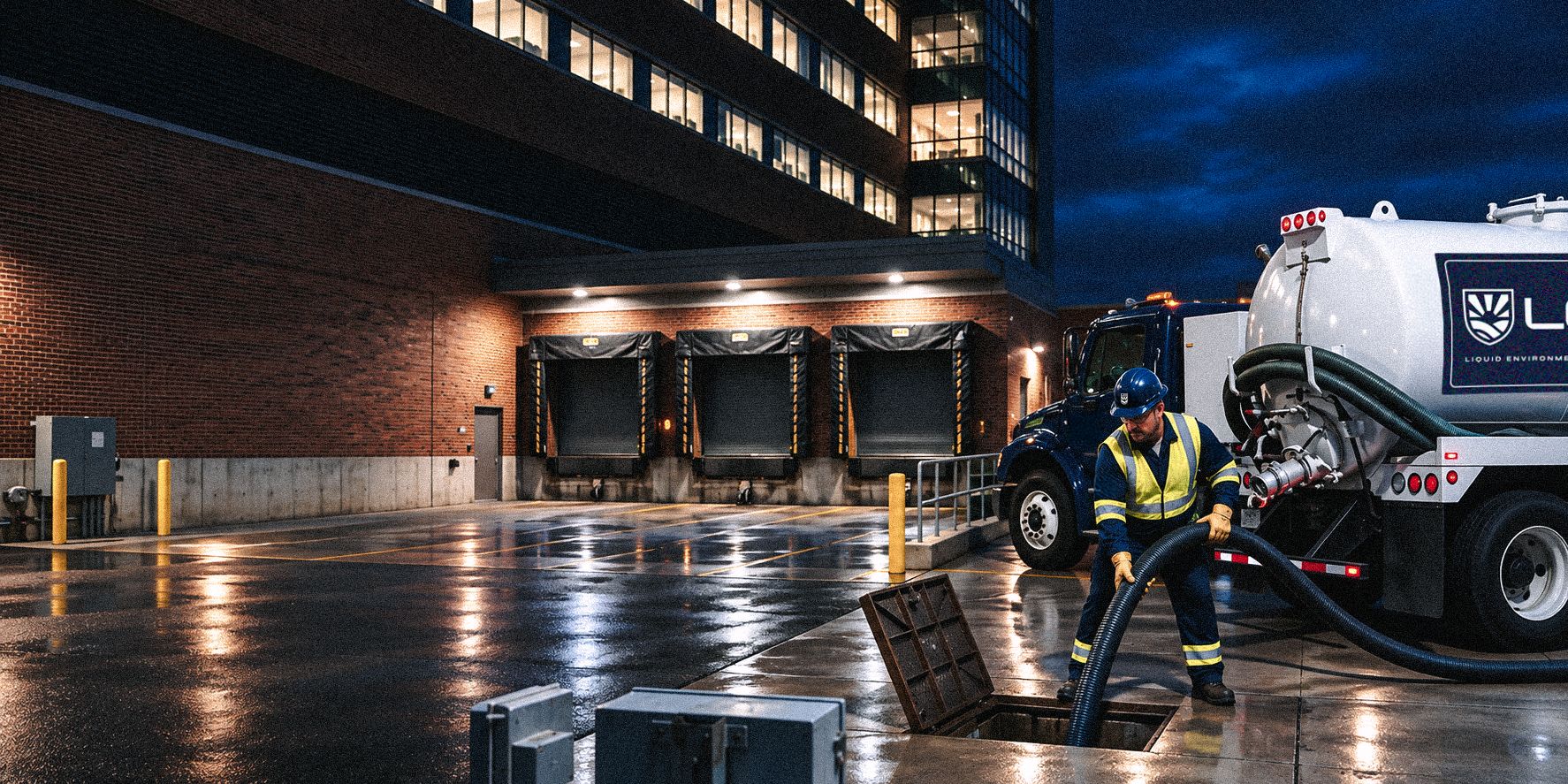
A Restaurant Can Close for the Night. A Hospital Can’t.We Service the Building That Never Empties.
Grease interceptors, drain lines, separators and campus wastewater. We work in occupied clinical space, plan around care, and keep the records ready before anyone asks.










In a restaurant, a blocked grease interceptor closes the kitchen for a night. In a hospital, it sends wastewater and odor into a building nobody can leave.
And the kitchen still has to serve three patient meals that day.
The difference isn’t size. It’s that the building can never close while the problem gets fixed quietly.
LES services liquid waste equipment across your whole campus: kitchen, central plant, ambulance bay and parking deck. Then we haul, process and recycle what we collect at facilities LES owns. One company, one chain of custody, and one record when a surveyor asks for it.
Request a Campus Assessment

- customer locations served
- 129,500+
- facilities nationwide
- 90+
- trucks and tankers
- 1,000+
- in liquid waste
- 24+ years
- on-time service
- 95%
- of material recycled
- 94%
- route coverage
- Day & night
- Compliance Guarantee™
- TripleLock
Your Kitchen Serves Three Meals a Day, Every Day.We Set the Schedule for a Kitchen That Never Stops.
A hospital kitchen has no closing time and no slow season. There is no night when volume drops to zero. And it isn’t one kitchen. The patient tray line, staff cafeteria and retail food service often share one interceptor. Each one loads it differently.
What this means for you
Many hospital kitchens run on a schedule borrowed from restaurants. They either pay for visits they don’t need or find the gap in the middle of a meal. LES sets your schedule by interceptor size and the waste your campus actually produces. Then we adjust it as patient counts and food service change.
Nobody Can Close the Wing While You Work.We Plan for That Before the Truck Arrives.
In a hospital, work happens around patients, visitors and clinical staff who are still there. Access routes, noise, odor and infection control are not small details. They decide whether the work can happen at all.
Scheduled around care, not the route
Meals, quiet hours, visiting hours and shift changes limit when work can happen. We book service in the window that works for your building.
Day and night routes
LES runs both. So work can move fully outside busy hours when that is the better choice.
Odor and disruption kept to a minimum
Odor in a patient wing reaches the people least able to get away from it. It also shows up in patient experience scores.
Staffed for the size of the job
A large campus interceptor is not a one-truck visit. If a site needs several trucks and technicians over more than one day, we plan it that way from the start.
Six Vendors on One Campus Means Six Schedules to Protect.Here Is Everything We Cover.
Full pump-out of built-up grease, solids and wastewater from kitchen interceptors, both outdoor and under-sink.
Collection and recycling from cafeteria and retail food operations.
High-pressure cleaning of kitchen and facility drain lines before hardened buildup blocks them.
Broken baffles, structural damage, and resizing when food service has outgrown the original unit.
Separators at ambulance bays, loading docks, fuel storage and generator areas.
Campus lots and emergency vehicle bays collect motor oil, antifreeze, tire particles and de-icing chemicals. That runoff drains under your stormwater permit.
Boiler and cooling tower blowdown, floor scrubber water, graywater.
Lift stations clog quietly. When they fail, everything upstream backs up.
Hauled to LES facilities and processed. 94% of what we collect is recovered for reuse.
Manifests and service records are tracked against local rules and kept in an online portal.
The Enzyme Product Your Kitchen Buys Makes Things Worse.Here Is What Actually Reduces Grease.
This problem looks like a service issue, but it isn’t. Enzyme and bacteria products are sold to break down grease in the trap. They do just that. They break the FOG into tiny drops so it stops separating. Then it flows out of the interceptor in the water. It cools and hardens again in the sewer line past your property.
The interceptor looks clean. The service records look clean. But the clog forms somewhere you don’t own. The first you hear of it is from the city.
It also ruins the oil layer that could be recycled. That layer is what gives a well-run interceptor its value at the other end.
Every LES visit includes an inspection, not just a pump-out. So we spot problems like this early, before they turn into violations. When it helps, LES will point out kitchen habits worth a second look:
Stop dosing enzymes and emulsifiers
Hot water flushes, enzymes and soaps used to “dissolve” grease break it apart. They push the problem downstream and make the oil impossible to recycle.
Dry-scrape before washing
Train kitchen staff to scrape plates, trays and pans into the trash before washing. It is the cheapest place to stop grease.
Watch the 25% rule
Service the trap before grease and solids together fill a quarter of the tank. Past that point, FOG starts escaping into the city sewer, no matter what the schedule says.
Size the interceptor to the kitchen
Large outdoor interceptors with several chambers separate grease far better than small under-sink units. They also leave a cleaner oil layer that is easier to recycle.
Send floor and mop water to the right drain
Floor cleaning water should drain only into drains connected to an interceptor. Water often skips the interceptor by mistake, and few people notice.
The Surveyor Doesn’t Call Ahead.The Record Has to Already Exist.
Accreditation surveys and licensing checks arrive without notice. They cover environment of care, sanitation and maintenance records. A service history pulled together after they ask is not the same as one that was already there.
We leave a manifest copy on site at every visit. Final manifests, with disposal details, are kept in an online portal your team can access. Every visit also creates an inspection record. It covers the interceptor, baffles, structure and separator status.
Four Things to Check Before You Hire Any Waste Hauler.Here Is How We Answer Each One.
One Campus Has Six Vendors. A Health System Has Sixty.Bring Them Into One Record.
One service standard
The same documented process at every campus and clinic. Done by LES team members in LES trucks, not handed off to whoever is local.
One chain of custody
Every gallon tracked from your site, on LES trucks, to an LES processing facility. Documented for each site.
System-wide reporting
Service history, volumes and compliance records across every site. No piecing them together from separate vendor invoices when a survey starts.
Schedules still set for each site
A 600-bed academic medical center and a suburban outpatient campus are different sites, even in the same system. One vendor makes one team responsible. It doesn’t mean the same schedule everywhere.
Acquired hospitals join the existing program
New campuses are assessed, measured and added to the same standard. They don’t keep whatever vendor came with them.
You Will Need Another Provider for Some of This.Here Is Exactly What.
LES is a non-hazardous liquid waste company. In a hospital, that line matters more than anywhere else. So we state it plainly instead of hiding it.
LES handles
- Kitchen grease interceptors: pumping, cleaning, repair, replacement, installation
- Used cooking oil collection and recycling
- Drain line cleaning and hydro jetting
- Oil-water and stormwater separators, catch basins
- Graywater, floor scrubber water, blowdown
- Lift stations and wet wells
- Compliance records and recycling
LES does not
- Regulated medical waste, red bag waste, and sharps
- Body fluids, including blood, urine, and secretions
- Dialysis effluent
- Hydrotherapy, whirlpool, and burn unit water
- Expired saline, IV fluids, and pharmaceutical waste
- Hazardous waste of any classification
- Solid waste, refuse, and recycling hauling
Keep the campus running and the record clean.
Interceptors, drains, separators and campus wastewater. Serviced around care, documented before anyone asks, and recycled at facilities LES owns.