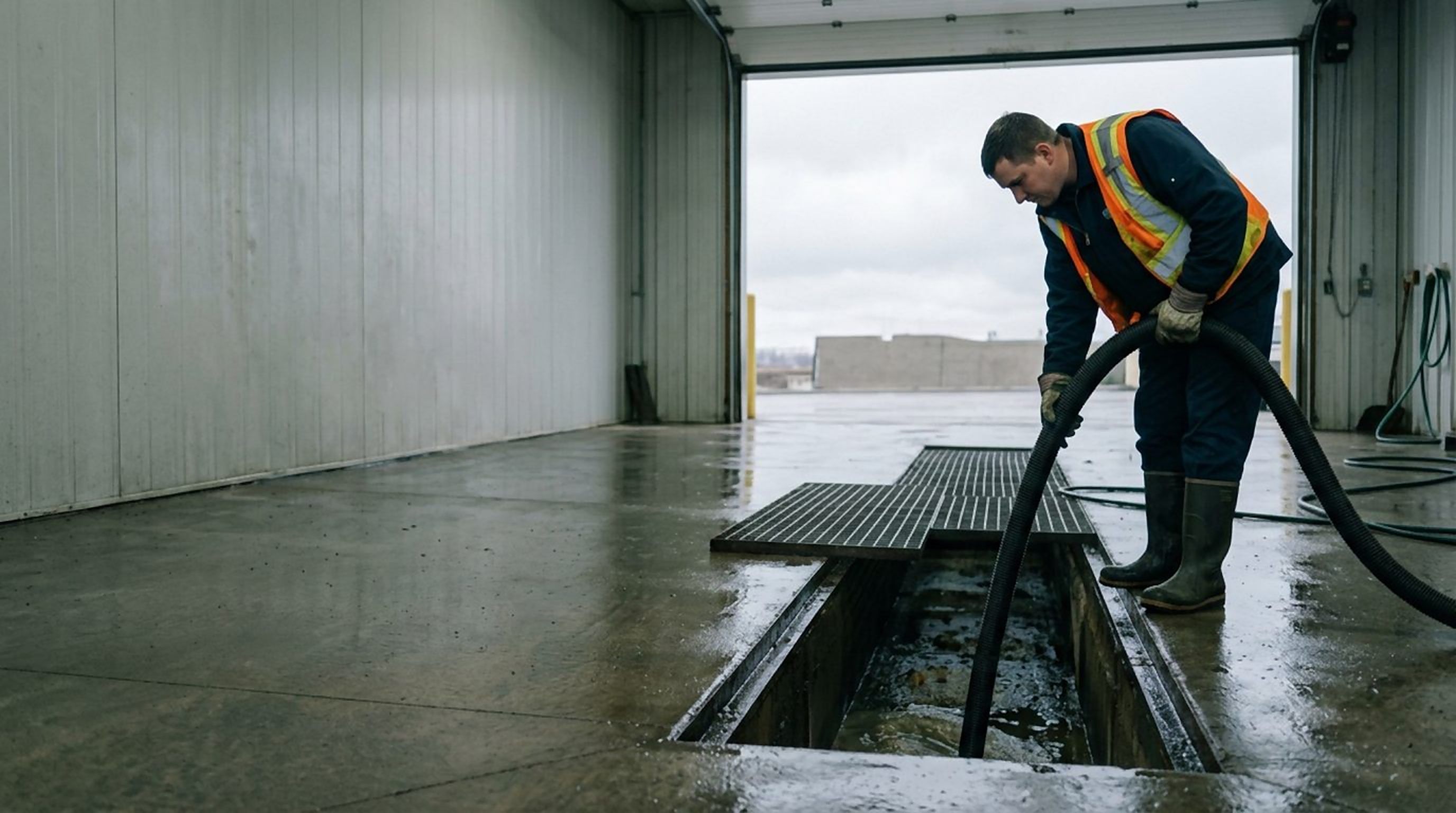
Skim-Pumping Isn't Just Poor Service. It's Prohibited.We Pump Out to the Floor.
City codes across the US clearly ban decanting and skim-pumping to cut hauled volume. We do a full pump-out, hydro jetting to bare wall and keep manifest records that add up.




Here's the Failure Almost No One Catches
A truck shows up, pulls the liquid off the top, writes a ticket and leaves. The trap looks empty. The invoice says serviced.
But grit doesn't float, and it doesn't stay loose. It sinks, settles and packs into a hard layer on the floor of the trap. Pumping off only the liquid doesn't touch it. The space the trap needs to work is still gone. The unit still can't separate, and you've paid to remove water.
Two months later, the trap is full again, and it looks like the schedule is wrong. It usually isn't. The pump-out was.
There's a second problem with that ticket, and it's the more serious one. Partial pumping isn't a shortcut. Across the US, it's clearly prohibited.


- facilities nationwide
- 90+
- trucks and tankers
- 1,000+
- customer locations served
- 129,500+
- in liquid waste
- 24+ years
- on-time service
- 95%
- of material recycled
- 94%
- to the floor, every visit
- Full evacuation
- Compliance™ Guarantee
- TripleLock
Grease Blocks Pipes. Grit Grinds Them.We Service Them Differently.
A grease trap and a grit trap look like the same problem, but they're not. Grease is organic, it floats and it builds up. Grit is mineral, heavy and rough — sand, gravel, road silt, metal shavings and bits of asphalt.
That difference changes what a failure costs. Grease blocks a line. Grit grinds it. It wears down the pipe wall from the inside, and the damage happens down the line in pipes you don't own.
The rules follow from that wear. City codes take heavy grit discharge seriously because it damages public pipes, not just slows them down. That's why fines for grit tend to be harsher than for a similar FOG (fats, oils and grease) problem.
Decanting Isn't a Shortcut. It's Prohibited.We Pump Out 100%, Every Visit.
Most buyers have never been told this part of grit trap service. It changes how you should read a service ticket.
Clearly prohibited
City codes from local water authorities across the US clearly ban decanting, skim-pumping and flushing liquid back into an interceptor to cut the volume a hauler has to carry away. It's not about service quality. It's a banned practice.
The 24-hour rule
State rules — Texas Commission on Environmental Quality rules are a well-known example — cover traps too big for one vacuum truck. The permitted hauler must bring more trucks so the unit is fully pumped out within 24 hours. A large trap is no reason to leave waste behind.
Cradle-to-grave manifest audits
EPA and state manifest systems require the volume pumped from your vault to match the certified weight ticket at the receiving facility. Skimming or decanting breaks that match. The manifest isn't just paperwork. It's how a partial pump-out gets caught.
A Test You Can Run on Your Current Vendor
Take your trap's rated capacity and compare it to the volumes on your last few manifests. If the volume is always a fraction of what the unit holds, it isn't being fully pumped out — and your own records prove it. This is the most useful thing on this page, and it costs nothing to check.
One thing to know for budgeting: when a trap truly needs two trucks, that's not an upsell. It's what a full pump-out of that unit takes. Under the rules above, it's what a permitted hauler must arrange. A quote for one truck on a unit that needs two is a quote for a service that can't legally be done that way.
Removing Liquid Off the Top Isn't Cleaning.A Full Pump-Out Restores the Space You Paid For.
Every LES grit trap service is a full pump-out. Not a skim, not a decant.
01
Full pump-out to the floor
High-vacuum equipment pulls out all the sludge and packed sand on the bottom, not just the liquid above it. That restores the space the trap was designed with — the space it needs to separate.
02
Hydro jetting to bare wall
After the pump-out, we pressure-wash the walls, baffles and inlet and outlet pipes. This removes hardened mineral scale, mud and oily film. Scale survives pumping. It doesn't survive jetting.
03
Condition check every visit
While the unit is empty and easy to see, technicians check the concrete or fiberglass for wear. They make sure the inlet and outlet tees are still in place and the baffles are still solid.
04
Chain-of-custody records
Volume pumped out, hauling details and the confirmed permitted disposal or recycling site — recorded every visit and kept on file.
A Calendar Doesn't Know What You Process.We Set Schedules by What Your Site Really Produces.
How fast grit builds up depends on the type of site more than almost any other waste. It also changes with the seasons. Common industry starting points look like this:
These are starting points, not answers. LES sets each site's schedule based on the trap's size and how fast it really fills. Two car washes in the same chain — one in a snowy, salted market and one on the coast — won't fill at the same rate.
Cracks and Shifted Tees Don't Announce Themselves.We Check While the Unit Is Empty.
You can only inspect a grit trap at one moment: right after it's pumped out and before it refills. That's the window, and most providers drive away during it.
We note what we find on the service record. If repair, replacement or resizing is needed, LES manages it. So the diagnosis and the fix stay with one responsible partner.
The Inspector Wants the Manifest Records, Not Your Word.Ours Are Already Filed.
City inspectors here look for one thing: proof that heavy grit and oils went to a permitted site, not into the sewer main. That proof is the manifest record. It has to be complete, and the volumes have to match the certified weight tickets at the receiving facility.
At every visit, LES records the total volume pumped out, hauling details and the confirmed permitted disposal or recycling site. We leave a manifest copy on site. Final manifests are kept in an online portal for five years, and your team can access them. That meets or beats the three-to-five-year record rule most cities have.
Where an LES error results in an emergency service or a Notice of Violation, LES covers the associated cost in accordance with the TripleLock Compliance™ Guarantee. The guarantee applies where LES is the cause.
You'll Need Another Provider for Some of This.Here's What.
LES handles
- Grit trap and sand interceptor cleaning
- Full pump-out and hydro jetting
- Structure and condition inspection
- Repair, replacement, resizing and installation
- Wastewater disposal and recycling
- Manifest and chain-of-custody records
LES does not
- Hazardous waste of any kind
- Used motor oil, filters, coolant and antifreeze
- Fuel islands, underground tanks and fuel systems
- Solid waste and refuse hauling
- Paving, drainage construction or civil works
- Sweeping and surface cleaning
Grit Trap Cleaning Near You
LES runs 90+ facilities and 1,000+ trucks and tankers nationwide. Find service and local rules for your area:
- Atlanta, Georgia
- Austin, Texas
- Birmingham, Alabama
- Charlotte, North Carolina
- Chicago, Illinois
- Cincinnati, Ohio
- Cleveland, Ohio
- Columbus, Ohio
- Dallas, Texas
- Denver, Colorado
- Detroit, Michigan
- Fayetteville, North Carolina
- Houston, Texas
- Jacksonville, Florida
- Kansas City, Kansas
- Knoxville, Tennessee
- Little Rock, Arkansas
- Miami, Florida
- Milwaukee, Wisconsin
- Mobile, Alabama
- Nashville, Tennessee
- New Orleans, Louisiana
- Oklahoma City, Oklahoma
- Orlando, Florida
- Phoenix, Arizona
- Port Charlotte, Florida
- Portland, Oregon
- Rio Grande Valley, Texas
- Riverside / Inland Empire, California
- San Antonio, Texas
- San Diego, California
- San Francisco Bay Area, California
- Shreveport, Louisiana
- St. Louis, Missouri
- Tacoma, Washington
- Tampa, Florida
- Winston-Salem, North Carolina
Full again already? The schedule probably isn't the problem.
We'll measure what's really in the unit, check whether it's holding its rated volume and set a schedule that fits your site.