Finding the Problem Is Half the Job. These Services Are the Other Half.
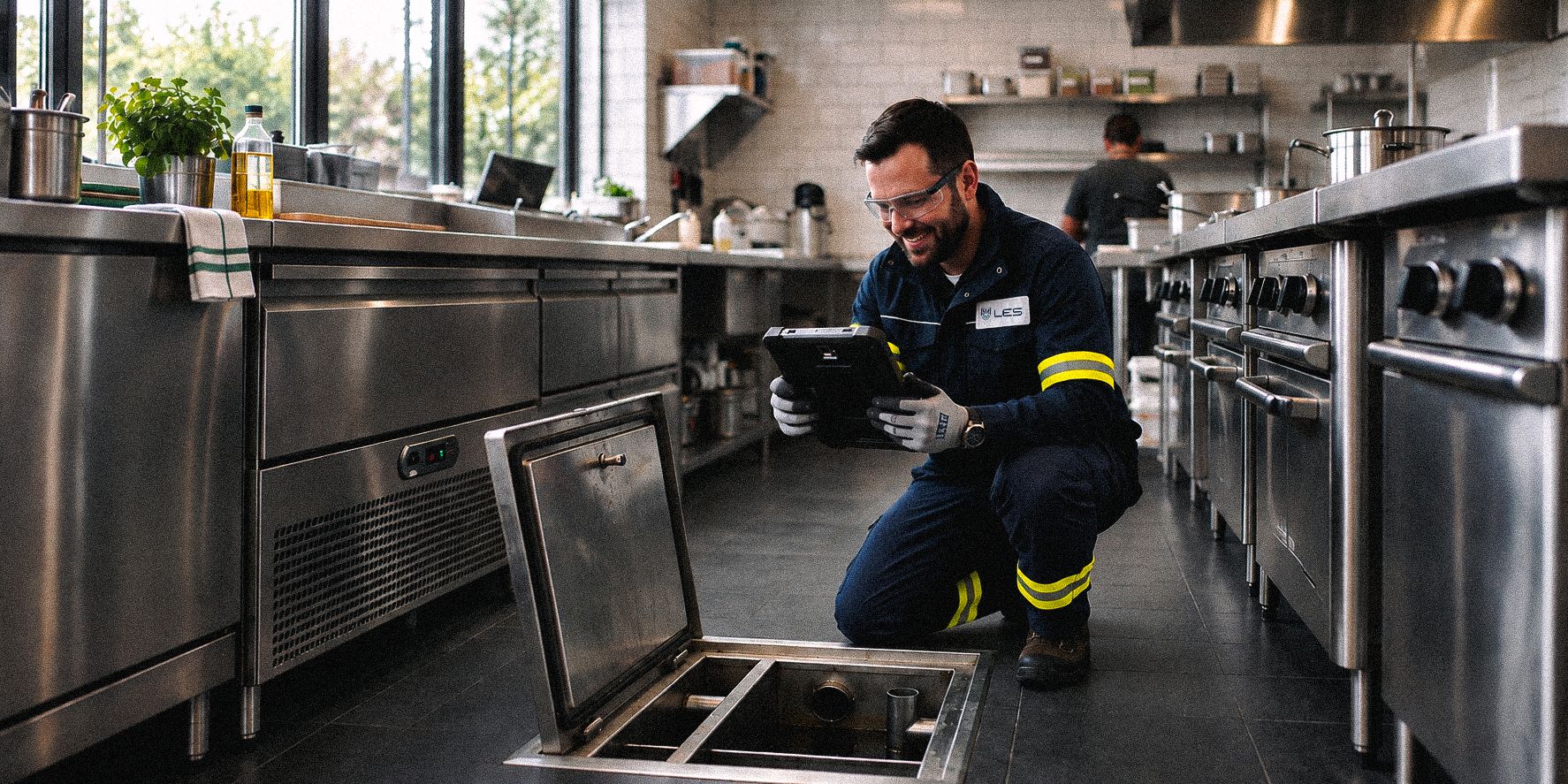
Every LES service visit includes an inspection with written records. That is how we find cracked lines, failing baffles and blocked laterals. These services fix what the inspection finds. They are available nationwide as a managed program. So you don't get a problem report and a list of contractors to call.
Trusted by leading multi-site operators nationwide








Everything Here Moves Water Off Your Site.That Is Why It Belongs Together.
These are not eight random services. Together they keep one system working: the pipes, structures and surfaces that carry water from where it lands to where it leaves.
Clear it when it slows. Look inside when clearing does not hold. Empty the structures that catch what the water carries. Dig to reach what has failed. Fix it. Wash down what is left.
-
Drain & sewer
When flow slows or stops.
-
Stormwater & site drainage
What leaves your property in the rain.
-
Repair & site work
Reach it, fix it, clean up after it.
Three Groups, Eight Services.Start With What Is Failing.
Commercial drain line cleaning
We clear kitchen, floor and process drain lines before buildup chokes them into a backup.
Hydro jetting & line jetting
High-pressure water scrubs the inside of the pipe wall. It doesn't just punch a hole through the clog. Used on grease lines, wash bays, trench drains, storm drains and industrial sewer lines.
Video pipe inspection
A camera shows what is really in the line and where. You see it before anyone quotes a repair based on a guess. Also called CCTV, sewer camera or pipe camera inspection.
Basin cleaning
We empty the structures that trap dirt, litter and oil from your lot before they reach the storm system.
Stormwater separator service
Hydrodynamic separator cleaning. Your stormwater permit requires you to maintain these devices. Inspectors ask about them first.
Commercial plumbing
Commercial only. We do not take residential work. This covers the work beyond routine drain clearing, from a company that already knows your site.
Hydro excavation
Water pressure and vacuum expose buried utilities without digging into them. Potholing, daylighting and slot trenching. Available in nine markets only.
Commercial power washing
Dumpster pads, drive-thru lanes, loading docks and service bay aprons. The runoff has to go somewhere legal.
Basin Cleaning
You Don’t Have a Catch Basin. You Have Forty of Them.
You Know What Is Happening.We’ll Tell You What It Is.
-
One drain is slow, the others are fine
Drain line cleaning — usually a clog in one spot
-
Cleared last month, slow again already
Video pipe inspection, then jetting. Repeat clogs usually mean buildup on the pipe wall or a defect, not loose debris
-
Multiple fixtures backing up at once
Hydro jetting — the clog is in the main line, not a branch
-
Water standing on the lot after rain
Catch basin cleaning — the basins are full and no longer draining
-
A stormwater inspection is coming, or one found something
Stormwater separator service
-
Someone needs to dig near a gas, fiber or electric line
Hydro excavation — where available
-
The line is broken, not blocked
Commercial plumbing
-
The pad, the lane or the apron is the problem
Power washing — with the runoff handled properly
You Are Not Hiring a New Vendor.You Are Closing the Loop on the One You Have.
Every LES grease trap and oil water separator visit includes an inspection with written records. That is where problems get found. A rusted baffle. A cracked line. A lateral that has been narrowing for two years. A catch basin that stopped draining last winter.
Until now, the service ended once the problem was found. You got a report. Then it was your job to find a contractor, explain the site, schedule around your hours and hope the work got written up.
The same company found the problem, scoped it and holds your service history. So nothing has to be explained twice. And the repair goes into the same records as the service that found it.
- The problem is already found No extra visit to diagnose it, no second opinion, no describing a smell over the phone. The technician who found it wrote it up with photos.
- One record, service through repair The inspection that found the fault and the work that fixed it sit in the same file for each location. That is what an inspector or auditor wants to see.
- One responsible partner No arguing over whether the trap company or the plumber owns the failure. LES scopes the work, sets the standard, keeps the records and answers for the result.
- It gets fixed while it is still cheap A failing baffle found during routine service is a planned repair. Found by a backup on a Friday night, it is an emergency. That means a closure and a call-out premium.
-
Find it.
-
Flag it.
-
Fix it. These services are the third part.
Never heard of LES?Here is the second advantage
You have a clog, a broken line or a failed structure, and you need it fixed now. Any good contractor can clear it. Fewer can tell you where the waste went afterward.
All of it is regulated. Most contractors hand it to a second vendor. That is exactly where the chain of custody gets weak.
For LES, this is the core business. The waste goes into an LES truck and is treated at an LES plant. One manifest, one company.
-
Jetting makes slurry.
-
Basin cleaning makes sediment.
-
Digging makes spoil.
-
Power washing makes dirty runoff.
We Already Know What Is Wrong. Let Us Fix It.
Already an LES customer? These services fix what your inspections have already found.
New to LES? We clear it, fix it and haul the waste away on one manifest.
Frequently Asked Questions
I am already an LES customer. Do I have to set anything up?
Is this the same as calling a plumber?
Do you handle residential properties?
Are all of these available everywhere?
Why does it matter who takes the waste away?
My line keeps clogging even though it gets cleared. Why?
Can LES do this across multiple sites in different states?
Do these connect to my grease trap or separator service?
Where LES offers site & facility services
- Atlanta, Georgia
- Austin, Texas
- Birmingham, Alabama
- Charlotte, North Carolina
- Chicago, Illinois
- Cincinnati, Ohio
- Cleveland, Ohio
- Columbus, Ohio
- Dallas, Texas
- Denver, Colorado
- Detroit, Michigan
- Fayetteville, North Carolina
- Houston, Texas
- Jacksonville, Florida
- Kansas City, Kansas
- Knoxville, Tennessee
- Little Rock, Arkansas
- Miami, Florida
- Milwaukee, Wisconsin
- Mobile, Alabama
- Nashville, Tennessee
- New Orleans, Louisiana
- Oklahoma City, Oklahoma
- Orlando, Florida
- Phoenix, Arizona
- Port Charlotte, Florida
- Portland, Oregon
- Rio Grande Valley, Texas
- Riverside / Inland Empire, California
- San Antonio, Texas
- San Diego, California
- San Francisco Bay Area, California
- Shreveport, Louisiana
- St. Louis, Missouri
- Tacoma, Washington
- Tampa, Florida
- Winston-Salem, North Carolina