Skip to content

Get a Service Quote Now!

Get a Service Quote Now!

Fast response · No obligation

Step 1 of 2

Your contact info

Next: the service, address and details. Under a minute.

Call
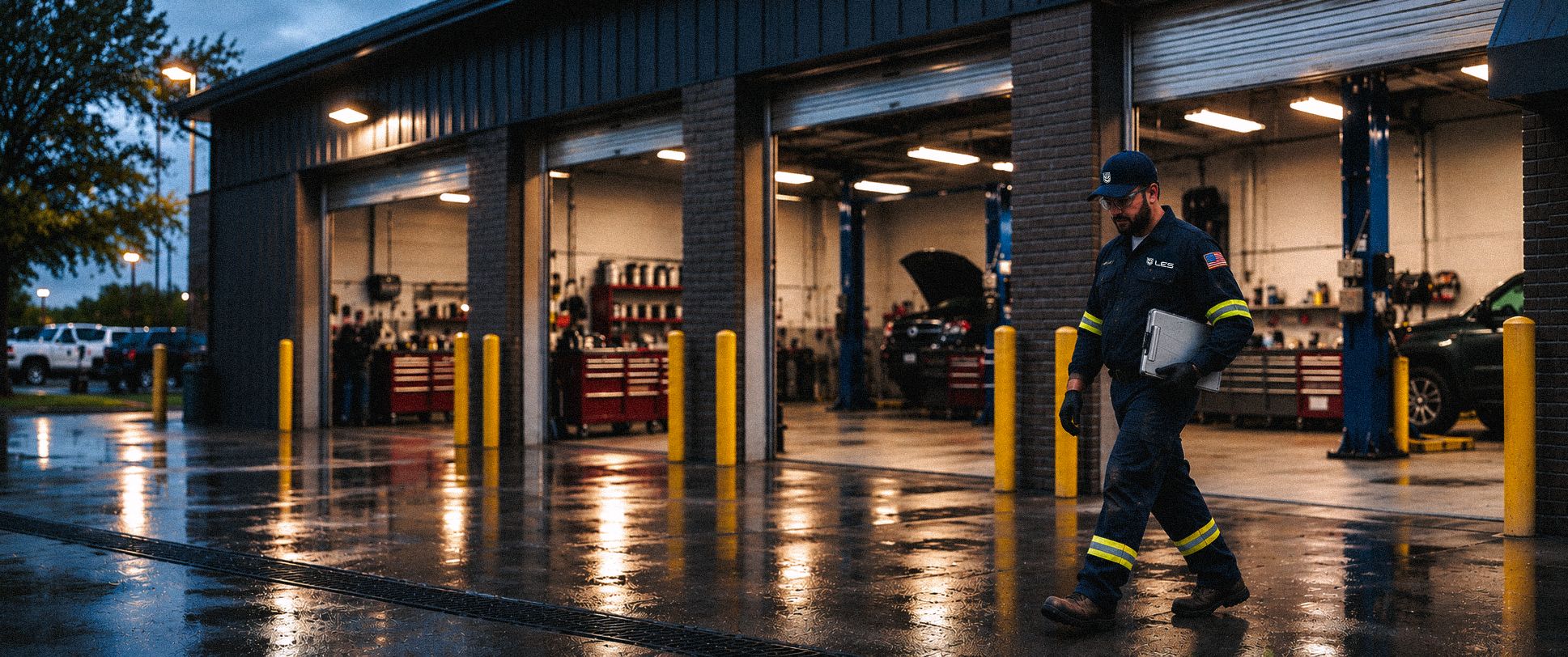
An LES technician walking past a quick lube's open service bays at dusk

One Blocked Drain Takes Out a Third of Your Store. LES quick lube oil water separator service Clears It Before You Open.

Separators, service pits, bay drains and lot drainage — cleaned, repaired and upgraded overnight. Every bay is open when you unlock.


First, let's clear something up: LES does not collect your used oil. That stream has its own handler, and we are not it.

We handle everything on the water side. That means the oil-water separator, the service pit, the bay drains and trenches that feed it, the grit traps and the lot drainage. These are the parts of the store nobody thinks about until one of them stops a bay.

And in a three-bay store, a stopped bay is not a small hassle. It is a third of your output, in a business built on speed.

  • Oil-water separator

  • Service pit

  • Bay drains and trenches

  • Grit traps

  • Lot drainage

  • Used oil

A three-bay store

⅓of your output gone with one stopped bay

Open, Open, Stopped

customer locations served
129,500+
facilities nationwide
90+
trucks and tankers
1,000+
in liquid waste
24+ years
on-time service
95%
of material recycled
94%
service scheduling
Overnight
Compliance Guarantee™
TripleLock

Five Assets Can Stop a Bay.LES Maintains All Five.

01Service pit
Drainage slows, water and fluid build up, and the pit becomes unsafe or unusable for the technician working in it.
The bay is out. There is nowhere to move the work, and the pit is the one asset with no workaround.
02Bay floor drains and trenches
Clogged by sediment, spilled fluid and shop debris until the bay will not drain during wash-down.
Standing water on a working floor, and a bay that cannot be cleaned down between vehicles.
03Oil-water separator
Fills with built-up oil, sludge and sediment. Its capacity and ability to separate drop.
Discharge falls out of permit. It is also the unit most likely to fail an inspection.
04Grit trap
Sediment builds up and flows downstream into the separator.
Shortens the time between separator cleanings and hides the real cause of repeat problems.
05Lot catch basins
Fill with sediment and debris from a small, busy lot.
Standing water at the entrance of a business that sells convenience, plus stormwater risk.

Serviced Overnight,So You Open With Every Bay

A store that opens at seven and takes its last car at six has no window during the day. A bay lost to a service visit costs the same as a bay lost to a blockage.

  • Scheduled outside operating hours

    Overnight or pre-open service, agreed store by store, not set by what suits the route.

  • Pit left safe and working

    Drains cleared, pit clean, covers and grates secured before the first technician steps down into it.

  • Inspected on every visit

    Separator and pit condition recorded every time, so problems show up as scheduled work, not a closed bay mid-shift.

  • One vendor across the streams

    Separator, pit, bay drains, grit trap and lot drainage on one schedule and one set of records.

Stop Chasing Four Vendors for One Store.Here's Everything LES Does at a Quick Lube.

Oil-water separator cleaning

A full pump-out, a recorded inspection of the unit every visit, and the recovered wastewater recycled.

Service pit cleaning

Built-up fluid, sediment and sludge removed from pits below the floor, and the pit left safe to work in.

Drain line and trench cleaning

Bay floor drains and the lines that run to the separator, cleared before they clog.

Grit trap cleaning

Sediment interceptors that serve the bays and wash-down areas.

Wastewater disposal and recycling

Hauled to LES facilities, processed and recycled — 94% of what we collect is put to good use again.

Separator and line repair

Failed baffles, rusted T-pipes, cracked bodies and broken line connections — handled through screened contractors.

Installation and upgrade

New separators for new stores and relocations. Resizing when car volume has outgrown the current unit.

Stormwater and catch basins

Lot and apron drainage — cleaned and recorded under the city stormwater program.

What We Don't Take, So You Know Who to Call

Said plainly, because this is the business where mix-ups are most likely.

LES handles

  • Oil-water separator cleaning, repair, installation and upgrade
  • Service pit cleaning
  • Bay floor drains, trenches and drain lines
  • Grit traps
  • Wastewater disposal and recycling
  • Catch basins and stormwater drainage

LES does not

  • Used motor oil — your primary stream, and it has its own handler
  • Oil filters
  • Coolant and antifreeze
  • Parts washer solvent
  • Underground storage tanks and bulk oil systems
  • Batteries, tires and solid waste

You Can Set Franchisee Standards. You Can't Set Their Vendor. We Solve Both.

Quick lube chains are heavily franchised, and the two halves cannot be served the same way. A franchisor can set standards. It usually cannot require a vendor.

Corporate-operated stores

  • Central contract, central billing, portfolio-wide reporting
  • Schedules set store by store from how fast each one fills
  • Full visibility for the facilities team
  • New stores added to the program at opening

Franchised stores

  • National account pricing for franchisees who opt in, billed directly to the franchisee
  • Same service standard, same records, same inspection report
  • Brand-level view of compliance status where the franchise agreement allows
  • Onboarding help for franchisees who join at any point

Ready When theInspector Arrives

This matters more in a small store than a large one. There is no facilities office and no filing cabinet. When an inspector walks in, the manager needs the record to already exist somewhere they can reach it.

  • A manifest copy is left on site at every visit.

  • Final manifests, with disposal details, are kept in an online portal for five years. Your team can access them there.

    5 yrs
  • Every visit also produces an inspection record covering separator and pit condition.

Every bay open when you unlock.

Separator, pit, bay drains and lot drainage — serviced overnight, recorded for the inspector and recycled through our own facilities.

Request a Store Assessment

Step 1 of 2

Your contact info

Next: the service, address and details. Under a minute.

Frequently Asked Questions

Do you collect used motor oil?

No. Used motor oil is a quick lube's main waste stream, and it has its own permitted handler. LES is not it. We also don't take oil filters, coolant or antifreeze. LES handles the water side of the store: the oil-water separator, the service pit, the bay floor drains and trenches, the grit traps and the lot drainage. We say this first because it is the first thing quick lube operators need to know.

Why does a service pit need cleaning?

Because it collects everything that misses the drain pan — drips, spills, wash-down water and sediment. And it gives no overflow warning. As drainage slows, fluid builds up in the space where a technician has to stand. That makes the pit unsafe before it makes it unusable. It is also the asset least likely to be on a maintenance schedule, because it sits below the floor and out of sight.

Does a quick lube need an oil-water separator?

In most areas, yes. Any site with bay floor drains that carry oil, sediment and wash-down water usually must catch it before it reaches the sewer. The common problem here is sizing. A small building that serves a lot of cars can produce more than the unit installed at opening was built to handle.

Can you service without taking a bay out of production?

Yes — service is scheduled outside operating hours, overnight or pre-open, agreed store by store. A bay lost to a service visit costs exactly what a bay lost to a blockage costs. So servicing during the day defeats the purpose.

How often should the separator and pit be cleaned?

It depends on car volume and what local rules require. In this business, volume varies a lot between stores in the same chain. Set schedules from how fast each site fills, not one schedule for all. LES sets the schedule from what it finds at each visit.

Do you serve franchised stores as well as corporate?

Yes, set up differently. Corporate stores run on a central contract with portfolio-wide reporting. Franchised stores can opt into national account pricing and be billed directly. They get the same service standard, records and inspection report. This matters because a franchisor can usually set standards but cannot require a vendor.

What happens if the separator is undersized for our volume?

No cleaning schedule fixes a capacity problem. If your volume has outgrown the unit, the store can send out water that breaks the limits, even while it is pumped perfectly on schedule. The separator no longer holds water long enough to separate it. LES measures your actual output against the unit’s capacity and handles resizing, replacement and installation.

Can you cover a national chain?

Yes. LES serves 129,500+ customer locations from 90+ facilities with 1,000+ trucks and tankers. We own the collection, transport, records and recycling instead of brokering them. You get one contract, one service standard and one reporting portal. Schedules are set store by store, not chain-wide.