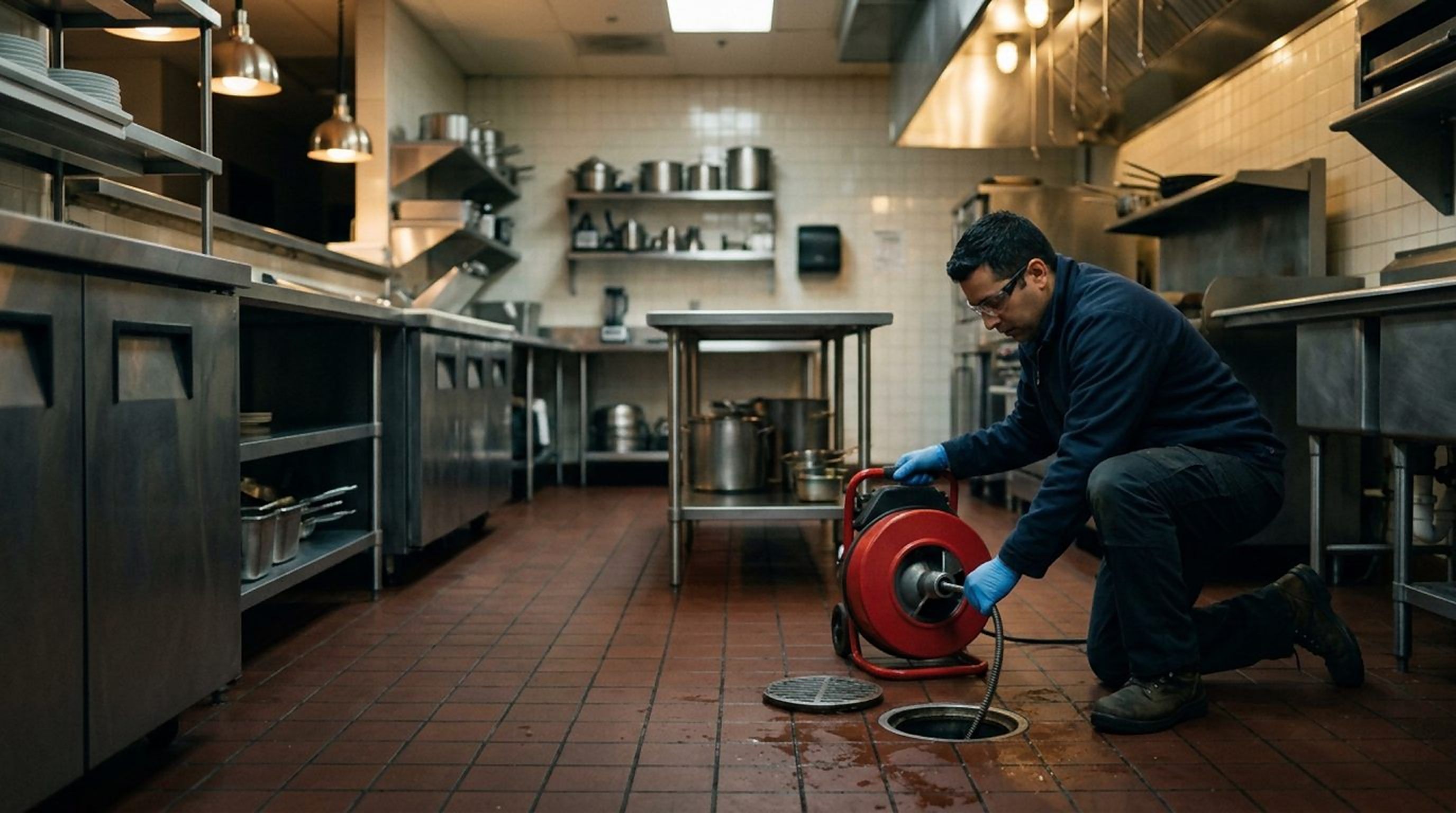
A Friday Night Backup Doesn’t Slow Service. It Closes You.We Clear the Line Before It Fills.
Scheduled descaling, clearing and camera inspection for commercial drain lines. So the line never fills up during a dinner rush.










Drain lines don’t fail all at once. They narrow for months while everything still seems to work. Then they hit capacity at the worst moment, which is exactly when volume is highest.
By the time wastewater comes up through a floor drain, the line has been closing for a long time. Nobody saw it, because there was nothing to see.


- customer locations served
- 129,500+
- facilities nationwide
- 90+
- trucks and tankers
- 1,000+
- in liquid waste
- 24+ years
- on-time service
- 95%
- of material recycled
- 94%
- route coverage
- Day & night
- Compliance™ Guarantee
- TripleLock
Your Line Isn’t Clogged. It’s Coated.Snaking Punches a Hole. Jetting Restores the Pipe.
This explains why a line you had cleared three months ago is backing up again.
A cable machine cuts an opening through a clog. Water flows again, the invoice is signed, and everyone thinks the problem is solved. But the grease, scale and sludge on the pipe wall are still there. The line is still narrow, just not fully blocked. It fills back up from the same starting point.
Here’s a simple test for facility managers.
Has the same line been cleared more than once in twelve months? Then it was probably snaked when it needed jetting. Or there’s a pipe defect nobody has looked for. Either way, clearing it again will get the same result on the same schedule.
Waiting for the Backup Means Paying Emergency Rates for Work You Could Have Scheduled.
Emergency drain work is the most expensive way to buy this service.
It comes at premium rates, at the worst hour, after the damage is done.
-
Scheduled descaling
Jetting high-volume lines every three or six months strips soft buildup before it hardens. It’s planned, priced up front and done outside business hours.
-
Schedules set by what the line carries
A dishwashing line in a busy kitchen and a restroom line in the same building don’t need the same schedule. We set how often based on what each line really handles.
-
Day and night routes
LES runs both, so the work happens outside service hours, not during them.
-
Recorded on every visit
What was cleared, how, and what the technician saw. A repeat problem shows up in the record instead of looking like a string of unrelated calls.
Three Ways This Ends Badly.All Three Were Preventable on a Schedule.
Each of these starts the same way, with a line nobody was watching. Where it ends depends on the site.
The kitchen floor sink backup: a health code closure
A casual-dining restaurant’s dishwashing line collects food scraps, fats and soap for months. It forms a hardened mass in the 4-inch main under the kitchen floor. During a Friday dinner rush, the line fills up. Graywater gushes from every floor drain and pools in the prep areas. Cooking stops, diners are sent out, and the doors close on a health hazard. Lost food, lost sales, and a health inspector already on the way.
The deli and beverage station: structural water damage
A grocery store’s fountain and deli drains take old syrups, dairy and coffee grounds. Sugar and milk coat the line and grow a thick bacterial slime that chokes it off. Fountain machines pump under pressure and run all night. The blocked line overflows behind the wall. By morning the water has ruined drywall, warped flooring through the checkout lanes and shorted register wiring. A plumbing problem became a construction problem.
The coffee bar: a drain fly infestation
A convenience store’s espresso drains take milk foam and sugar all day and are never flushed out. The line never fully clogs. It just coats itself with rotting organic slime, called biofilm. That biofilm is a perfect breeding ground for drain flies. Within weeks, swarms circle the pastry case. Nothing has failed, but the reviews say otherwise. Morning commuters go to the competitor down the road.
Half of This Starts at the Sink.Here’s What Your Staff Can Change Tomorrow.
Cleaning restores the line. Daily habits decide how fast it fills back up. These steps cost nothing and stretch the time between visits:
Fine-mesh strainers on every drain
Heavy-duty baskets on floor sinks, mop sinks and prep sinks, emptied into the trash daily. They catch solids, stickers and wrappers before they get into the line.
Scrape before washing
Scrape plates and pans fully into the trash before they reach a sink. This is the biggest source of what ends up coating the pipe.
Grease into the container, never the drain
Liquid FOG (fats, oils and grease) goes into the collection container. Every gallon poured down a sink will be cleaned out of a line later, at a higher cost.
End-of-shift hot flush with enzyme treatment
Run hot water and a live-bacteria enzyme treatment through the main floor drains at close. The enzymes eat the organic biofilm, the layer that breeds drain flies.
Train new staff, and retrain
Cleaning crews turn over. Good habits slip quietly, and the drain is where it shows up three months later.
You Can’t Fix What You Can’t See.Camera Inspection Shows Why It Keeps Coming Back.
When the same line clogs again and again, cleaning it again only treats the symptom. A camera shows the cause. It may be buildup, which is a schedule problem. Or it may be a crack, sag, offset or partial collapse, which is not.
That difference matters for your budget. Buildup is solved with a schedule. A pipe defect is solved with a repair. Every cleaning before that repair is money spent on a problem that will come back.
To be clear about scope: LES does video inspection with its own crews in markets where it bought companies with that skill. Elsewhere, screened contractors that LES manages do the work. LES coordinates it either way, and you get the same report. See the video pipe inspection page for details.
You’ll Need Another Provider for Some of This.Here’s What.
LES handles
- Commercial drain line cleaning and descaling
- Motorized snaking
- Hydro jetting of drain and sewer lines
- Floor sink, floor drain and trench drain lines
- Grease line clearing up to the interceptor
- Wastewater disposal and recycling
LES does not
- Drain chemicals and treatment products
- Residential plumbing of any kind
- Fixture repair, replacement or installation
- Pipe replacement and re-lining
- Water supply lines
- Septic systems
Cleared the same line twice this year?
We’ll look at what the line carries, whether it was cleaned or just opened, and whether a pipe defect is causing the repeat.
Drain Line Cleaning Near You
LES runs 90+ facilities and 1,000+ trucks and tankers nationwide. Find service and local rules for your area:
- Atlanta, Georgia
- Austin, Texas
- Birmingham, Alabama
- Charlotte, North Carolina
- Chicago, Illinois
- Cincinnati, Ohio
- Cleveland, Ohio
- Columbus, Ohio
- Dallas, Texas
- Denver, Colorado
- Detroit, Michigan
- Fayetteville, North Carolina
- Houston, Texas
- Jacksonville, Florida
- Kansas City, Kansas
- Knoxville, Tennessee
- Little Rock, Arkansas
- Miami, Florida
- Milwaukee, Wisconsin
- Mobile, Alabama
- Nashville, Tennessee
- New Orleans, Louisiana
- Oklahoma City, Oklahoma
- Orlando, Florida
- Phoenix, Arizona
- Port Charlotte, Florida
- Portland, Oregon
- Rio Grande Valley, Texas
- Riverside / Inland Empire, California
- San Antonio, Texas
- San Diego, California
- San Francisco Bay Area, California
- Shreveport, Louisiana
- St. Louis, Missouri
- Tacoma, Washington
- Tampa, Florida
- Winston-Salem, North Carolina
Clear the line properly. Then keep it that way.
Scheduled descaling, clearing and camera inspection. Recorded every visit, with what comes out recycled at our own facilities.