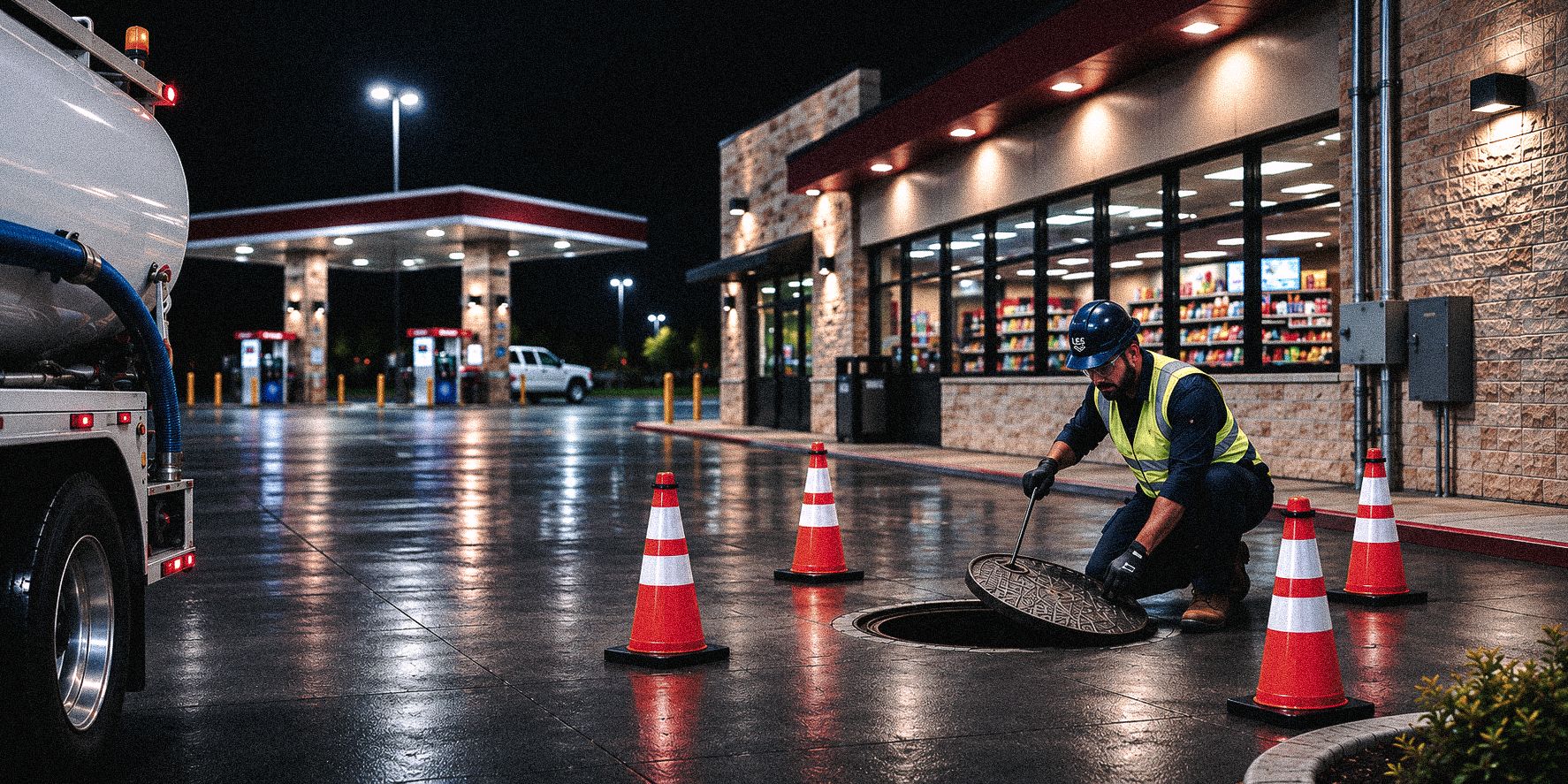
Your Stores Became Restaurants. Your Infrastructure Didn’t.
Roller grills, fried chicken, pizza and made-to-order menus now run through grease traps sized for a store that used to sell coffee and chips. LES manages the liquid waste on the site: kitchen, car wash and lot drainage.









Prepared food is now a major source of growth and profit for convenience stores.
It is also where the compliance risk went. And almost nobody resized the plumbing to match.
A store that added fried chicken three years ago now makes several times the fats, oils and grease it was built for. The trap is emptied on the same old schedule. The drains run slower every month. Nobody notices until a store closes on a Saturday or an inspector opens the lid.
LES manages convenience store wastewater as one program. We own the collection, transportation and recycling, so one team answers for the kitchen, car wash and lot. We handle the site’s wastewater, not the fuel system.


- customer locations served
- 129,500+
- facilities nationwide
- 90+
- trucks and tankers
- 1,000+
- in liquid waste
- 24+ years
- on-time service
- 95%
- of material recycled
- 94%
- recovered annually
- 525M+ gal
- regulation tracking
- FOGLaw®
One Convenience Store.Three Regulators.
A convenience store takes up a small part of a supermarket’s space, but it answers to just as many agencies. Most chains manage the three waste streams through three vendors. Often no one handles the third at all.
LES services all three streams and records each one for whichever regulator asks.
Grease Traps, Catch Basins and Wash Pits, Handled Before Anyone at the Store Has to Notice.
This is the big difference between c-stores and every other food service type. It shapes how the whole program has to work.
A restaurant has a GM who notices a smell. A supermarket has a facilities lead. A c-store has a manager running a shift, covering the register and dealing with staff turnover. Above them is one facilities director covering hundreds of sites.
Nothing depends on store staff noticing
LES sets service schedules by the local rule and the waste each store really makes. Not by someone calling when a drain runs slow.
Used cooking oil containers have sensors
Pickup happens when the container is really full. No call from the store, and no overflowing container out back.
Every visit is recorded
The store manager does not need to keep records. Service history is kept in one place and ready when an inspector shows up.
Store staff call one number, whichever stream the problem is in.
What LES Handles Across a C-Store
One Provider for Every Liquid Waste Stream at the Store, From Grease Traps to Car Wash Pits
-
Grease traps & interceptors
Convenience store grease trap service: grease trap cleaning with a full pump-out and a recorded inspection every visit. Includes the small indoor units common in older c-stores.
-
Used cooking oil
Used cooking oil collection in sensor-tracked containers sized for a small back room. Rebates improve as volume grows across your stores.
-
Oil-water separators for car wash bays
Oil water separator cleaning for wash bays and service areas. Every visit is recorded and the contents are recycled.
-
Car wash pits & wash bays
Car wash pit cleaning: sediment and sludge removal from wash pits, settling tanks, reclaim systems and grit and sand interceptors.
-
Repair, replacement & installation
Traps that are too small, failed baffles and units that no longer fit what the store sells.
-
Drain line jetting
Preventive line cleaning for the grease loads a c-store kitchen now makes.
What We Do Not Handle
Fuel Site Scope: What LES Handles and What Stays With Your Fuel Contractor
LES handles
- Grease trap and interceptor waste
- Used cooking oil and yellow grease
- Oil-water separator contents
- Car wash pit and wash bay sludge
- Non-hazardous wash and process water
- Storm drains and lot drainage
LES does not
- Fuel islands and forecourt separators
- Underground storage tank work of any kind
- Fuel system testing, monitoring or maintenance
- Fuel delivery, polishing or tank cleanup
- Hazardous waste of any classification
- Solid waste, refuse or recycling hauling
- Any residential service
Corporate, Franchised and Dealer C-Stores
Convenience retail is rarely uniform. One brand can include company-run stores, franchised stores and branded dealer sites. Who makes the buying decision is different in each.
Company-run
- Central contract, central billing, reports across all stores
- Service schedules set by the local rule and real output at each site
- Full view for the facilities team
- New builds and remodels added automatically
Franchised and dealer sites
- National account pricing, if they choose to opt in
- Same service standard and same records, billed directly to the store owner
- Brand-level view of compliance status, where the agreement allows
- Help getting set up for sites that join at any time
What It Costs to Find Out Late
Found on a schedule
- Trap resized before the food program outgrows it
- Catch basins cleared before the rainy season
- Car wash pit cleaned before reclaim quality drops
- One coordinated visit
Found when it fails
- Backup into a store full of customers, during business hours, on the busiest day
- Flooded entrance in heavy rain, plus a stormwater inspection finding
- Wash bay shut down, and a revenue stream stopped on a weekend
- Emergency call-out rates, plus whatever the failure damaged along the way
Convenience Store Kitchen, Car Wash and Lot. One Partner.
Kitchen, car wash and lot drainage waste, managed through one program.