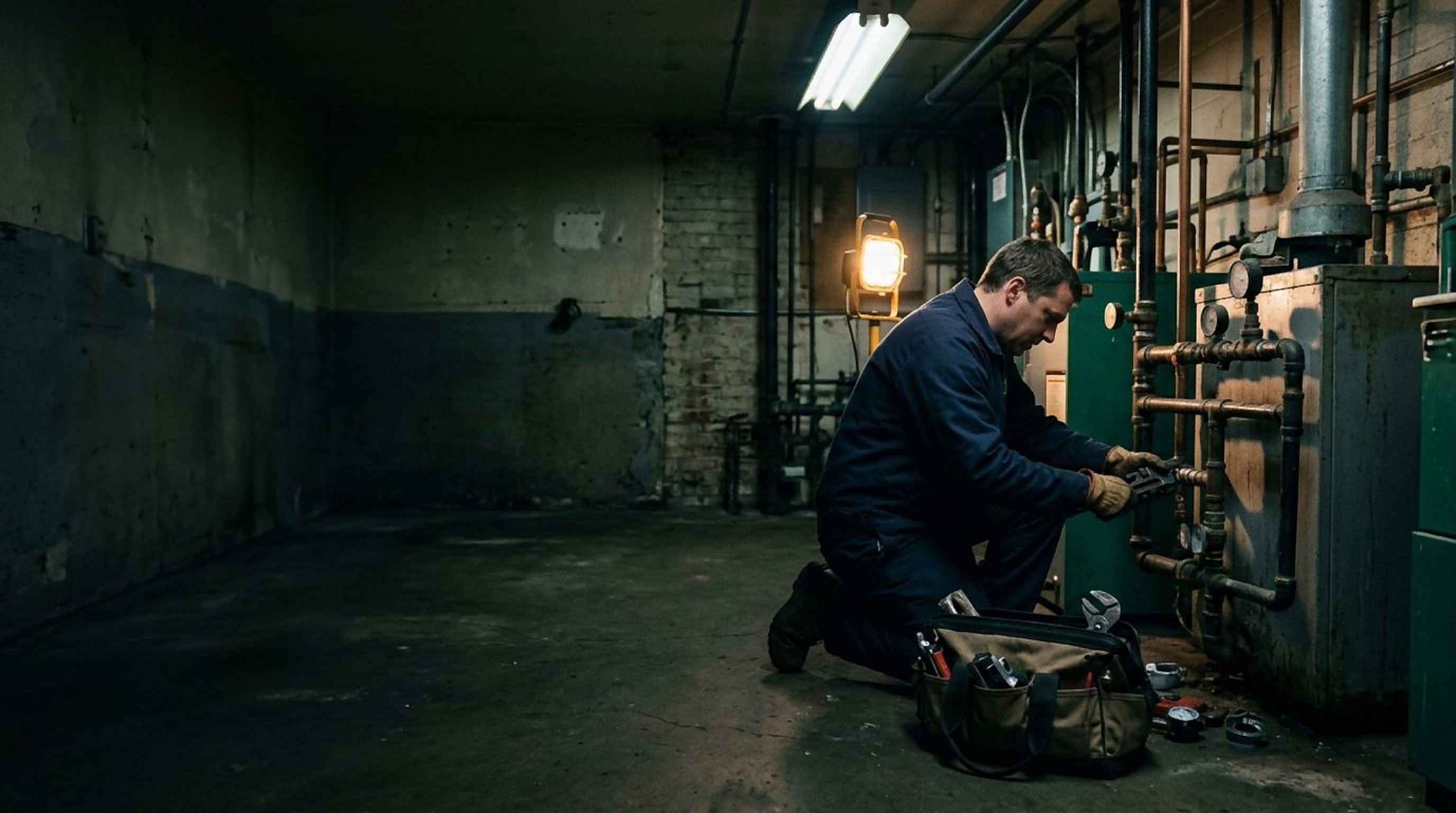
Commercial Plumbing Services for Food Service and Fleet Sites: 24/7/365 Emergency Response for LES Customers
At 2am the Question Isn’t Who’s Cheapest. It’s Who Answers. Our Customers Get 24/7/365.










LES handles grease trap plumbing, interceptor plumbing, lift station repair and commercial water heater replacement. And we already maintain what your plumbing drains into.
Commercial Plumbing Failures Don’t Just Slow a Business Down.They Close It.
In most jurisdictions, a kitchen with no hot water can’t sanitize, so it can’t open. A jammed lift station puts sewage on a parking lot. A failed separator sends oil and fuel into the city sewer, which brings a fine and a shutdown notice.
None of these can wait until Tuesday. In a commercial plumbing emergency, the number that matters isn’t the one on the estimate. It’s the one that gets answered at two in the morning.
LES maintains the interceptors, separators and lift stations your plumbing connects to. So one team answers for the pipe and for what it drains into.


- customer locations served
- 129,500+
- facilities nationwide
- 90+
- trucks and tankers
- 1,000+
- in liquid waste
- 24+ years
- emergency response for customers
- 24/7/365
- only — no residential
- Commercial
- LES crews and partners alike
- Licensed technicians
- plumbing and liquid waste
- One partner
A Commercial Plumbing Emergency Needs Two Things: Someone Who Answers and the Right Part.LES Customers Get Both
Every plumbing company advertises emergency service. What matters is what happens when you call at 2am on a Sunday in February.
LES provides 24/7/365 emergency response to current customers. We set that limit on purpose. Emergency capacity is limited, so we save it for the accounts we already know. We have records and equipment history for those sites, and our technicians have been there before.
Why being a customer matters at 2am
We already have the site’s service history, equipment records and access details. The crew isn’t starting from scratch in the dark at a site they’ve never seen.
What that means for the response
Faster diagnosis. The right parts more often on the first visit. No time lost finding out who you are and what you have.
What it means for your business
Emergency response comes with the relationship. It isn’t a one-off sale. It’s one of the clearest reasons to move your scheduled work to one provider.
What we will not do
Promise a national arrival time we can’t keep everywhere. Our response is real and put first. A single clock for every site would not be.
Most Plumbers Have Never Seen Inside a Grease Interceptor.We Maintain Them Every Week.
This is where LES is truly different from a plumbing contractor.
LES technicians open these units on a schedule. We know what weir plates should look like, what a failed skimmer does to the water leaving your site, and what an interceptor looks like after three years of bad service.
Three Failures That Closed a Site.All Three Were Fixable in Hours.
The fleet wash bay: a sewer surcharge and a padlock threat
A logistics company’s truck wash drains through an underground oil water separator. The separator’s weir plates and floating skimmer rust and fail. Raw petroleum and heavy silt flow straight into the city sewer. The city’s wastewater department detects the spike. It issues a large surcharge and threatens to close the wash bay. We fully rebuild the separator’s internal parts. We add backup shut-off sensors that close the discharge line if oil levels spike again. The yard is back in compliance, and the daily fines stop.
The fast-food restaurant: no hot water, no legal right to open
The site needs a steady supply of hot water for its dishwashers and hand sinks to meet health code. The tankless system’s control board and burner fail during morning prep. Without hot water, the kitchen can’t legally sanitize or let staff wash hands. It must close at once, mid-shift. Priority dispatch gets a licensed technician on site within hours. The real holdup is the part, not the labor. Brand-specific parts for commercial units often take days through normal shipping. LES has direct relationships with manufacturers that move parts straight to the technician. The repair is done the same day, and the lunch and dinner shifts are saved.
The highway convenience store: sewage on the forecourt
The site sits below the city sewer main. It relies on an underground sewage ejector lift station to pump wastewater uphill. Customers flush plastic, sanitary products and vape cartridges down the public restrooms. Both grinder pumps jam and burn out. Raw sewage backs up and bursts from the lift station manhole onto the parking lot. A vacuum truck pumps down the wet well. The burned-out pumps come out. Chopper pumps with hardened cutting blades go in, built to handle solids. A dual-pump control panel with cellular alarms now warns the corporate office before an overload becomes a spill.
Nobody Watches Water Pressure Until a Heater Bursts.We Control It Before That.
Self-Performed Where We Own the Crews. Managed Everywhere Else.Always Ours to Answer For.
In markets where LES has acquired plumbing companies, our own crews handle commercial plumbing. Everywhere else, we use screened third-party plumbers.
Either way, the person on your job is properly licensed. Our team members who do plumbing repairs hold the required licenses, and every outside plumber is licensed in the state where they work, as state and local regulations require.
What does not change
Licensing, the standard, the records and who is responsible. LES technicians and partner plumbers are all licensed in the states they work in. One company scopes the work, keeps the record and answers for the result.
Why we say it plainly
No national provider truly does its own plumbing in every market. Naming the limit is what makes the rest believable.
What to ask us
Tell us your locations, and we’ll tell you which model applies where. In markets with our own crews, our local sales teams can say so. That is a stronger claim than this national page can make.
Commercial Only.Here’s What That Rules Out.
LES handles food service plumbing and commercial plumbing for automotive, fleet, retail and industrial sites.
LES does not handle:
- Residential plumbing of any kind, including single-family and multi-family properties
- Rough-in plumbing for new commercial construction
- Fire suppression systems
- HVAC and mechanical services
- Gas appliance service and certification
Commercial Plumbing Near You
LES runs 90+ facilities and 1,000+ trucks and tankers nationwide. Find service and local rules for your area:
- Atlanta, Georgia
- Austin, Texas
- Birmingham, Alabama
- Charlotte, North Carolina
- Chicago, Illinois
- Cincinnati, Ohio
- Cleveland, Ohio
- Columbus, Ohio
- Dallas, Texas
- Denver, Colorado
- Detroit, Michigan
- Fayetteville, North Carolina
- Houston, Texas
- Jacksonville, Florida
- Kansas City, Kansas
- Knoxville, Tennessee
- Little Rock, Arkansas
- Miami, Florida
- Milwaukee, Wisconsin
- Mobile, Alabama
- Nashville, Tennessee
- New Orleans, Louisiana
- Oklahoma City, Oklahoma
- Orlando, Florida
- Phoenix, Arizona
- Port Charlotte, Florida
- Portland, Oregon
- Rio Grande Valley, Texas
- Riverside / Inland Empire, California
- San Antonio, Texas
- San Diego, California
- San Francisco Bay Area, California
- Shreveport, Louisiana
- St. Louis, Missouri
- Tacoma, Washington
- Tampa, Florida
- Winston-Salem, North Carolina
One partner for the pipe and everything it drains into.
Interceptors, separators, lift stations and water heaters. Scheduled, recorded and answered at 2am if it comes to that.