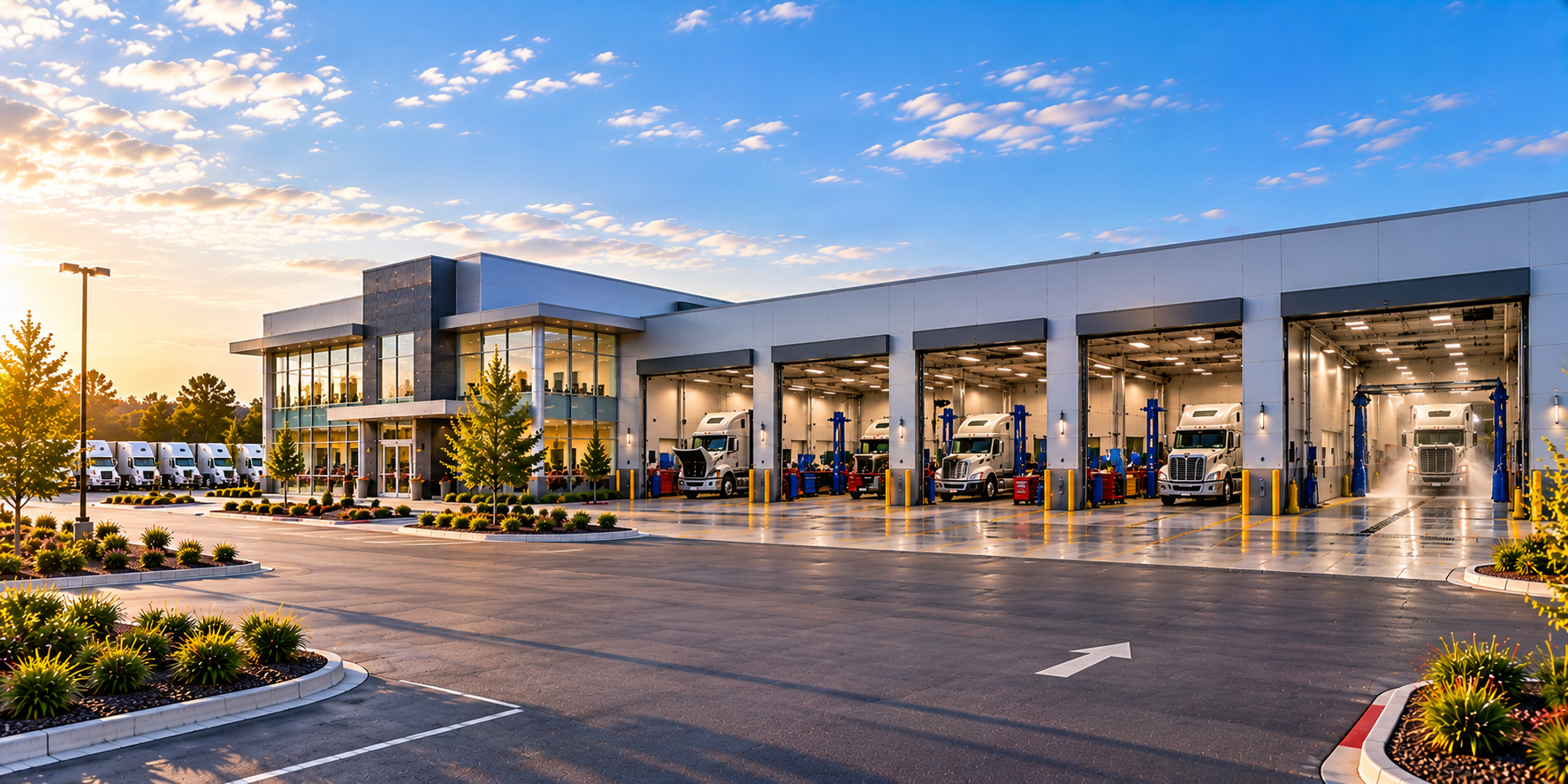
Your Depot Runs Day and Night. So Do Our Routes.
Wash racks, shop drains, grit traps and trailer yard drainage — serviced day or night, on schedules set by what your site really produces.









Most facilities vendors are built around a closing time. They show up after the last customer, work in an empty building and leave before opening.
A parcel hub sorts through the night and rolls out at dawn. A distribution center runs three shifts. A for-hire terminal takes drivers back whenever the load finishes. There is rarely an empty building — only a quieter part of the cycle.
LES runs both overnight and daytime routes, so we can schedule service where it disrupts least. Servicing a fleet depot means working inside a live operation. We work around the yard jockey, between wash rack cycles, and without taking the shop bay a technician needs. That comes down to how we operate, not our equipment — and it is what most vendors get wrong.
Request a Depot Assessment

- customer locations served
- 129,500+
- facilities nationwide
- 90+
- trucks and tankers
- 1,000+
- in liquid waste
- 24+ years
- on-time service
- 95%
- of material collected is recycled
- 94%
- 7,651,624 on-site treatment
- US Patent
- route coverage
- Day & night
Three Assets, One Site, Usually Three Vendors
Serviced Inside a Live Operation, Not an Empty One
Schedules set by your actual load
How often we come is based on the size of each interceptor and how fast your site really produces waste — not a network default used at every depot.
Day and night routes
LES runs both daytime and overnight routes, so service can land in the quieter part of your cycle, not the middle of it.
Staffed for the size of the job
Large depots are not single-truck visits. A high-volume site can take two trucks and four technicians across two days. We plan it that way from the start, not halfway through.
Yard-aware crews
Technicians who work safely around jockeys, live staging lanes and nonstop vehicle movement — and who know not to block a dock or an access lane.
Asset by asset, not all at once
Wash rack, shop and yard work done in separate steps, so no single visit takes out more of the site than you can spare.
Site access handled in advance
We plan for security rules, escorted access, contractor inductions and site safety rules when we schedule. We don't find out about them on arrival.
Water Reduction You Can Actually Report
Large fleets make public sustainability promises, and water is one of the harder ones to prove. That is especially true when water leaves the site in someone else's truck and the trail ends there.
LES holds a patented process — US patent 7,651,624. It separates oil, water and sludge inside the truck during the visit and returns the water to your system. Only the oil and sludge are hauled away.
Across thousands of visits at similar high-volume car washes, LES onsite recycling trucks processed 85% of the waste on site and returned clean water. Only a small amount of solids had to be shipped off for processing.
Stop Chasing Four Vendors for One Depot.Here’s Everything We Cover.
Wash rack and shop separators — a full pump-out, a recorded inspection every visit, and recovered wastewater recycled.
Trench drains, reclaim tanks and settling chambers for truck wash and undercarriage wash systems.
The heavy solids that come off road vehicles, especially in markets that salt their roads.
Shop bay floor drains, trenches and the lines that run to the separator.
Hauled to LES facilities, processed and recycled — 94% of what we collect is put to good use again.
Failed baffles, rusted T-pipes, cracked bodies and broken connections — handled through screened contractors.
New separators for new depots and expansions. Resizing when fleet growth has outgrown the current unit.
What We Don’t Take, So You Know Who to Call
LES handles
- Oil-water separators — cleaning, repair, installation and upgrade
- Wash rack trenches, reclaim tanks and settling chambers
- Grit traps and sediment interceptors
- Shop bay drains and drain lines
- Non-hazardous wash and process water
- Catch basins and yard stormwater drainage
LES does not
- Used motor oil and oil filters
- Coolant, antifreeze and DEF
- Parts washer solvent
- Fuel islands, underground storage tanks and fuel systems
- Scrap tires, batteries and solid waste
- Vehicle maintenance or washing itself
One Program Across a Network
A national fleet network is rarely the same everywhere. Hubs, satellite terminals, shop-only sites and leased sites all sit under one operation, with very different equipment.
Hubs and major terminals
- Full set of equipment, multi-truck service, scheduled around nonstop operations
- Schedules set from measured volume at each site
- Network-wide reporting for facilities and sustainability teams
- New depots added to the program when they open
Satellite terminals and leased sites
- Smaller setups, scheduled around local patterns
- Schedules set from actual use, not a network default
- Same record standard and same portal, whoever holds the lease
- Landlord and tenant duties recorded where the site is leased
Documented for Every Authority That Asks
Fleet depots answer to the local pretreatment authority for what leaves the separator. They answer to the city stormwater program for the yard. On leased sites, the landlord may have rules of its own.
Where an LES error results in an emergency service or a Notice of Violation, LES covers the associated cost in accordance with the TripleLock Compliance™ Guarantee. The guarantee applies where LES is the cause.
-
A manifest copy is left on site at every visit.
-
Final manifests, with disposal details, are kept in an online portal for five years. Your team can access them there.
5 yrs -
Every visit also produces an inspection record covering separator condition, T-pipes, baffles and lids.
Keep the wave moving.
Wash racks, shop drains, grit traps and trailer yards — serviced day or night, recorded for every regulator and recycled through our own facilities.