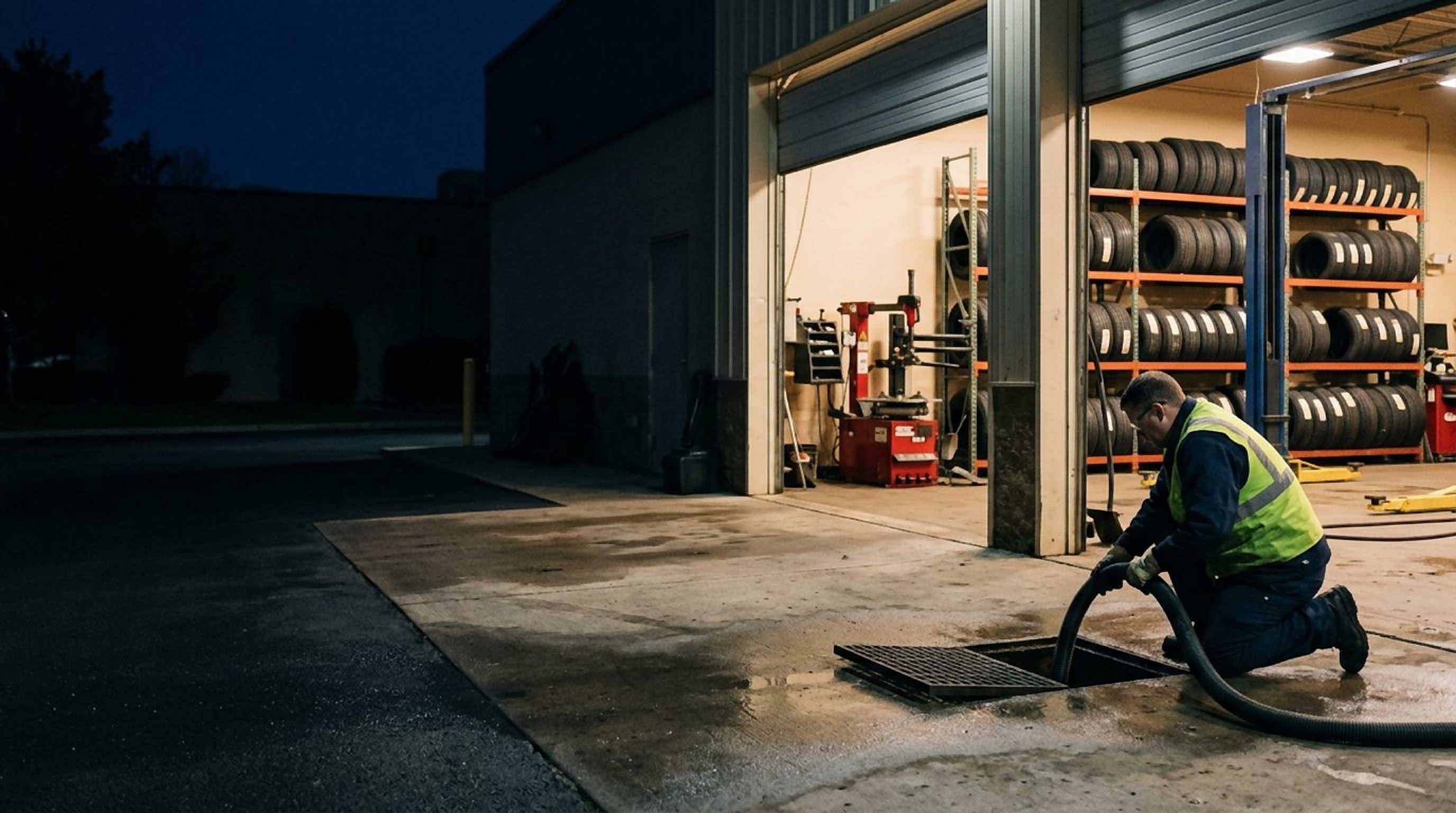
Your Grit Trap Fills Fastest When You Can Least Afford a Closed Bay. We Service It Before the Season Hits.
Grit traps, bay drains, separators and lot drainage — cleaned, repaired and upgraded overnight. Schedules are set by how fast your sites really fill.










To be clear about what we don't do: LES does not take scrap tires. That is solid waste, and it has its own handler.
We handle what the tires leave behind. Every car that comes into a bay brings the road with it. Grit, sand, road salt and rubber bits wash off the wheels and down the bay drain, with mounting lubricant on top.
It ends up in the grit trap. In changeover season, it gets there faster than at any other auto business — in the same few weeks you can't afford to lose a bay.


- customer locations served
- 129,500+
- facilities nationwide
- 90+
- trucks and tankers
- 1,000+
- in liquid waste
- 24+ years
- on-time service
- 95%
- of material recycled
- 94%
- service scheduling
- Overnight
- Compliance Guarantee™
- TripleLock
The Road Comes In on Every Vehicle.We Take It Back Out.
Changeover Season Doesn't Wait for Your Service Schedule
In northern markets, months of built-up road salt and sand come off wheels in a few busy weeks. Southern markets see a milder version of the same effect after storm season.
A fixed quarterly schedule handles neither. It over-services the quiet months and under-services the weeks that matter. That is how stores end up with a clogged drain during their busiest two weeks of the year.
Schedules set to your seasons
Service scheduled ahead of changeover, not on a flat calendar. We use how fast your sites actually fill, not an auto industry default.
Pre-season clearance
Grit traps, bay drains and catch basins cleared before the peak, so the season starts with full capacity.
Capacity checked, not assumed
If the interceptor cannot hold a season's load, no schedule will fix it. We size up the problem before we schedule around it.
Regional differences respected
A store in a salt-belt market and one in a coastal market are not on the same schedule, even under the same brand.
Never Give Up a Bay to the Vendor Servicing It
A four-bay store that loses one bay to a service visit during business hours gives up a quarter of its capacity. And it does so to fix a problem that hasn't happened yet.
Scheduled outside operating hours
Overnight or pre-open service, agreed store by store, not set by what suits the route.
Bays returned ready to work
Drains cleared, grates and covers secured and the floor ready to use before the first car goes up.
Inspected every visit
Interceptor and separator condition recorded every time, so problems show up as scheduled work, not mid-shift.
One vendor across the streams
Grit trap, bay drains, separator, wastewater and lot drainage on one schedule and one set of records.
Stop Chasing Four Vendors for One Store.Here's Everything We Cover.
The main asset at a tire store. A full pump-out, with its condition inspected and recorded.
Drains and the lines that run to the interceptor, cleared before they clog.
A full pump-out and a recorded inspection, with the recovered wastewater recycled.
Hauled to LES facilities, processed and recycled — 94% of what we collect is put to good use again.
Damaged baffles, cracked bodies, failed lids and broken line connections — handled through screened contractors.
New interceptors and separators for new stores and relocations. Resizing when seasonal load has outgrown the current unit.
What We Don't Take, So You Know Who to Call
LES handles
- Grit traps and sediment interceptors
- Bay floor drains, trenches and drain lines
- Oil-water separator cleaning, repair, installation and upgrade
- Wastewater disposal and recycling
- Catch basins and stormwater drainage
LES does not
- Scrap tires — solid waste, with its own handler
- Used motor oil and oil filters
- Coolant and antifreeze
- Parts washer solvent
- Batteries and wheel weights as a collected stream
- General refuse and solid waste
You Can Set Franchisee Standards. You Can't Set Their Vendor. We Solve Both.
Tire chains run a mix of company-run stores, franchised locations and independent dealers that carry the brand. Compliance risk does not tell them apart, and neither does a customer.
Company-operated stores
- Central contract, central billing, portfolio-wide reporting
- Schedules set store by store from measured seasonal load
- Full visibility for the facilities team
- New stores added to the program at opening
Franchised and independent dealer locations
- National account pricing for locations that opt in, billed directly
- Same service standard, same records, same inspection report
- Brand-level view of compliance status where the agreement allows
- Onboarding help for locations that join at any point
No Facilities Office, No Filing Cabinet.The Record Exists Before the Inspector Does.
A manifest copy is left on site at every visit. Final manifests, with disposal details, are kept in an online portal for five years. Your team can access them there. Every visit also produces an inspection record covering interceptor and separator condition.
At store level, there is no facilities office and nowhere to file anything. When an inspector walks in, the record has to already exist somewhere the manager can reach in a minute.
Where an LES error results in an emergency service or a Notice of Violation, LES covers the associated cost in accordance with the TripleLock Compliance™ Guarantee. The guarantee applies where LES is the cause.
Every bay open through changeover season.
Grit traps, bay drains, separators and lot drainage — serviced overnight, sized for your seasonal load and recorded for the inspector.