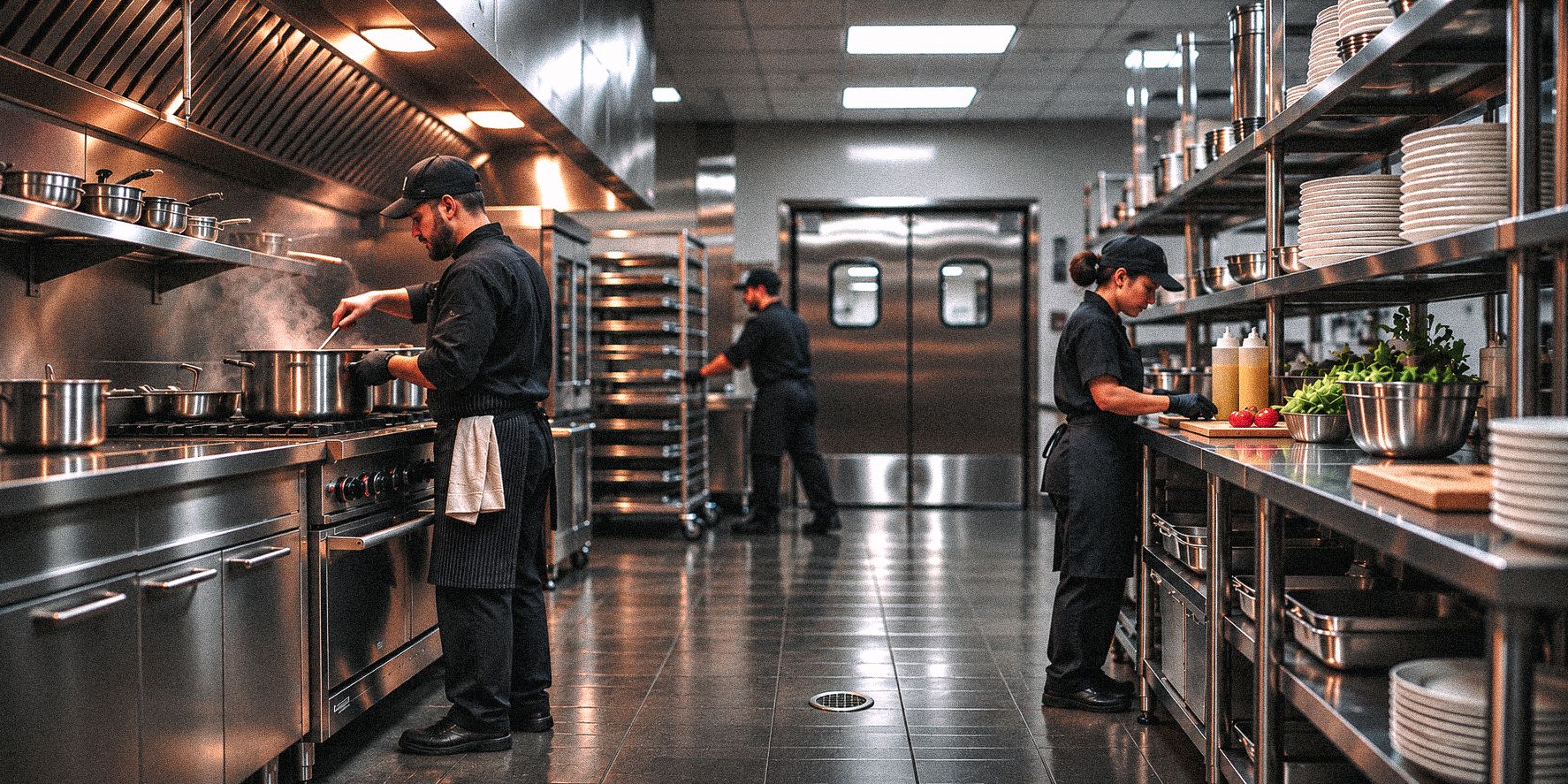
Commercial Kitchen Grease Services From One Partner, So No One Passes You Along
One company pumps the trap. Another repairs it. A third collects the oil, and a fourth cleans the hood. When something fails, each one says it's someone else's job.
LES provides restaurant grease services and commercial kitchen grease management as one program. We cover all four jobs, so one company answers for the whole kitchen, and LES owns the collection, transportation and recycling.
Trusted by leading multi-site operators nationwide









A Grease Trap Has a Whole Life.Most Vendors Only Show Up for One Part.
A grease trap has a whole life. It's installed when the kitchen is built, serviced every month or quarter, and at risk along the way as a baffle rusts, a lid cracks or the menu outgrows the unit. Meanwhile the fryer oil leaves on its own, and the hood must be cleaned to fire code. Kitchen grease infrastructure services have to cover all of it, but many kitchens buy the five stages from four companies that never talk to each other.
The gap is stage three. No one is paid to look, so no one looks.
LES covers all five. Every scheduled visit is also an inspection. That turns a failed baffle from a Friday night emergency into a planned repair.
Four Jobs, One Kitchen.Pick the One You Need, or Take All Four.
Grease trap & interceptor cleaning
A full pump-out and cleaning on a set schedule, with a written inspection at every visit. Your schedule is based on local rules and how much grease you make, not a one-size-fits-all cycle.
Repair, replacement & installation
Cracked bodies, failed baffles, leaking lids, rusted tees and units that are too small. We find them during routine service, quote them and fix them through screened commercial plumbers.
Used cooking oil collection & recycling
Sealed containers, pickups set by how full they are instead of a fixed calendar, and a rebate based on how much oil you have and its quality.
Commercial kitchen hood cleaning
NFPA 96 exhaust cleaning for the hood, the ductwork and the rooftop fan — the part most vendors skip.
You Know the Symptom.We’ll Tell You Which Service It Is.
Most people know what went wrong, not what the service is called. Find your problem below.
-
Slow drains, or a smell that comes back a few days after every service
The trap is being skimmed, not fully pumped out. Or the schedule is too long for what the kitchen makes now.
Grease trap cleaning -
The trap was pumped on time, and you still failed an inspection
This is almost always a condition problem. A rusted baffle or failed tee means the unit stopped working, even though the service records looked perfect.
Repair & replacement -
Standing water, a soft spot in the ground or a lid that no longer sits flat
The structure is failing. It won't get better on its own, and it costs more the longer you wait.
Repair & replacement -
The trap fills faster than it used to
Your menu or volume changed, and the unit is now too small. Either the schedule changes or the unit does.
Repair & replacement, or a service schedule review -
Fryer oil overflowing, or staff pouring it into the trap
The container is too small, pickups are on a fixed calendar instead of fill level, or there's no container at all. Oil in the trap kills the oil's value and overloads the trap.
Used cooking oil -
Grease dripping from the hood, or a fire or insurance inspection coming up
Exhaust cleaning is overdue. If your last vendor only cleaned the hood, the duct and fan are still full of grease.
Hood cleaning
You can't find the service records someone just asked for
This is a records problem, not an equipment one. In most areas, service with no records counts as no service.
When Four Vendors Share a Problem, No One Owns It.One Does.
The pumping company says the trap is failing, so call a plumber. The plumber says it needs to be emptied first. No one has asked the oil vendor. Meanwhile, the kitchen is closed.
LES covers all four services, so there are no handoffs. You get one contract, one service standard, one set of records and one number to call when something goes wrong.
-
The inspection really happens
The company that services your trap is the same one that would repair it. So we have a reason to look closely — and a way to fix what we find.
-
The oil stays out of the trap
When one company handles both the oil and the trap, container sizes and pickup schedules are planned together, not separately.
-
One set of records
Service records, manifests, inspection findings and disposal records in one place for each location — not four vendor portals and a filing cabinet.
-
One number to call
At 9pm on a Friday, you have one number to call. The company that answers can send the right truck, not just a diagnosis.


The Rules Changed and No One Told You. FOGLaw® Did.
FOG (fats, oils and grease) rules are set locally. They differ from place to place, and they change without warning. A single-site business deals with one set of rules. A multi-site business may deal with hundreds that don't agree.
LES tracks wastewater rules through FOGLaw®. We set each location’s schedule based on local rules and how much grease that kitchen makes. And we keep records of every visit.
We track the rules
FOGLaw® tracks more than 6,000 rules nationwide. So a rule change updates your service schedule before it shows up on your inspection report.
We do the service right
Every grease trap visit follows a written seven-step process. It's built to make sure the unit is fully pumped out and cleaned.
If we cause it, we own it
Where an error by LES results in a qualifying emergency service or Notice of Violation, LES covers the associated cost in accordance with the TripleLock Compliance™ Guarantee.
You Pay to Remove It. We Make Sure It Becomes Something.
Used cooking oil is a product, not a waste. Trap contents are mostly water. Both are worth more recycled than buried, and LES owns the plants that do it.
Used cooking oil is screened and heat-separated into a clean product ready for market. It becomes the raw material for biodiesel and sustainable aviation fuel
Grease is pulled from trap solids with 3-phase high-speed centrifuges instead of going to a landfill
Leftover solids are dried and sent to composting where it's available
Water is treated to remove harmful material before it goes into the city sewer. Then the local treatment plant cleans it further
94%
of collected material is recycled, with chain-of-custody records for each location — not just a company-wide claim
Stop Coordinating Four Vendors. Start With One Assessment.
Grease traps, repairs, cooking oil and hoods — checked together. Find out what your kitchens need before a problem tells you.
24/7 emergency service nationwide
Commercial Kitchen Grease Services Questions, Answered
What are commercial kitchen grease services?
Do I need all four services, or can I keep my current vendor?
What is the difference between used cooking oil and grease trap waste?
Can LES handle multiple locations across different states?
What documentation do I get?
Where do I start if I'm not sure what I have?
Where LES offers commercial kitchen solutions
- Atlanta, Georgia
- Austin, Texas
- Birmingham, Alabama
- Charlotte, North Carolina
- Chicago, Illinois
- Cincinnati, Ohio
- Cleveland, Ohio
- Columbus, Ohio
- Dallas, Texas
- Denver, Colorado
- Detroit, Michigan
- Fayetteville, North Carolina
- Houston, Texas
- Jacksonville, Florida
- Kansas City, Kansas
- Knoxville, Tennessee
- Little Rock, Arkansas
- Miami, Florida
- Milwaukee, Wisconsin
- Mobile, Alabama
- Nashville, Tennessee
- New Orleans, Louisiana
- Oklahoma City, Oklahoma
- Orlando, Florida
- Phoenix, Arizona
- Port Charlotte, Florida
- Portland, Oregon
- Rio Grande Valley, Texas
- Riverside / Inland Empire, California
- San Antonio, Texas
- San Diego, California
- San Francisco Bay Area, California
- Shreveport, Louisiana
- St. Louis, Missouri
- Tacoma, Washington
- Tampa, Florida
- Winston-Salem, North Carolina