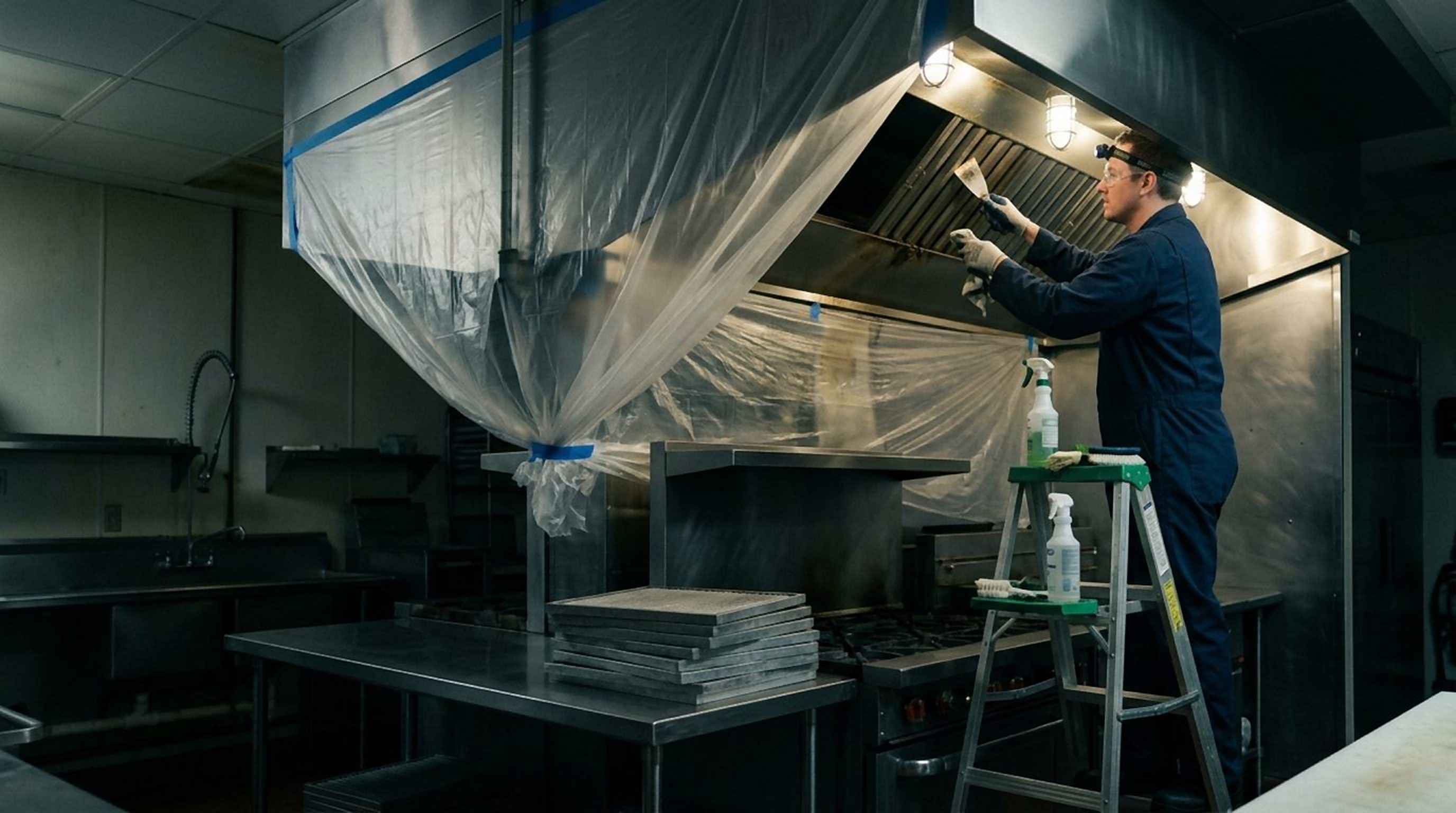
Commercial Kitchen Hood Cleaning That Reaches the Duct and the Rooftop Fan, With the Records to Prove It
NFPA 96 compliant exhaust cleaning. You get a dated certificate and photos. We work overnight, so your kitchen stays open.



Grease doesn't stop at the filters. It travels up the duct and builds up on the rooftop fan. Those are the two places most hood cleaning never reaches — and the two places a fire spreads fastest.
LES cleans the whole exhaust system to bare metal. We record what we reached, and we tell you plainly what we couldn't.
Then LES takes the grease away. If you hire a hood cleaner on your own, the wastewater usually goes down your floor drain. That sends it straight into the grease trap you already pay to have emptied.
Hood Cleaning That Stops at the Filters Leaves the Fire Risk Above Them.LES Cleans the Whole Exhaust System
A wiped-down hood looks clean and tells you nothing about the duct above it.
Hood and duct cleaning under NFPA 96 covers the whole exhaust system, cleaned to bare metal: the hood, baffle filters, horizontal and vertical ducts and the rooftop exhaust fan.
If a section couldn't be reached, your certificate should say so.
-
Duct runs
Reached through NFPA 96 access panels, invisible from the kitchen floor, and where a fire travels.
-
The rooftop fan
Shroud, base and blades, which means tipping or removing the unit.
-
Hood tracks
Heavy buildup that needs hand scraping before any wash.
-
Inaccessible sections
Areas that can't be reached are documented on the certificate, not quietly left off.


- compliant method
- NFPA 96
- hood cleaning technicians
- Certified
- service available
- Overnight
- one standard
- Nationwide
Hood Cleaning Waste Needs a Documented Destination.LES Hauls It Away, Recycles It and Shows You Where It Went.
Hood cleaning creates greasy wastewater and spent chemicals, and that waste has to go somewhere. When a hood cleaner you hired on your own rinses it into the floor drain, it can reach your grease trap or the sewer. In many areas that discharge is a violation, no matter who caused it.
LES provides hood cleaning through certified specialist contractors working under LES contracts, service standards and record-keeping rules. Everything removed from your exhaust system is taken to an LES disposal facility and processed through the LES recycling network.
You get chain-of-custody records showing where it went, which is the proof an inspector, auditor or ESG report asks for.
One responsible partner for the hood, the grease trap and everything removed from both.
Six Steps, Every Service
01
Prep
Test the exhaust fan before starting and note any problem. Lock out the power. Shut off gas and pilot lights. Wrap cooking equipment in heavy plastic, with plywood over warm surfaces.
02
Contain
Build a plastic funnel under the hood. It channels grease, wastewater and chemicals into collection bins instead of onto the floor.
03
Soak & Scrape
Baffle filters go into a hot degreasing soak tank. Heavy buildup on hood tracks and duct openings is scraped off by hand before any washing starts.
04
Wash to Bare Metal
Hot-water pressure washing through the hood, duct access panels and ducts. The rooftop fan is tipped or removed, and the shroud, base and blades are each degreased. Fusible links and fire suppression sensors are protected the whole time. Chemical degreasers are never sprayed on them.
05
Capture & Haul
Collected grease, wastewater and chemicals leave the site. They go to an LES disposal facility for processing through the LES recycling network — not into your floor drain.
06
Reset & Certify
Squeegee and dry the hood, and polish the outside stainless steel with food-safe polish. Put the filters back, relight pilots, turn the power back on and test the fan. A dated NFPA 96 certificate label goes up in the kitchen. It lists the service date, the provider and any sections that couldn't be reached.
How Often NFPA 96 Requires Kitchen Cleaning?
NFPA 96 sets minimums by cooking volume and fuel type, not preference. A kitchen that adds a charbroiler moves from semi-annual to quarterly the day it goes in, and many kitchens never update the schedule.
A Kitchen That Adds a Charbroiler Changes Its NFPA 96 Schedule Overnight.
LES Reviews the Interval Whenever the Menu Changes.
After a Fire, Two Questions Get Asked. A Dated NFPA 96 Label Answers Both.
After a kitchen fire, two questions get asked.
When was the exhaust system last cleaned, and by whom?
A dated NFPA 96 label answers both. Without one, you're relying on memory and invoices. And insurers reviewing a claim may view an exhaust system with no cleaning record differently.
Every LES service comes with a dated certificate label, photos of the work and a written record of any section we couldn't reach.
We track the rules.
FOGLaw® tracks the rules that apply in the areas where you operate.
We do the service right.
Every visit follows a written service process, with records that show exactly what was done.
Cleaned Overnight.Open in the Morning.
Hood cleaning means shutting down the line, wrapping equipment and turning off the gas. During business hours, that means a closed kitchen.
LES schedules around you — overnight, or during whatever window your kitchen has.
For multi-site customers, we plan scheduling centrally. Every location stays on the correct NFPA 96 interval, and certification records for every site are retrievable on demand.
Every Kitchen Type Has a Different Hood Problem.LES Sets the Interval to the Kitchen, Not a Template
-
Full-service restaurants
Restaurant hood cleaning intervals shift with the menu. Adding a charbroiler or wok station moves a kitchen from semi-annual to quarterly.
Quick service and fast casual
High-volume frying fills ducts fast, and chains need one standard across every store.
-
Hotels and banquet kitchens
Event cooking comes in heavy bursts with long breaks, which is how grease hardens in a duct.
-
Hospitals and senior living
24-hour kitchens fall in the quarterly group and never close, so scheduling is the hard part. A long kitchen closure can be a licensing problem, not just a business one.
-
Schools and universities
Heavy use during the school year, with breaks as the only real service window. Missing that window costs a full term.
-
Grocery, ghost kitchens and food halls
Grocery deli, bakery and hot-food counters can each have separate exhaust systems and schedules. Ghost kitchens and food halls share one system, and no single tenant is in charge of cleaning it.
That's about more than convenience. When three vendors share a kitchen, no one owns the result.
The hood cleaner rinses into the floor drain. The grease trap fills early. The trap company says the schedule was set wrong. Everyone is partly right, and no one is responsible.
With one partner, there's nothing to argue about.
Putting your kitchen on one program means:
One master agreement
One MSA covers every service, with a statement of work for each. Add hood cleaning, grease trap service or oil collection whenever you’re ready. Each service has its own term.
One schedule
Hood, trap and oil pickups coordinated around your operating hours, not against each other
One compliance file
NFPA 96 certification, trap service records and recovery documentation in the same place
One onboarding per location
When a site opens, it joins an existing program instead of starting four vendor searches
Equipment matched to collection
LES supplies the oil storage container and sets the pickup interval to fit it, so it never overflows
A new location joins an existing program instead of starting three vendor searches.
Hood Cleaning Near You
LES runs 90+ facilities and 1,000+ trucks and tankers nationwide. Find service and local rules for your area:
- Atlanta, Georgia
- Austin, Texas
- Birmingham, Alabama
- Charlotte, North Carolina
- Chicago, Illinois
- Cincinnati, Ohio
- Cleveland, Ohio
- Columbus, Ohio
- Dallas, Texas
- Denver, Colorado
- Detroit, Michigan
- Fayetteville, North Carolina
- Houston, Texas
- Jacksonville, Florida
- Kansas City, Kansas
- Knoxville, Tennessee
- Little Rock, Arkansas
- Miami, Florida
- Milwaukee, Wisconsin
- Mobile, Alabama
- Nashville, Tennessee
- New Orleans, Louisiana
- Oklahoma City, Oklahoma
- Orlando, Florida
- Phoenix, Arizona
- Port Charlotte, Florida
- Portland, Oregon
- Rio Grande Valley, Texas
- Riverside / Inland Empire, California
- San Antonio, Texas
- San Diego, California
- San Francisco Bay Area, California
- Shreveport, Louisiana
- St. Louis, Missouri
- Tacoma, Washington
- Tampa, Florida
- Winston-Salem, North Carolina
When Was Your Rooftop Fan Last Cleaned?
If you can't answer that, your exhaust system hasn't been cleaned to NFPA 96 standard — no matter what the invoice said.
LES inspects the whole system, takes photos of what we find and tells you which schedule your kitchen really falls into.