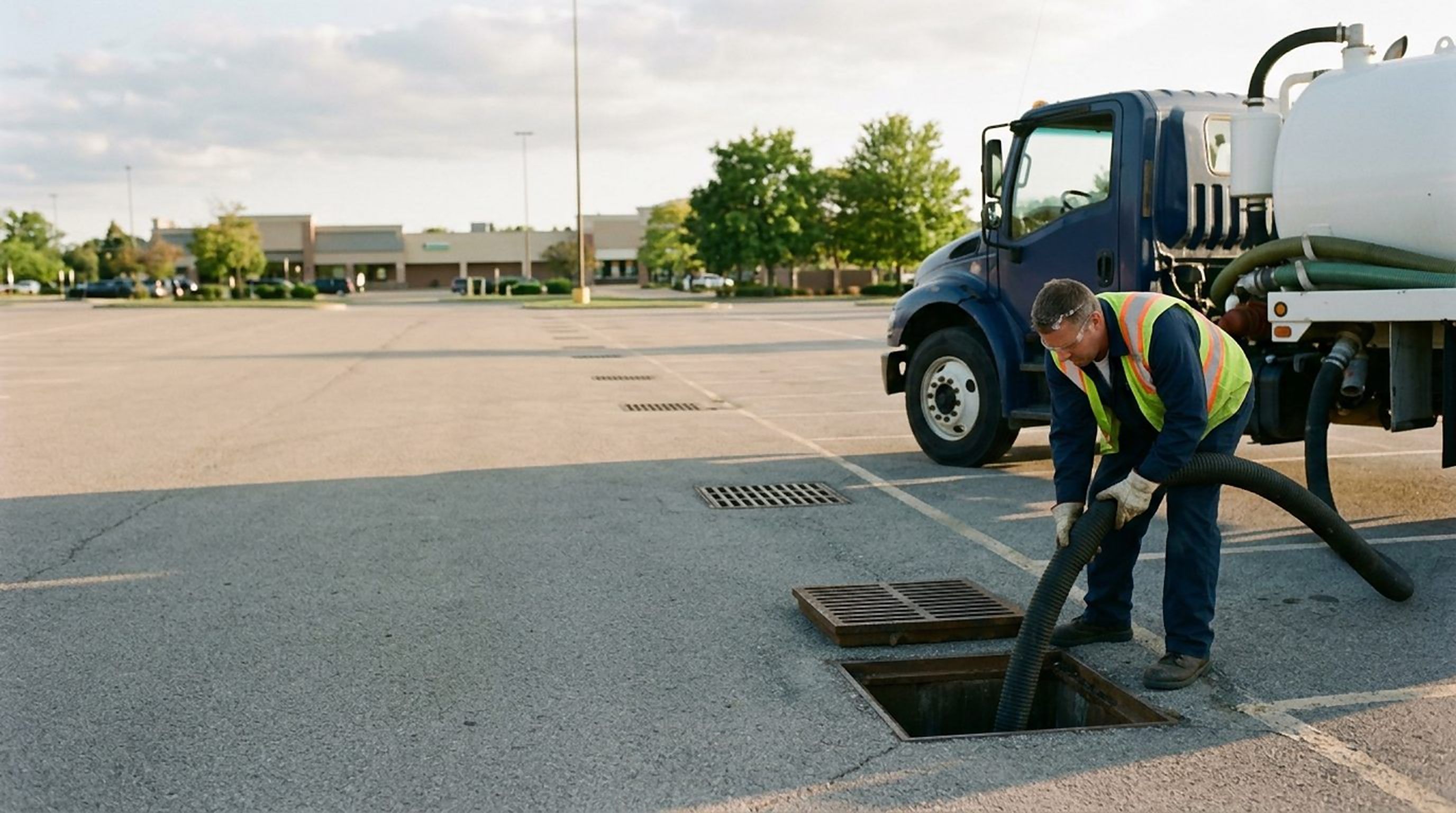












A retail center has twenty. An industrial yard has fifty. Most sites don’t know exactly how many they have, where they all are or which ones are already full.
Liquid Environmental Solutions (LES) offers scheduled basin cleaning, inspections and managed repairs. We serve commercial and industrial sites. We work basin by basin, across every site you own.
We vacuum clean the sump and record what we find. We flag failing basins and manage the repair when one needs it. You get a maintenance record for every basin on the property.
The Cheapest Thing on Site to Maintain, and the Most Expensive to Ignore
A basin is a sump. It fills with sediment, leaves, litter and road grit until it’s full. Then it stops holding anything back.
What happens next is hard to miss. Water sheets across the lot instead of draining. A loading dock floods. Sediment that should have stayed in the basin flows into the storm sewer. In an area with an MS4 program, that can become a discharge violation.
Meanwhile, the basin itself is breaking down out of sight. Walls crack. The bottom wears away. The outlet pipe pulls loose at the joint. The frame sinks under traffic until the grate no longer sits flat.
On a commercial lot, a cracked or sunken grate is a safety risk long before it’s a drainage problem.
LES does more than vacuum clean the sump. Every scheduled service is a recorded inspection of the basin. When something needs fixing, we manage the repair. We don’t hand you a list of contractors to call.


- facilities
- 90+
- trucks and tankers
- 1,000+
- customer locations
- 129,500+
- on-time service
- 95%
- regulations tracked
- 6,000+
- Compliance™ Guarantee
- TripleLock
- gallons of water recovered annually
- 525M+
- coverage
- Nationwide
Built for Sites With More Basins Than Anyone Has Counted
Basins aren’t serviced one at a time. They’re serviced as a site. So the first useful thing a provider can give you is a list of every basin.
LES maps the basins on your property and records the condition and sediment level of each. Then we build a service plan around the ones that fill fastest, instead of treating them all the same.
The basin under the trees by the dumpster fills three times faster than the one in the middle of the lot. If you service both once a year, one is overdue and the other is a wasted stop.
Plan around the seasons: fall leaves and the spring thaw are when most basins go from fine to blocked. Service before those, not after.
More Than a Vacuum Service Stop.Documented Basin Management.
Removing the sediment is the easy part. The program pays for itself by knowing which of your forty basins is about to fail and fixing it before it does.
01Locate
Map every basin on the site, including ones missing from the as-built drawings. Build a list you can really work from.
02Inspect
Measure sediment depth against sump capacity. Check the frame, grate, walls, bottom, and inlet and outlet pipes for damage or shifting.
03Vacuum
Remove built-up sediment, grit, leaves, litter and debris from the sump with vacuum equipment.
04Flag
Record the condition with photos and alert the right person about cracked walls, sunken frames, damaged grates or loose pipes.
05Repair
When repair work is needed, LES scopes it, quotes it and manages screened, licensed contractors until it’s done.
06Document
Give you a record for each basin: sediment readings, condition, photos, disposal records and the maintenance log your local area expects.
One visit. Every basin counted, the failing ones found and a record you can hand to anyone who asks.
Cleaning Is Ours.Structural Work Is Managed.
LES cleans and inspects basins with its own crews, in its own trucks, on a schedule we keep.
Rebuilds, frame and grate replacement, structural repair and new installs are done by licensed contractors we have screened and hired. We tell you plainly, because you deserve to know who is coming on site.
What does not change: LES plans the work, sets the standard, manages the job, keeps the records and answers for the result.
Most sites live with a vacuum contractor who cleans the basin, tells you the frame is cracked and leaves you to find someone else. With LES, it’s one phone number, one invoice and one company responsible, no matter who turns the wrench.
Compliance, and the Records That Prove It
Under MS4 stormwater programs, commercial property owners must usually maintain their drainage structures and be able to prove it.
Rules vary by city, county and state. A multi-site portfolio often spans several at once.
LES tracks the rules that apply to you through FOGLaw®. Our platform covers more than 6,000 federal, state and local regulations. We produce records in the form each local area expects.
TripleLock Compliance™ Guarantee
We Track the Rules
FOGLaw® tracks the rules for each of your addresses, so your service program stays current as they change.
We Do the Service Right
Full sump cleanout, a recorded inspection of every basin we service and a record of exactly what was done at each one.
If We Cause the Problem, We Own It
If an LES service error causes a qualifying compliance issue, LES stands behind its work, including eligible fines and corrective emergency service as defined by the guarantee.
The result: a maintenance file that’s complete before anyone asks. And one partner responsible for the quality of the program.
Lower Total Cost Starts With Knowing Which Basin Is Failing
The cheapest basin service empties the sump and notices nothing else.
Basins fail slowly, then all at once. A hairline crack becomes a hole behind the wall. The asphalt around it loses support. What could have been a small repair becomes a lot closure, a dig and a repaving job.
Every LES service is also a recorded inspection.
So the problem shows up as a photo and a quote, not as a sinkhole in a parking space.
That helps you:
-
Spot structural failure while it’s still a repair
-
Prevent lot flooding that closes loading docks and parking areas
-
Remove the trip and vehicle-damage risk of a cracked or sunken grate
-
Avoid discharge violations under your local stormwater program
-
Keep a complete maintenance record across every basin and every site
-
Replace several local vacuum truck vendors with one responsible program
Why Property and Facility Teams Choose LES
Basin-Level Inventory
Every basin mapped, measured and tracked, not one lump-sum site visit.
Structural Issues Found Early
Cracked walls, sunken frames and loose pipes show up as repairs, not lot closures.
Repairs Managed, Not Referred
LES scopes, quotes and manages the repair work through screened contractors.
Compliance Records
Sediment readings, photos and the maintenance record your local area requires.
One National Partner
The same service and reports at every property you manage.
Basin Cleaning Near You
LES runs 90+ facilities and 1,000+ trucks and tankers nationwide. Find service and local rules for your area:
- Atlanta, Georgia
- Austin, Texas
- Birmingham, Alabama
- Charlotte, North Carolina
- Chicago, Illinois
- Cincinnati, Ohio
- Cleveland, Ohio
- Columbus, Ohio
- Dallas, Texas
- Denver, Colorado
- Detroit, Michigan
- Fayetteville, North Carolina
- Houston, Texas
- Jacksonville, Florida
- Kansas City, Kansas
- Knoxville, Tennessee
- Little Rock, Arkansas
- Miami, Florida
- Milwaukee, Wisconsin
- Mobile, Alabama
- Nashville, Tennessee
- New Orleans, Louisiana
- Oklahoma City, Oklahoma
- Orlando, Florida
- Phoenix, Arizona
- Port Charlotte, Florida
- Portland, Oregon
- Rio Grande Valley, Texas
- Riverside / Inland Empire, California
- San Antonio, Texas
- San Diego, California
- San Francisco Bay Area, California
- Shreveport, Louisiana
- St. Louis, Missouri
- Tacoma, Washington
- Tampa, Florida
- Winston-Salem, North Carolina
Find Out How Many Basins You Actually Have
Most sites work from as-built drawings that are twenty years old. Their maintenance history lives in someone’s memory.
LES can map the basins on your property and measure buildup against sump capacity. We record each basin’s condition. Then we build a service schedule that keeps each one working and each file complete.