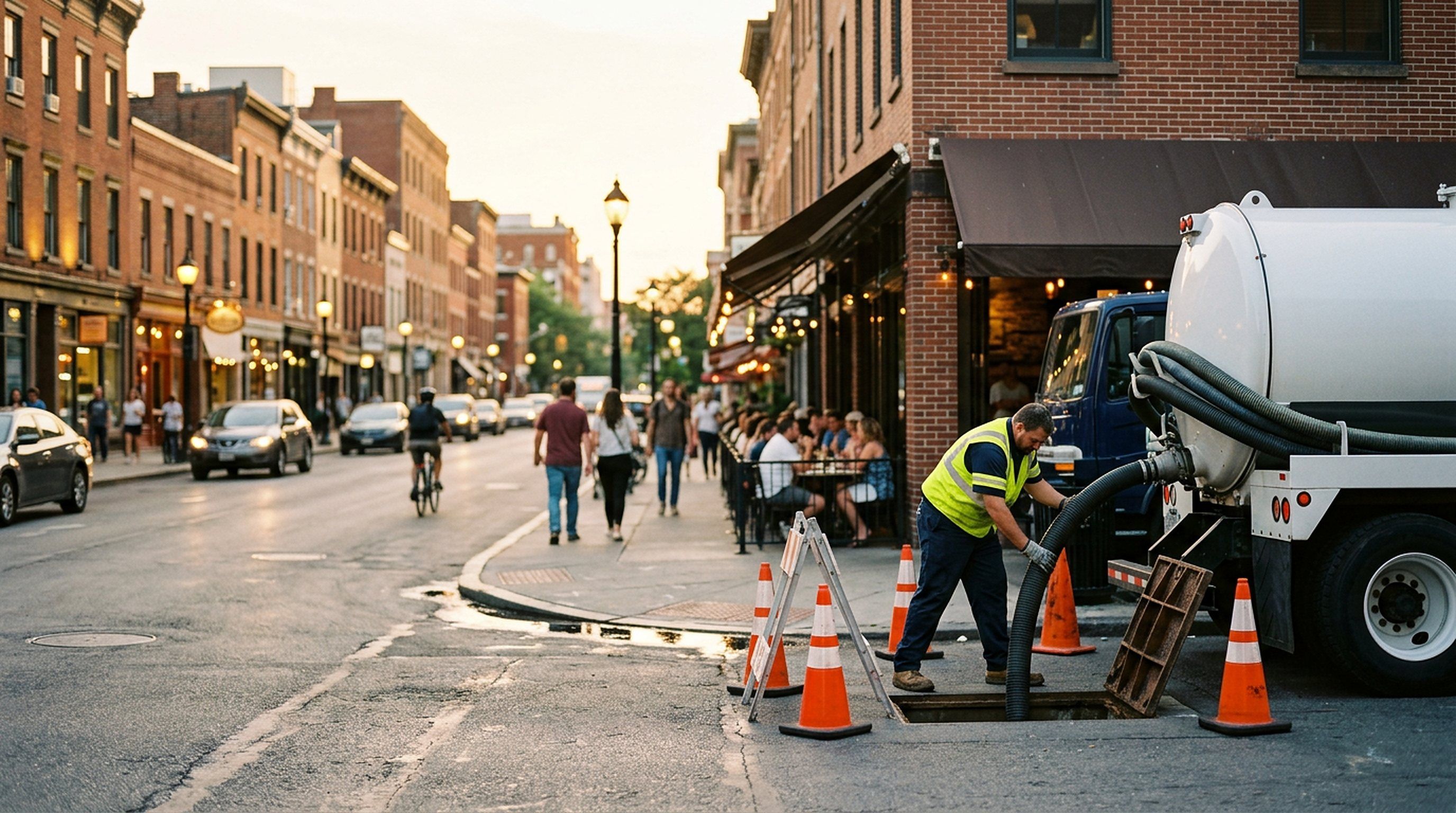
Grease Trap Cleaning and Liquid Waste Services in Atlanta
LES trucks and technicians across metro Atlanta — backed by a national network and one standard you can hold us to.
Local
Corn Road facility & fleet
90+
facilities nationwide
1,000+
trucks & tankers
94%
of what we collect is recycled
-
Is your grease trap overdue?
-
Is your fryer oil bin full?
-
Did a line back up during a busy shift?
You need a company that shows up on time and records the work — not a middleman who hands your call to someone else.
We clean it, we haul it, we record it — across the metro, to one standard.
One Partner for the Whole Life of Your Grease Trap, Interceptor or Separator
Most companies do only one part of this.
A hauler pumps it. A plumber fixes it. A recycler takes the oil. That means four bills, four phone numbers and no one in charge of the trap itself. You find this out when a trap fails in the middle of a busy shift.
LES covers every step — from putting the tank in the ground to recycling what comes out of it.
- LES team members
- Licensed specialists, managed by LES
- 01
Install (licensed specialist, managed by LES)
Sizing, planning, permits and installation for grease traps, interceptors, oil water separators and used cooking oil containers
- 02
Service to code
Full pump-out and cleaning on the schedule your local rules require — tracked for each address in FOGLaw®
- 03
Inspect & maintain
Every scheduled visit includes an inspection on record. We track the condition over time, not just once
- 04
Recycle & record
What we collect is processed through the LES recycling network. 94% is recycled, and every gallon is on record
- 05
Repair
Baffles, lids, chambers, inlets, outlets, sensors and alarms — fixed before a failure shuts you down
- 06
Line work & plumbing
Line jetting, drain cleaning and commercial plumbing beyond everyday drain work
- 07
Upgrade or replace (licensed specialist, managed by LES)
Resizing and replacement when your business outgrows the unit it has
LES technicians do our core services in LES trucks. These include grease trap cleaning, used cooking oil pickup, oil-water separator and grit trap service, inspection and recycling.
Repairs, installation and licensed plumbing are done by screened, licensed plumbers. LES manages their work to make sure it is done well and on time. We tell you this up front because you deserve to know who is coming.
What does not change: LES plans the work, sets the standard, manages the job, keeps the records and answers for the result.
One phone number. One bill. One company responsible — no matter who does the work.
Get a QuoteLES Trucks and Technicians Across Metro Atlanta
What we collect here is processed at an LES-owned facility, not brokered to a third party.
- Phone
- 866.694.7327
- Role
- Service branch. Scheduled and emergency service.
Waste we handle:
- Grease
- Used cooking oil
- Oily water
- Grit
- Non-hazardous industrial wastewater
One Restaurant or One Hundred, You Get the Same Standard. Only the Schedule Changes.
- Restaurants & Breweries Grease trap cleaning, fryer oil pickup and drain lines — for one of the busiest dining and craft-brewing scenes in the Southeast.
- Airport & Convention Food Stands Hartsfield-Jackson and the convention district produce huge amounts of FOG (fats, oils and grease). Service windows are tight and security-controlled.
- Grocery, Convenience & Delis Deli, bakery and hot-food fryers. These often run on separate systems with separate schedules.
- Hotels, Stadiums & Venues Banquet kitchens and concession stands that get slammed around events and cannot close for service.
- Healthcare & Education Campus dining and 24-hour kitchens. Access rules are strict, and a missed visit is not an option.
- Food & Beverage Manufacturing Wastewater from production, oil-water separation and pumping of non-hazardous industrial waste.
- Automotive Services Oil water separators, grit traps and wash bay drains for repair shops, quick lubes and car washes. Serviced before solids reach the sewer.
- Fleet Wash racks, separators and waste fluid pickup for fleet yards and maintenance depots. Scheduled around your routes, not ours.
Serving Atlanta, Sandy Springs, Roswell, Alpharetta, Marietta, Smyrna, Decatur, Duluth, Lawrenceville, Kennesaw, Johns Creek, East Point and surrounding communities.
Metro Atlanta’s FOG Rules Are Not One Rulebook. They’re Several.
- 01
Inside the City of Atlanta, the FOG Management Division sets your schedule.
Indoor grease traps must be cleaned every 14 days. Outdoor interceptors every 90 days, or sooner when grease and solids reach 25% of capacity.
- 02
Outside city limits, the rules change at the county line.
Fulton, Cobb, DeKalb and Gwinnett each run their own FOG program. A restaurant group with sites in the city and two counties can face three sets of rules, three inspection cycles and three sets of paperwork.
- 03
FOGLaw® is the LES database of rules.
It tracks more than 6,000 regulations and finds the one that applies to your address. LES sets your service schedule to meet it. Every visit gives you the manifest and service record an inspector will ask for.
We’re Hiring in Atlanta
LES runs its own trucks here, so we hire our own people here. We hire CDL drivers, service techs and dispatchers based in metro Atlanta.
- Paid training and CDL support — no license yet? We will help you get one
- We promote from within — many of our supervisors and facility managers started on a truck
- Benefits from day one — medical, dental, vision, 401(k) match and paid time off
- Safety comes first — everyone goes home safe, every shift, every route
Built a Liquid Waste Business in Georgia? Let’s Talk.
LES has grown across the country by buying strong local companies. These companies have loyal customers, good people and ways of working worth keeping. More than 20 have joined us.
Do you own a grease trap, used cooking oil or liquid waste business with service routes in metro Atlanta or across Georgia? If you are planning to retire or hand off the business, and you want your team to land well, we would like to hear how you built it. All talks are private, and there is no obligation.
Start a ConversationNeed Service in Atlanta?
Tell us what you have and where you are. We will give you a quote and get you on the schedule.
Call 866.694.7327Frequently Asked Questions
How often does a grease trap need to be cleaned in Atlanta?
How much does grease trap cleaning cost in Atlanta?
Do you serve the whole metro — city and counties?
Where does my grease actually go?
Do you handle repairs and line work, or only cleaning?
Do you pay for used cooking oil?
Can you come out for an emergency?
Are you licensed and insured in Georgia?
Can you service more than one of my locations?
Find LES near you
- Atlanta, Georgia
- Austin, Texas
- Birmingham, Alabama
- Charlotte, North Carolina
- Chicago, Illinois
- Cincinnati, Ohio
- Cleveland, Ohio
- Columbus, Ohio
- Dallas, Texas
- Denver, Colorado
- Detroit, Michigan
- Fayetteville, North Carolina
- Houston, Texas
- Jacksonville, Florida
- Kansas City, Kansas
- Knoxville, Tennessee
- Little Rock, Arkansas
- Miami, Florida
- Milwaukee, Wisconsin
- Mobile, Alabama
- Nashville, Tennessee
- New Orleans, Louisiana
- Oklahoma City, Oklahoma
- Orlando, Florida
- Phoenix, Arizona
- Port Charlotte, Florida
- Portland, Oregon
- Rio Grande Valley, Texas
- Riverside / Inland Empire, California
- San Antonio, Texas
- San Diego, California
- San Francisco Bay Area, California
- Shreveport, Louisiana
- St. Louis, Missouri
- Tacoma, Washington
- Tampa, Florida
- Winston-Salem, North Carolina