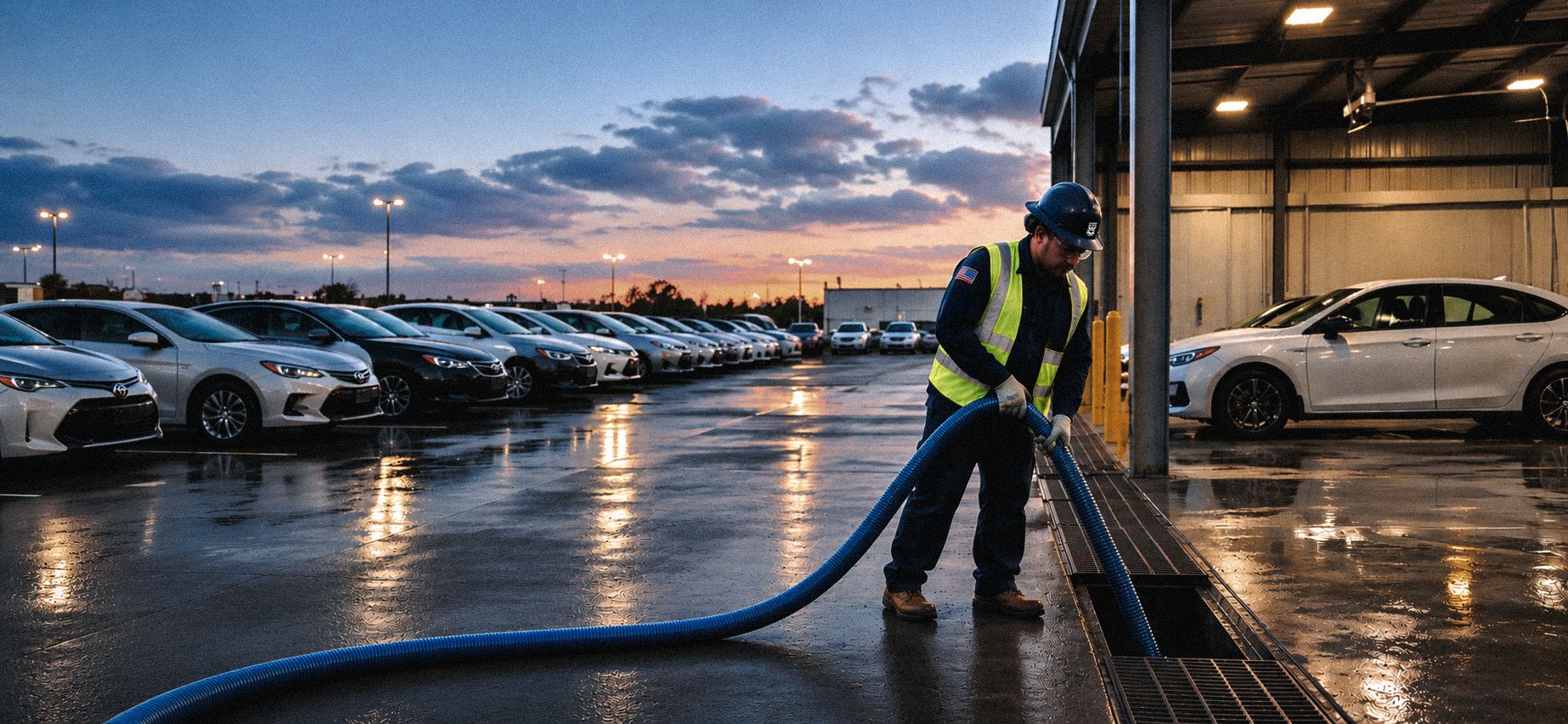
A Car That Isn’t Washed Isn’t Rentable.
Wash bay drains, reclaim tanks, grit traps and shop drains — serviced around your return peaks. The line keeps moving when the whole fleet comes back at once.






At a rental return site, the wash line is not a facilities job. It is the last step between a returned car and a rentable one. Everything before it is waiting.
When a trench backs up or a reclaim system stops working, cars pile up. They pile up on a Sunday afternoon when the whole fleet comes back at once, or on the Friday the fleet was sized for.
Unwashed cars on a lot are cars not on rent. That makes wash line downtime a lost-rental problem long before it is a maintenance one.


- customer locations served
- 129,500+
- facilities nationwide
- 90+
- trucks and tankers
- 1,000+
- in liquid waste
- 24+ years
- on-time service
- 95%
- of material recycled
- 94%
- 7,651,624 on-site treatment
- US Patent
- airport and city coverage
- Nationwide
Three Operations on One Site
A rental return site is not a wash site with extras. It is three separate operations sharing one footprint. Most companies manage them through separate vendors — or, for the yard, through nobody at all.
Serviced Around the Return Peak, Not Around Our Route
Rental demand is uneven, and so are returns. Sunday and Monday mornings, Friday afternoons, holiday weekends and the end of a convention all bring the fleet back at once. The wash line has to absorb it.
We set service schedules from the size of each interceptor and how fast the site really fills it. LES runs both daytime and overnight routes, so the work lands in the quieter part of your cycle, not the peak. Large sites get the crew they need: a high-bay return can take two trucks and four technicians across two days.
Schedules set by actual load
How often we come is based on interceptor size and the measured waste at each site, not a network default.
Day and night routes
LES runs both, so service can land in the quieter part of your return cycle.
Trained on wash equipment
Technicians shut down and restart wash systems correctly, so reclaim tanks refill before the line starts again.
Staffed for the size of the job
A high-bay site is a multi-truck, multi-day job — often two trucks and four technicians over two days. One truck on a sixty-bay site gives a partial result and a quick repeat visit.
Site ready before the peak
Grates secured and the area ready to use before the return window, not during it.
Airport Facilities Have an Extra Layer
Rental sites on airport property answer to more parties than a city branch. There is the local pretreatment authority and the stormwater program. Then there is the airport authority, with its own access, badge and escort rules, and environmental terms written into the concession agreement.
At consolidated rental car facilities, several brands often share one building and sometimes one drainage system. Who is responsible for the separator? Who answers if the site goes over a discharge limit? It could be the rental company, the facility manager or the airport authority. Settle who owns it before there is a problem, not during one.
What LES handles
Badged and escorted access where required, and service scheduled within airport operating rules. Records are formatted for both the city and the airport authority.
What we will confirm for you
Which assets serve your operation at a shared site, so your compliance record covers what you are really responsible for.
For High-Bay Facilities: On-Site Treatment
At a sixty-bay return site, the amount of water being moved is the problem. LES holds a patented process — US patent 7,651,624. It separates oil, water and sludge inside the truck during the visit and returns the water to your system. Only the oil and sludge are hauled away.
Across thousands of visits at similar high-volume car washes, LES onsite recycling trucks processed 85% of the waste on site and returned clean water. Only a small amount of solids had to be shipped off for processing.
Why it matters here
Rental returns are the largest wash operations LES services. Less time filling and emptying trucks means more of the service window spent working. It also means a measurable drop in water drawn and hauled at each site.
Availability
Parr-equipped trucks are specialized and limited in number. Returning treated water needs local approval, which is not in place everywhere. So on-site treatment is offered only at select sites. Standard service is available everywhere LES operates.
One Program Across Airports and City Branches
A rental network is not all the same. A major airport return and a downtown branch with two bays need different schedules, crew sizes and timing. But they should sit on one contract, one standard and one reporting system.
Airport and consolidated facilities
- High bay counts, multi-truck service, overnight windows and airport authority records
- Service schedules set from measured volume at each site
- Full portfolio reporting for facilities and environmental teams
- New facilities added to the program at opening
City, neighborhood and franchise branches
- Smaller wash and service setups, scheduled around local business patterns
- Schedules set from actual use, not a chain-wide default
- Same record standard, same portal, whoever runs the site
- Franchise and licensee sites served on the same terms where the agreement allows
Compliance and Documentation
Rental sites answer to several authorities. The local pretreatment authority is one. The city stormwater program is another, where the site has a lot of paved area. State environmental agencies cover fuel-related assets. On airport property, the airport authority does too.
A manifest copy is left on site at every visit. Final manifests, with disposal details, are kept in an online portal for five years. Your team can access them there. Every visit also produces an inspection record covering separator condition, T-pipes, baffles and lids.
Where an LES error results in an emergency service or a Notice of Violation, LES covers the associated cost in accordance with the TripleLock Compliance™ Guarantee. The guarantee applies where LES is the cause.
What We Do Not Handle
Stated plainly, because people often make assumptions about what we cover at fleet sites.
LES handles
- Wash bay trench, pit and reclaim tank cleaning
- Oil-water separator cleaning, with the recovered wastewater recycled
- Separator repair, replacement, installation and upgrade
- Maintenance shop trench and bay drains
- Grit traps, catch basins and lot drainage
LES does not
- Used motor oil and oil filters — classed as hazardous
- Coolant and antifreeze
- Fuel islands, underground storage tanks and fuel systems
- Vehicle maintenance or detailing
- Solid waste and refuse hauling
- Wash equipment repair or reclaim system supply
Keep the wash line moving. Keep the fleet earning.
Wash bays, shop drains, grit traps and lot drainage — serviced around your return peaks, with records for every authority that asks.