












Skip to content

Get a Service Quote Now!

Get a Service Quote Now!

Fast response · No obligation

Step 1 of 2

Your contact info

Next: the service, address and details. Under a minute.

Call
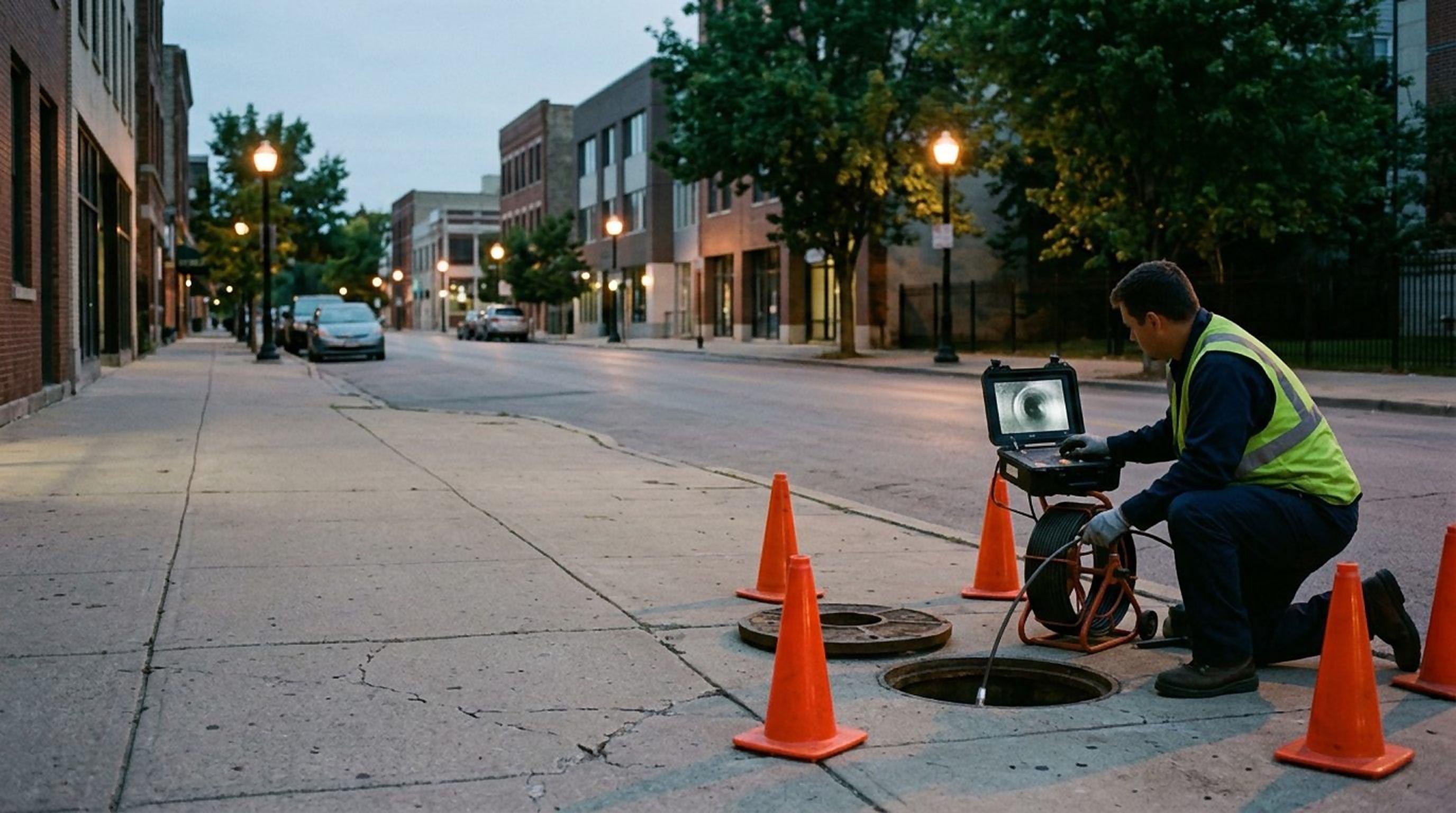
An LES technician feeding a sewer inspection camera into a cleanout on a city sidewalk at dusk, watching the monitor

Clearing the Same Line Every Quarter Isn't a Fix. It's a Subscription.We Show You What's Causing It.

HD camera inspection that finds the defect and marks its exact spot and depth from above ground. You get video you can act on, or use to hold someone else responsible.

A line that clogs once has a clog. A line that clogs every quarter has a defect. No amount of clearing will change that.

This matters because you’re paying for one and getting the other. Each visit gets water flowing, but nobody looks at why. The time between callouts becomes the running cost of a problem you could have fixed once.

A camera ends that cycle in about twenty minutes.

LES utilizes video pipe inspection equipment to evaluate the interior condition of commercial drain and sewer lines. These inspections can help identify obstructions, structural deficiencies, and other conditions contributing to recurring drainage problems, allowing customers to make informed maintenance and repair decisions.

customer locations served
129,500+
facilities nationwide
90+
trucks and tankers
1,000+
in liquid waste
24+ years

A Camera in a Dirty Line Shows You Nothing.We Jet First, Then Look.

This is the most common way money gets wasted on this service, so we’ll say it first.

Camera through a dirty line


If a line is packed with sludge, coated in grease or full of standing water, the lens gets dirty within a few feet. The technician sees brown. The report says inconclusive. You pay for the visit and learn nothing.

Before you say yes

If a provider offers to run a camera through a badly blocked line without cleaning it first, ask what they expect to see. A quick look before clearing can help in some cases, like confirming a full blockage or checking for a collapse before running a cable. But a full diagnostic survey through a dirty line isn’t one of them.

Jet first, then look


LES jets the line first and inspects it clean. That costs more on the day and less over the whole job. An inconclusive inspection isn’t a cheaper inspection. It’s a wasted one, and the problem is still there.

Digging to Find the Problem Costs More Than the Repair.We Mark the Exact Spot From Above Ground.

The camera head carries a transmitter. At the surface, a locator wand picks up its signal and shows exactly where the camera is and how deep. So a defect thirty feet under a slab becomes a marked spot on the floor, not a search area.

What we mark
We flag the exact spot on your pavement or slab with color-coded paint or flags. We also note the footage marker in the video log, so the defect can be found again.
Why it saves money
Digging is priced by how much you open up, and patching it back usually costs more than the repair. Knowing the exact spot turns a trench into a small square cut.
Slope and bellies
On main lines, a camera with a digital inclinometer (a slope sensor) records the pipe’s real slope. That finds sags where water and debris pool. A belly doesn’t look like damage on video. It shows up as clogs that keep coming back.
What you receive
An HD video file and a written log of each problem by footage marker. A contractor who wasn’t on site can still use the record.

Three Problems That Kept Recurring.The Camera Ended All Three.

  • A dropped PVC joint under a grocery freezer aisle

    Freezer condensation drains backed up again and again. Snaking cleared the line for about a week each time before the problem returned. The camera found a cracked PVC joint that had dropped as the ground shifted under the slab. It left a sharp ledge that caught food debris and ice. Because we marked the exact spot and depth, the fix was one 2x2 foot cut in the floor and an overnight joint replacement. No trenching the aisle and closing it for days.

  • Channel rot under a 1970s kitchen

    Every floor sink drained slowly, even with regular enzyme treatment. Nothing was blocked. Everything was just wrong. The camera showed the bottom half of the old cast-iron main had rusted away, leaving an open trench. Wastewater was soaking into the soil under the foundation instead of reaching the grease trap. Finding it early meant trenchless lining could be done during a planned holiday closure. That avoided a slab collapse and a health department closure on the department’s schedule.

  • Construction debris in a three-week-old store

    A brand-new convenience store had a major backup weeks after opening. The contractor claimed staff had flushed something they shouldn’t have. An independent camera survey went 45 feet down the main. It hit a solid wall of hardened grout, concrete wash and a plastic bottle. All of it had been swept into an open cleanout during finishing work. The time-stamped video moved the full cost of repair and digging onto the contractor’s insurance.

When the Damage Isn't Yours, You Need Proof.Time-Stamped Video Is Proof.

Most business owners have never thought about the third case. It’s worth thinking about before you need it, not after.

On a new build, a remodel, a tenant fit-out or any job where trades could reach open drains, a camera survey at handover is cheap. It records the condition of the line on a set date, on video, before anyone uses it.

  • At handover on new construction

    It proves the line was clear when you took it over. Without it, a backup three weeks later is an argument you’ll likely lose.

  • After a remodel or fit-out

    Trades sweep debris into open cleanouts. It’s common, it’s rarely on purpose, and it hardens solid. A survey when the job is done catches it while the responsible party is still on site.

  • Before taking on a lease or a site

    You can’t see the drains under a slab, and they’re costly to fix. A survey before you move in is the only way to know what you’re taking on.

  • When a dispute is already live

    An independent, time-stamped survey with footage markers and located depths gives you much stronger evidence than a plumber’s verbal account of what they saw.

One Inspection Is a Snapshot.A Registry Shows You What's Getting Worse.

A single survey tells you the state of the line today. Kept over years, the same footage becomes more useful: a record of change.

Roots grow in. Cracks spread. Rust spreads. Comparing this year’s footage with footage from three years ago shows which defects are stable and which are heading toward failure. Then you can plan the repair instead of reacting to it.

Our advice for multi-site companies: save every inspection file and its written log, sorted by site and line. It costs nothing and takes minutes. The first time a line fails where you have past footage, it will pay for the whole habit.

You’ll Need Another Provider for Some of This.Here’s What.

LES handles

  • HD video inspection of commercial drain and sewer lines
  • Locating and marking defect position and depth
  • Slope and belly identification
  • Jetting before inspection so the survey is usable
  • Video file and written pipe condition log
  • Post-construction and handover surveys

LES does not

  • Pipe repair, replacement or re-lining
  • Trenchless CIPP installation
  • Residential inspections
  • Utility locating as a standalone service
  • Structural or civil engineering reviews
  • Expert witness or formal legal testimony

Stop guessing. Look.

Jetted clean, filmed in HD, located from above ground and recorded in a file you can hand to whoever needs to act on it.

Book a camera inspection

Step 1 of 2

Your contact info

Next: the service, address and details. Under a minute.

Frequently Asked Questions

What is a video pipe inspection?

It’s a survey that uses an HD waterproof camera on a flexible push cable or a remote-control crawler. The camera goes in through a cleanout, drain line or catch basin. It sends live video of the inside of the pipe to the technician’s screen. Advanced camera heads carry a transmitter. A locator wand at the surface finds the camera’s exact spot and depth. So a defect under a slab can be marked on the floor above it. It’s also called CCTV inspection or sewer camera inspection.

Why does my line need cleaning before the camera goes in?

Because a dirty lens shows nothing. If the line is packed with sludge, coated in grease or full of standing water, the camera goes blind within a few feet. The survey comes back inconclusive. Jetting first costs more on the day and less over the job. An inconclusive inspection isn’t cheaper. It’s wasted, and the real problem is still unknown.

What can a camera actually find?

Cracks and dropped joints that create offsets. Sags, or bellies, where water pools. Roots, rust and channel rot in cast iron. Partial or full collapse. Foreign objects, including construction debris. It can also confirm the opposite: the line is sound, and the problem is buildup. That calls for a cleaning schedule, not a repair.

What is a pipe belly?

A sag in the line where the pipe has lost its slope, often from ground movement or poor bedding. Water and solids pool in the low spot instead of flowing through. So that section clogs again and again, no matter how often it’s cleared. A belly doesn’t look like damage on video alone. To find one reliably, you need a camera with a digital inclinometer that records the pipe’s real slope.

Can you tell exactly where the problem is?

Yes. The camera head sends a signal, and a locator wand at the surface picks up its position and depth. We mark the spot on your pavement or floor and note the footage marker in the log. That turns a repair from a search trench into a targeted cut. And digging and patching usually cost more than the repair itself.

What do we receive afterward?

The video file and a written log of each problem by footage marker, so a contractor who wasn’t on site can use it. We recommend saving both by site and line. Comparing footage over the years is how you tell a stable defect from one that’s getting worse.

Can the video be used to prove a contractor caused the damage?

It often is. A dated, recorded survey showing construction debris or damage in a new or recently worked-on line is much stronger than a verbal account. LES supplies the survey, the log and the located positions. We don’t give legal opinions or act as an expert witness. But these records are what those talks are usually built on.

Should we inspect a line before taking on a new site?

Yes, it’s worth it. Drains under a slab can’t be seen and are costly to fix. A walkthrough won’t show their condition. A survey before you move in tells you what you’re taking on. A survey at handover on new construction proves the line was clear on a set date. That’s very hard to prove later.