

Renewable fuels
- Biodiesel
- Renewable diesel (HVO)
- Sustainable aviation fuel
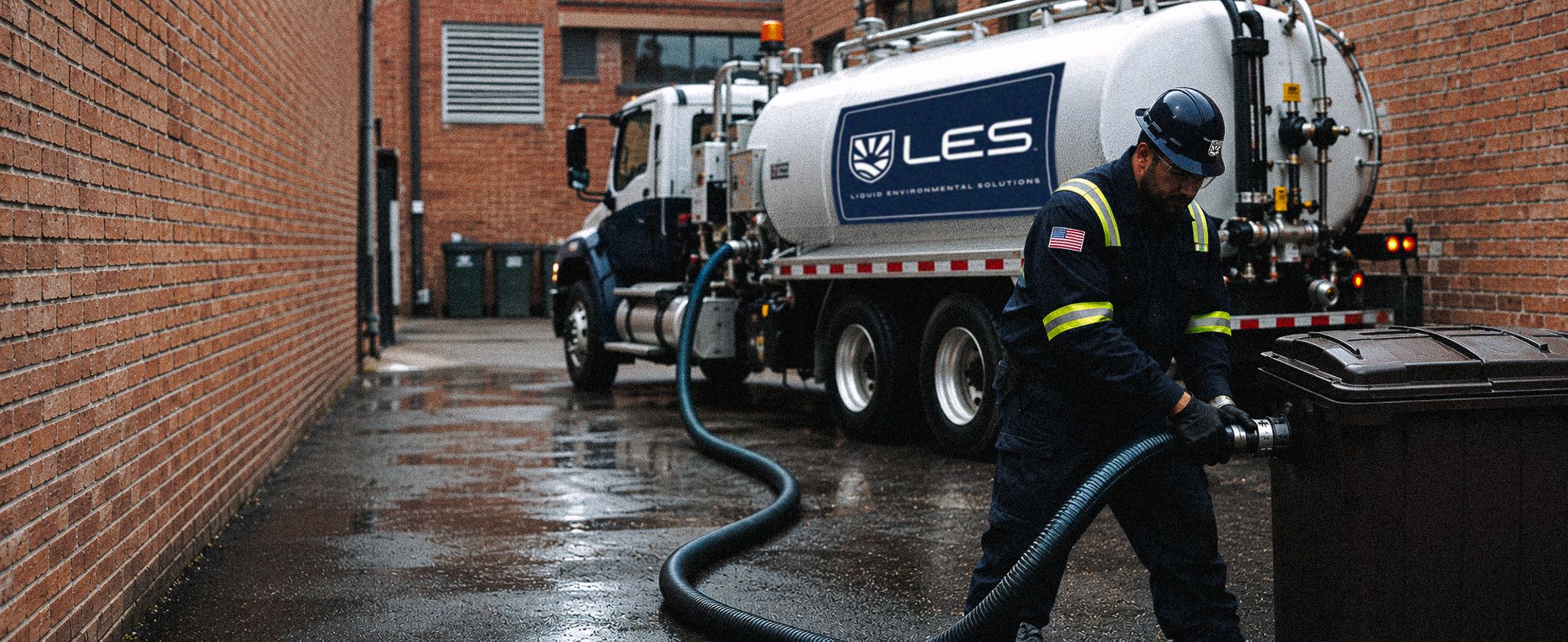
Sensor-monitored bins that never overflow. Rebates tied to the Jacobsen index. And records that show where every gallon went.










Your fryers make something people trade. Yellow grease has a daily published price. Yet most kitchens hand it over without checking what it was worth.
LES collects when the bin says it's full. We price your oil against public market data and recycle it through our own network.
The same partner also services your grease traps, cleans your hoods, jets your drain lines and repairs your plumbing. One company for every way grease leaves a kitchen.
Used cooking oil is traded as yellow grease, and its price changes daily. That price is published on the Jacobsen index.
It depends on the market and what it costs to serve your location. Collection may earn you a rebate, be free or carry a fee.
Four things set the price:
You control three of those four.
Pick the right container size so pickups are full. Keep water, food scraps and cleaning chemicals out of the bin. Put multiple locations on one program so the route has more stops.
LES will tell you which one is costing you the most.
A rate that ignores the market has to build in extra margin in case yellow grease prices drop. The customer pays for that margin.
When we price against a public index, you can look up the same market data LES uses.
Used cooking oil collection, grease trap service, hood cleaning, line jetting and plumbing use different trucks and different technicians. Bundling doesn't change that, and LES won't pretend it does.
What it does change is the value of your account. You get one contract, one setup and one relationship. And your site is worth more to serve.
LES passes that back to you as a better rebate on your oil or a discount on your services. The more of the kitchen LES manages, the better your terms on all of it.
There's a second benefit, and it shows up in the bin. Oil poured down a drain is oil you don't get paid for. It's also oil your grease trap then has to catch.
A route is set when the account opens and often doesn't change. So bins get emptied half full or overflow between visits.
LES puts level sensors on the containers we supply, and we plan routes around what's really happening in your kitchen.
You aren't calling because it overflowed. LES arrives before it does.
Containers, indoor and outdoor
LES supplies the container as part of the service. Each one is sized to your output, heat-resistant, leakproof and lockable. Locks matter more than most people expect. Outdoor bins are a target for theft, and an open lid draws pests within days. A container too small for its pickup schedule will overflow no matter how reliable the pickups are. The goal is to match the two.
No spills, no odour complaints, no pests around the tank
A half-empty bin does not trigger a truck, and that protects your rate
Volume changes show up in the data instead of on the floor
Fill levels across the portfolio in one view, not forty phone calls
Sustained fill data shows when a location has outgrown its bin
It goes out of the fryers as used cooking oil. It goes down the drains into the grease trap. And it goes up through the hood and ductwork.
And when a line cracks, a trap fails, or a fixture backs up, LES plumbers fix it, or LES manages the repairs. There's no fourth vendor to call.
When three vendors share a kitchen, no one owns the result. The hood cleaner rinses into the floor drain. The grease trap fills early. Then the trap company says the schedule was set wrong.
With one partner, there's nothing to argue about — and the bundled terms are better.
Used Cooking Oil Collection and Recycling
Used cooking oil is a raw material, not a waste. Refined the right way, it replaces petroleum.
Most of it becomes renewable fuel.
Biodiesel is made through a chemical process and then blended with regular diesel. Renewable diesel is treated with hydrogen until it's the same as petroleum diesel. That means it can replace it fully, with no blending limit. Renewable diesel and sustainable aviation fuel are worth the most. That's why how clean your oil is affects what you get paid for it.
For more and more businesses, recycling isn't enough. Proving it is what counts.
Sustainability reports, customer surveys, franchise standards and public goals all need proof. They want to see what was collected and where it went.
Where LES processes it, it never passes to a broker; where partners do, LES tracks and documents every gallon. That's why we can track the whole chain from start to finish.
Volumes by location and period — what each site produced, not a portfolio estimate
Chain-of-custody records — collection through processing, with no gap where a third party took over
Reporting for ESG disclosure — evidence you can hand to whoever prepares the report
One format across the portfolio — not a different report from a different vendor in every market
Water, food scraps, trash and cleaning chemicals lower the grade of used cooking oil. Loads with too much of them get rejected.
That costs you money. Dirty oil can't go into the higher-value fuels, and oil quality is one of the four factors that set your rate.
Hot oil causes serious burns and can deform the container
A mesh filter before transfer preserves the grade and the yield
Water, food scraps, trash and cleaning chemicals are the four common rejections
Theft and pests, in that order
Drips become stormwater pollution and a slip hazard, and both are your liability
LES trains your kitchen team on oil handling at setup, because what goes into the bin decides what comes out of it.
Steady weekly output. The usual problem is a container sized for the menu from three years ago.
The most oil per square foot in food service. Small containers overflow between visits.
Output swings a lot around events. A fixed schedule is either wasteful or late, and rarely right.
Nonstop cooking across the main kitchen, cafeteria and staff dining, with strict access rules for pickups.
Steady daily output. Odor and pests around a bin affect residents' well-being, not just housekeeping.
Heavy output during the school year, close to zero over breaks. Pickups have to follow the calendar.
Deli and hot-food fryers run all day, often with no set space for a container.
Several businesses share one pickup point, and no single tenant is in charge of it.
In most places, it's against the law to put used cooking oil in drains or the trash. Many areas also require records that it was handled properly.
Rules vary by city and state. FOGLaw®, the LES rule-tracking platform, watches what applies to each of your locations.
Every pickup creates the records those rules call for.
Searching for used cooking oil collection near me, waste cooking oil collection near me or a grease collection service near me? LES serves 129,500+ customer locations from 90+ facilities nationwide.
LES will review your current volumes, container sizes and pickup schedule. Then we'll quote against the market, not a rate card.
Already paying for grease trap service or hood cleaning? Ask what bundling does to your price.