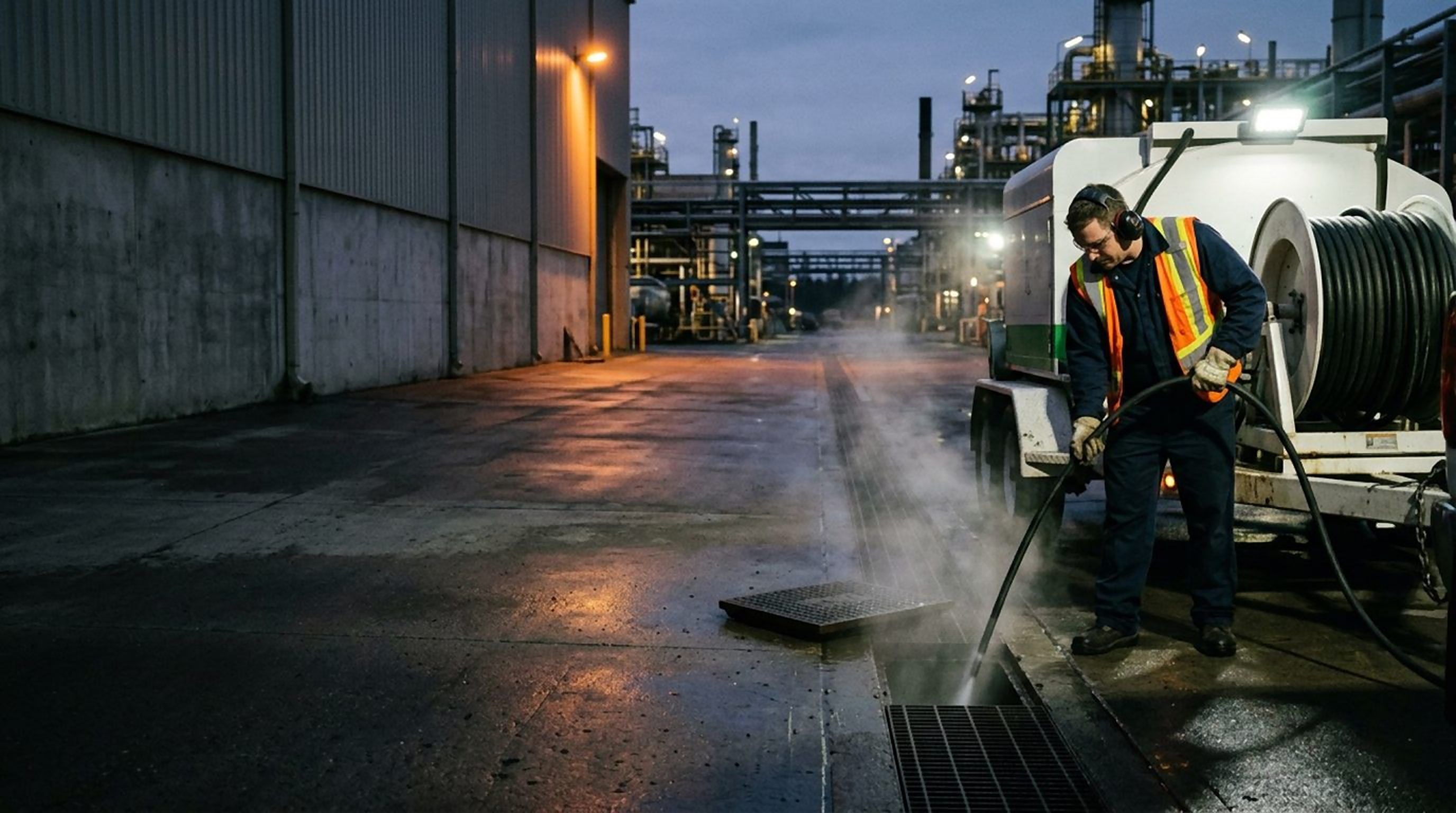
Hydro Jetting That Clears the Line and Hauls Away What Comes Out
High-pressure jetting for kitchen grease lines, wash bays, trench drains, storm drains and industrial sewer lines.



Grease, sludge and sediment build up on pipe walls until the line stops moving. A kitchen floor drain backs up mid-service. A wash bay floods. A trench drain overflows into the shop.
LES brings truck and trailer jet-vac units. They clear the line and vacuum out what comes loose in the same pass. Then we haul it under license, recycle it and record the whole chain.
Most jetting contractors do the first part and flush the rest downstream.
That doesn’t solve the problem. It just moves it.


- facilities nationwide
- 90+
- trucks and tankers
- 1,000+
- coverage
- Nationwide
A Snake Makes a Hole.Jetting Cleans the Pipe.
A mechanical snake or rod punches a channel through a clog. Water flows again, the call is closed, and the grease and sludge on the pipe wall are still there.
That’s why snaked lines back up again, often within weeks.
Hydro jetting scrubs the full inside of the pipe. A spinning high-pressure head strips hardened grease, sludge and sediment off the pipe wall. It moves the waste out of the system, not just past the clog.
Six Steps, Every Job
01Inspect
We run a camera through the line before jetting. It finds the clog, checks pipe condition and rules out a broken pipe that jetting won’t fix.
02Jet
We match the nozzle and pressure to the line, the material and the pipe. Spinning nozzles cut through hardened buildup. Rear-thrust nozzles scrub the wall and drive the hose forward.
03Capture
LES runs jet-vac units, so loosening and vacuuming happen on the same truck in the same pass. Debris goes straight into the tank, not downstream.
04Verify
We run the camera again to confirm the full pipe is clear and record the finished condition.
05Haul
We haul the collected material under license and process it through the LES recovery network.
06Document
You get before-and-after video, service records and chain-of-custody records for the material removed.
Whatever Comes Out of That Line Still Has to Go Somewhere
Jetting doesn’t destroy grease and sludge. It knocks them loose.
A plumbing contractor with a jetter clears your line and pushes the waste downstream. It ends up in your next junction, your separator or the city sewer. It becomes someone’s problem later. Sometimes yours, sometimes the city’s.
LES captures it where we work, hauls it under license and processes it through our own recovery network.
One company jets the line, captures what comes out, and can prove where it went.
What LES Jets
Jetting isn’t just for sewer mains. Most trouble starts closer in, and it looks different depending on what the line carries.
Kitchen and food service lines
- Grease waste lines — fats and oils cool on the pipe wall and harden into a layer no snake will remove
- Lines feeding grease traps and interceptors — a restricted inlet line makes a healthy trap look like a failing one
- Floor drains, pot sink and dish lines — food solids and detergent scale narrowing the line a little at a time
Wash bay and fleet lines
- Wash bay drains and wash rack trenches — mud, sand, soap scum and automotive plastics and metals bind into a scale that cabling will not touch
- Trench drains — long runs that collect sediment across their full length, not at one point
- Fluid drainage systems — oil, coolant and solvent residue coating shop drain lines
- Lines feeding oil water separators — same principle as a grease trap: a blocked inlet reads as separator failure
Site-wide
- Storm drains and basin leads — silt and debris that surface as ponding in the yard or lot
- Industrial sewer laterals — the lines carrying everything above out to the main
The Material You Remove Is Regulated Waste
Grease, sludge and sediment vacuumed out of a line aren’t construction debris. They are non-hazardous liquid waste. Hauling and disposal come with record-keeping rules that vary by local area.
In most markets, flushing that waste into the city sewer is a discharge violation, no matter who pushed it there.
FOGLaw®, the LES regulatory intelligence platform, tracks the rules for each of your locations. Every job produces the records those rules require.
TripleLock Compliance™ Guarantee
We track the rules.
FOGLaw® tracks wastewater rules in every area where you operate.
We do the service right.
Every visit follows a written service process, with records that show exactly what was done.
When LES is the cause, LES owns it.
If an LES service error results in a qualifying compliance issue or emergency service, LES covers the associated cost in accordance with the guarantee.
Scheduled Jetting Costs Less Than the Backup It Prevents
Emergency jetting happens at the worst time: mid-shift, with a bay down and a technician standing idle.
Once you know what a line carries, it builds up at a steady rate. Busy shop drains are often cleared every 6 to 12 months. Busy kitchen grease lines usually need a shorter schedule.
Once LES has jetted a line and seen what came out, the schedule stops being a guess. It becomes a measurement.
Across a facility, that means:
Planned intervals — known lines jetted on a cycle, not on failure
No emergency premiums — scheduled work is priced as scheduled work
Bays stay open — no mid-shift shutdown for a line nobody was watching
Separators work as designed — clear inlet lines mean accurate separator performance
One vendor — jetting, separator service and disposal on one program
Where Lines Block, and Why
-
Restaurants
Fry oil and fats cool in the line and harden. Busy kitchens can narrow a lateral in months.
-
Grocery & Convenience Stores
Deli, bakery and hot-food lines feed the same lateral, so grease piles up at the junctions.
-
Hotels & Resorts
Banquet kitchens run in bursts. Heavy use on event days, then long idle stretches for grease to set.
-
Hospitals & Medical Campuses
Kitchens run 24/7 with no natural service window. A backup in a food service area is a patient-safety issue, not just downtime.
-
Senior Living & Long-Term Care
Three meals a day, every day, for residents who can’t go elsewhere. Odors and backups draw regulators fast.
-
Schools & Universities
Cafeteria lines work hard during the school year and sit idle over breaks. Breaks are also the only real service window.
-
Fleet Maintenance & Trucking Terminals
Shop drains carry oil, coolant and solvent residue. Washout and reefer lines carry the heaviest organic waste on site.
-
Car Washes & Wash Bays
Soap film binds with road grit into a scale that mechanical rodding can’t remove.


One Partner for the Line, the Separator and the Material
A blocked line, a full grease trap or separator, and the waste from both are one problem wearing three hats.
LES owns the collection, hauling, processing and recycling. One company jets the line, services the trap or separator, hauls the waste and records the chain.
For multi-site companies, that means one contract and one reporting platform. No more plumbing vendor, hauler and disposal company in every market.
- One contract
- One reporting platform
Hydro Jetting Near You
LES runs 90+ facilities and 1,000+ trucks and tankers nationwide. Find coverage for your market:
- Atlanta, Georgia
- Austin, Texas
- Birmingham, Alabama
- Charlotte, North Carolina
- Chicago, Illinois
- Cincinnati, Ohio
- Cleveland, Ohio
- Columbus, Ohio
- Dallas, Texas
- Denver, Colorado
- Detroit, Michigan
- Fayetteville, North Carolina
- Houston, Texas
- Jacksonville, Florida
- Kansas City, Kansas
- Knoxville, Tennessee
- Little Rock, Arkansas
- Miami, Florida
- Milwaukee, Wisconsin
- Mobile, Alabama
- Nashville, Tennessee
- New Orleans, Louisiana
- Oklahoma City, Oklahoma
- Orlando, Florida
- Phoenix, Arizona
- Port Charlotte, Florida
- Portland, Oregon
- Rio Grande Valley, Texas
- Riverside / Inland Empire, California
- San Antonio, Texas
- San Diego, California
- San Francisco Bay Area, California
- Shreveport, Louisiana
- St. Louis, Missouri
- Tacoma, Washington
- Tampa, Florida
- Winston-Salem, North Carolina
Stop Rodding the Same Line
If a line has backed up more than once, the clog was never the problem. The buildup around it was.
LES runs a camera through the line first, so you know what you’re paying to fix before work starts.