The Stain Is the Problem You See. The Runoff Is the One That Fines You. We Capture Both.
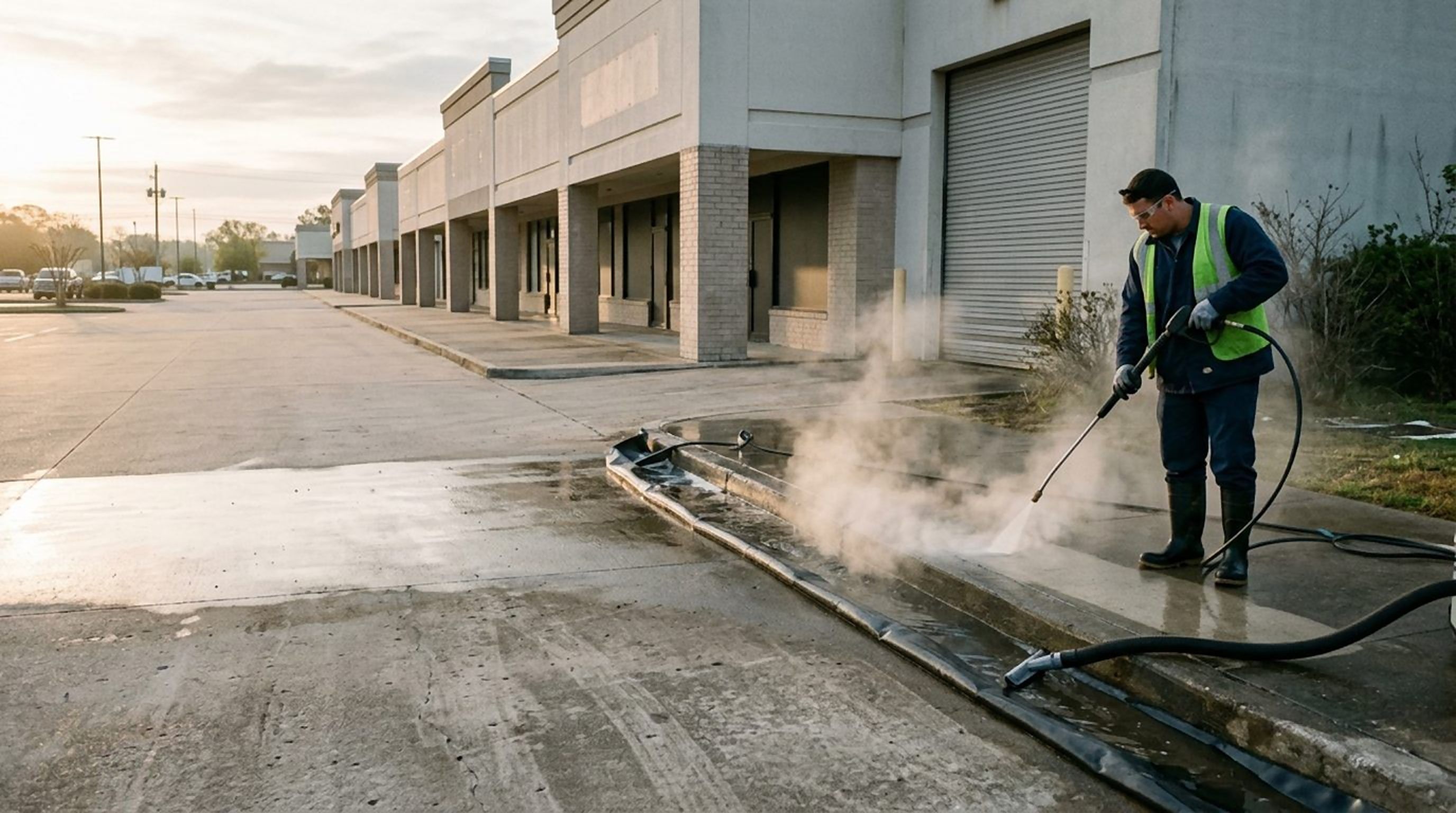
Hot-water power washing at 180–200°F with full wash water capture.










Our own crews do the work across most of the country. The same company that cleans your interceptors hauls the water and keeps the records.
Ask a Power Washing Contractor What Happens to the Water
The answer shows who has thought about it and who has not.
Wash a service bay, fuel apron or drive-thru lane, and the water carries motor oil, hydraulic fluid, brake dust, grease and sugar. Under the Clean Water Act, that water can't go into a storm drain. So the contractor either captures it and needs a licensed hauler to take it away, or lets it run. If it runs, the violation lands on your property, not theirs.
LES is the licensed hauler. Capturing, hauling, recording and processing dirty water isn't an add-on we set up for this service. It's what we do.


- customer locations served
- 129,500+
- facilities nationwide
- 90+
- trucks and tankers
- 1,000+
- in liquid waste
- 24+ years
- hot water units
- 180–200°F
- wash water captured
- 100%
- across most of the US
- Self-performed
- of material recycled
- 94%
Your Contractor's Runoff Becomes Your Violation.We Capture 100% of It.
Most buyers have never been asked to think about this part of the service. It's the part that carries the real risk.
01
What the rule says
Wash water with oil, chemicals or food waste in it can't go into a city storm drain. Storm drains flow to rivers and lakes with no treatment. That's the whole reason for the rule.
02
How we capture it
Vacuum recovery booms, berms and sandbags hold the wash water where we work. We pump it into tanks on the truck instead of letting it run.
03
Where it goes
LES trucks haul it to LES processing facilities, or to an approved sanitary sewer hookup if the site has one. Either way, it's recorded.
04
What you get
A manifest showing volume, hauling and final destination. It's the same record standard we use for grease trap and separator waste.
Here's a question to ask your current contractor: Where does the water go, and can you show me a manifest? Most can't answer the second part. These violations often come to light when a neighbor reports a sheen on the pavement after a wash. The property owner is the one who gets the letter.
Cold Water Smears Oil Deeper Into the Concrete.We Run 180 to 200°F.
Concrete is porous. Cold water at pressure doesn't lift oil out of it. It drives the oil deeper and spreads it wider. The lot looks wet for an hour and no cleaner a week later.
Washing During Business Hours Creates the Risk It's Meant to Remove.We Work Overnight.
A wet, chemical-treated surface with customers walking on it is worse than the stain. Spray hits vehicles. And a lane closed during business hours costs more than the wash.
Overnight and closed-hours scheduling
We work outside business hours or during planned holiday closures. LES runs both day and overnight routes, so this is normal scheduling, not a special favor.
Surface handed back dry and safe
The area goes back into service with no slip hazard and no chemical residue for your first customer to find.
No overspray risk
We protect vehicles, storefronts and neighboring tenants by working when the site is empty, not around people.
Sequenced by area
We handle bays, aprons and lanes in sections. That way, no more of the site is closed at once than your business can handle.
Three Ways Dirty Concrete Costs Real Money.All Three Were a Schedule Away From Fixed.
The quick lube: a lawsuit and an EPA file
Motor oil, transmission fluid and brake cleaner drip across service bays and lanes every day. Rain turns it into a rainbow film on the concrete. A customer steps out of their car, slips on the film and breaks a bone. Then a heavy storm washes the oil into the lot's storm drain. A neighbor reports the sheen to the environmental agency. Two problems, one cause. Hot-water washing every two weeks, with full capture, removes the oily layer and keeps the surface slip-resistant. Captured water goes through the site's oil water separator or gets hauled away. One visit addresses both the injury risk and the discharge violation.
The dealership and fleet yard: brand and asset damage
A shared concrete staging lot collects diesel soot, tire marks and hydraulic fluid from incoming flatbed trucks. Buyers arriving at a luxury showroom walk across stained, grimy paths. That undercuts the premium image the whole business is built on. Meanwhile, the hydraulic fluid softens the asphalt joints. That leads to early cracking and an early repaving bill. Monthly service with rotating surface cleaners and industrial degreasers restores the concrete's look. It also strips the harsh residue that is eating at the pavement. One program protects both your brand image and your pavement.
The drive-thru: pests at the pickup window
Hundreds of cars a day. Customers spill soda, milkshake, coffee and greasy food onto the concrete by the window. The residue bakes into a dark, sticky crust that smells. It feeds ants, wasps and roaches, right beside the window where food is handed out. Sales drop before anyone connects the two. Weekly late-night hot-water washing with an enzyme treatment breaks down baked sugars and food proteins. The pests lose their food source. The smell customers were reacting to goes away too.
Four Vendors Blaming Each Other for the Runoff.Or One Company That Hauls It.
That's why this service sits with grease traps and separators, not with landscaping and janitorial. It's the same waste stream, the same records and the same trucks.
Already on site
If LES already services your interceptor, separator or drains, we add surface work to the same visit pattern. No separate vendor calendar.
Same chain of custody
Wash water is manifested and processed just like the rest of your liquid waste. So the records live in one place for any inspector who asks.
Feeds the equipment you already have
If your site has an oil water separator, we can often route captured wash water through it. That only makes sense if someone is also maintaining that separator.
One responsible partner
Surface, drains, interceptor and separator under one agreement. No more four vendors each blaming the runoff on someone else.
Most National Providers Subcontract and Hope.We Self-Perform Across Most of the Country.
With power washing, the difference between doing the work and arranging it shows up in the runoff. LES uses its own crews across most of its footprint. Elsewhere, we manage screened contractors. Either way, it's one standard, and one company holds the manifest.
Where our own crews work
Most of the country. That includes every market where LES bought an operating company. It also includes any branch serving a national account that asked LES to do the work directly.
Where we manage
Everywhere else, screened contractors work to the LES standard. Same capture rule, same records, same responsibility.
What this means for a national account
Our own-crew coverage isn't a fixed list. If a multi-site customer wants LES crews in a market, we'll talk about it rather than say no. Tell us your locations, and we'll tell you what we can commit to.
You'll Need Another Provider for Some of This.Here's What.
LES handles
- Hot-water power washing of concrete and asphalt
- Service bay, apron, lane and staging lot cleaning
- Drive-thru and dumpster pad washing
- Wash water capture and reclamation
- Hauling, processing and manifest records
- Degreasing with dual-step chemistry
LES does not
- Building exteriors, roofs and windows
- Sandblasting, soda blasting or media blasting
- Graffiti removal and coatings
- Sealing, striping or repaving
- Interior janitorial and floor care
- Residential pressure washing
Power Washing Near You
LES runs 90+ facilities and 1,000+ trucks and tankers nationwide. Find service and local rules for your area:
- Atlanta, Georgia
- Austin, Texas
- Birmingham, Alabama
- Charlotte, North Carolina
- Chicago, Illinois
- Cincinnati, Ohio
- Cleveland, Ohio
- Columbus, Ohio
- Dallas, Texas
- Denver, Colorado
- Detroit, Michigan
- Fayetteville, North Carolina
- Houston, Texas
- Jacksonville, Florida
- Kansas City, Kansas
- Knoxville, Tennessee
- Little Rock, Arkansas
- Miami, Florida
- Milwaukee, Wisconsin
- Mobile, Alabama
- Nashville, Tennessee
- New Orleans, Louisiana
- Oklahoma City, Oklahoma
- Orlando, Florida
- Phoenix, Arizona
- Port Charlotte, Florida
- Portland, Oregon
- Rio Grande Valley, Texas
- Riverside / Inland Empire, California
- San Antonio, Texas
- San Diego, California
- San Francisco Bay Area, California
- Shreveport, Louisiana
- St. Louis, Missouri
- Tacoma, Washington
- Tampa, Florida
- Winston-Salem, North Carolina
Clean surface. Captured runoff. Recorded destination.
Hot-water washing scheduled around your hours. The wastewater is hauled and processed by the same company that maintains everything it drains into.