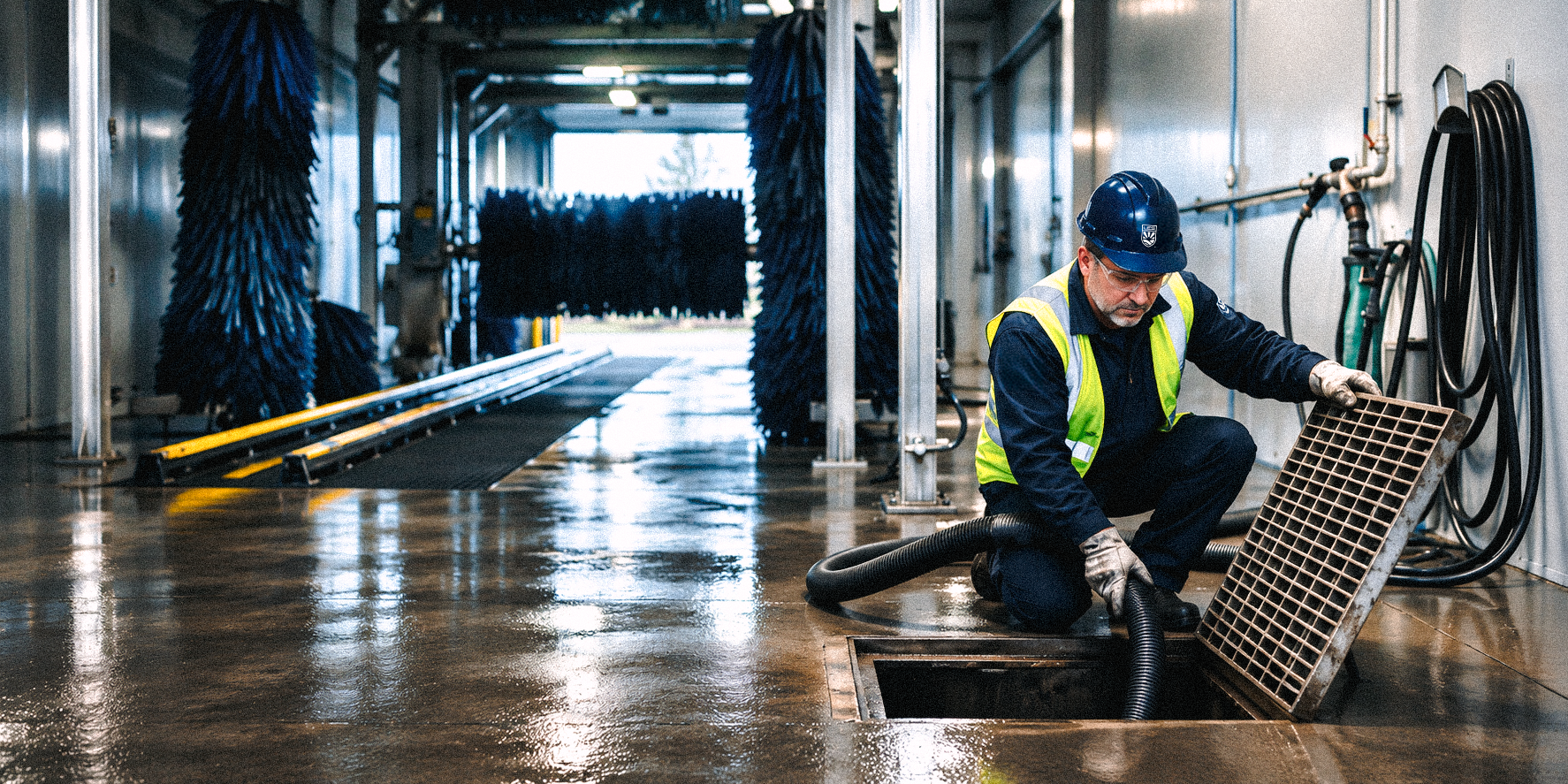
Car Wash Pit Cleaning That Keeps the Tunnel Open and the Reclaim Working
Trench, pit, reclaim and separator — about 12,500 gallons at a single site. Clean one and skip the rest, and the solids just move downstream.








Most vacuum truck companies pump the oil-water separator and leave. But the separator holds about 2,000 gallons of a system that runs to 12,500. That is about a sixth of the system.
Everything upstream keeps sending sediment down. The separator refills faster than planned, and reclaim water quality drops.
Within weeks, the site is back where it started — after paying for a service that covered a sixth of it.
The Four Systems, and What Each Holds
A full service at a typical tunnel site moves about 12,500 gallons across four connected systems. Each has different access, a different volume and a different crew size.


- customer locations served
- 129,500+
- facilities nationwide
- 90+
- trucks and tankers
- 1,000+
- in liquid waste
- 24+ years
- on-time service
- 95%
- of material recycled
- 94%
- typical full-site service
- 4–6 hrs
- 7,651,624 on-site treatment
- US Patent
Your Reclaim System Is a Revenue Line, Not a Maintenance Line
Express wash profits depend on reclaim performance. Every gallon the reclaim system recovers is a gallon you don't buy from the utility. And reclaim water quality directly affects how clean the cars come out.
When sediment carries over from a trench and pit that haven't been serviced, reclaim performance slips quietly. Water costs rise. Wash quality drifts. Customers notice the second one before anyone notices the first.
Serviced Around Your Hours, by Crews Trained on Wash Systems
A car wash cannot be serviced during business hours. A full site takes four to six hours. So the work happens in a narrow overnight or pre-open window — usually 4am to 8am, or 8pm to midnight.
That window only works with crews who know car wash equipment. LES technicians are trained to shut the wash system down, remove and replace bolted grates, and restart the system afterward so the reclaim tanks refill correctly. Get that last step wrong, and the site opens with an empty reclaim system.
Scheduled in your window
4am–8am or evening service, agreed site by site, not set by what suits the route.
Trained on wash equipment
Shutdown, grate removal and a correct restart, so reclaim tanks refill before opening.
Properly staffed
A full-site service is a multi-truck, multi-technician job. Sending one truck guarantees a partial result.
Site left ready to open
Grates secured and the area ready to use before the first car of the day.
For High-Volume Car Wash Operators: On-Site Treatment
At a site moving 12,500 gallons per service, most of what leaves in the truck is water. LES holds a patented process — US patent 7,651,624. It separates oil, water and sludge inside the truck during the visit and returns the water to your system. Only the oil and sludge are hauled away.
Across thousands of visits at similar high-volume car washes, LES onsite recycling trucks processed 85% of the waste on site and returned clean water. Only a small amount of solids had to be shipped off for processing.
Why it matters here
Car washes are the highest-volume use of this process anywhere LES works. Water savings can be measured at each site, and a truck filling up mid-shift is much less of a problem.
Availability
Parr-equipped trucks are specialized and limited in number. Returning treated water needs local approval, which is not yet in place everywhere. So on-site treatment is offered only at select sites. Standard service is available everywhere LES operates.
Multi-Site Operators
The top ten car wash brands each run more than a hundred locations. Most were built through acquisitions. That means inherited vendors, uneven service standards and no full view of site condition across the portfolio.
One service standard
The same recorded process at every site, done by LES team members in LES vehicles.
One chain of custody
Every gallon tracked from your site, on LES trucks, to an LES processing facility.
One reporting system
Service history, volumes and compliance records across the whole portfolio, not pieced together from invoices.
New sites added automatically
Sites join the existing program as they open or are acquired.
Compliance and Documentation
Car wash discharge falls under the local pretreatment authority. In many areas, it falls under the stormwater program too. Rules vary by city and change without notice.
A manifest copy is left on site at every visit. Final manifests, with disposal details, are kept in an online portal for five years. Your team can access them there. Every visit also produces an inspection record covering separator condition, T-pipes, baffles and lids.
Where an LES error results in an emergency service or a Notice of Violation, LES covers the associated cost in accordance with the TripleLock Compliance™ Guarantee. The guarantee applies where LES is the cause.
All four systems. One partner. Overnight.
Trench, pit, reclaim and separator — serviced around your hours, recorded for your permit and recycled through our own facilities.