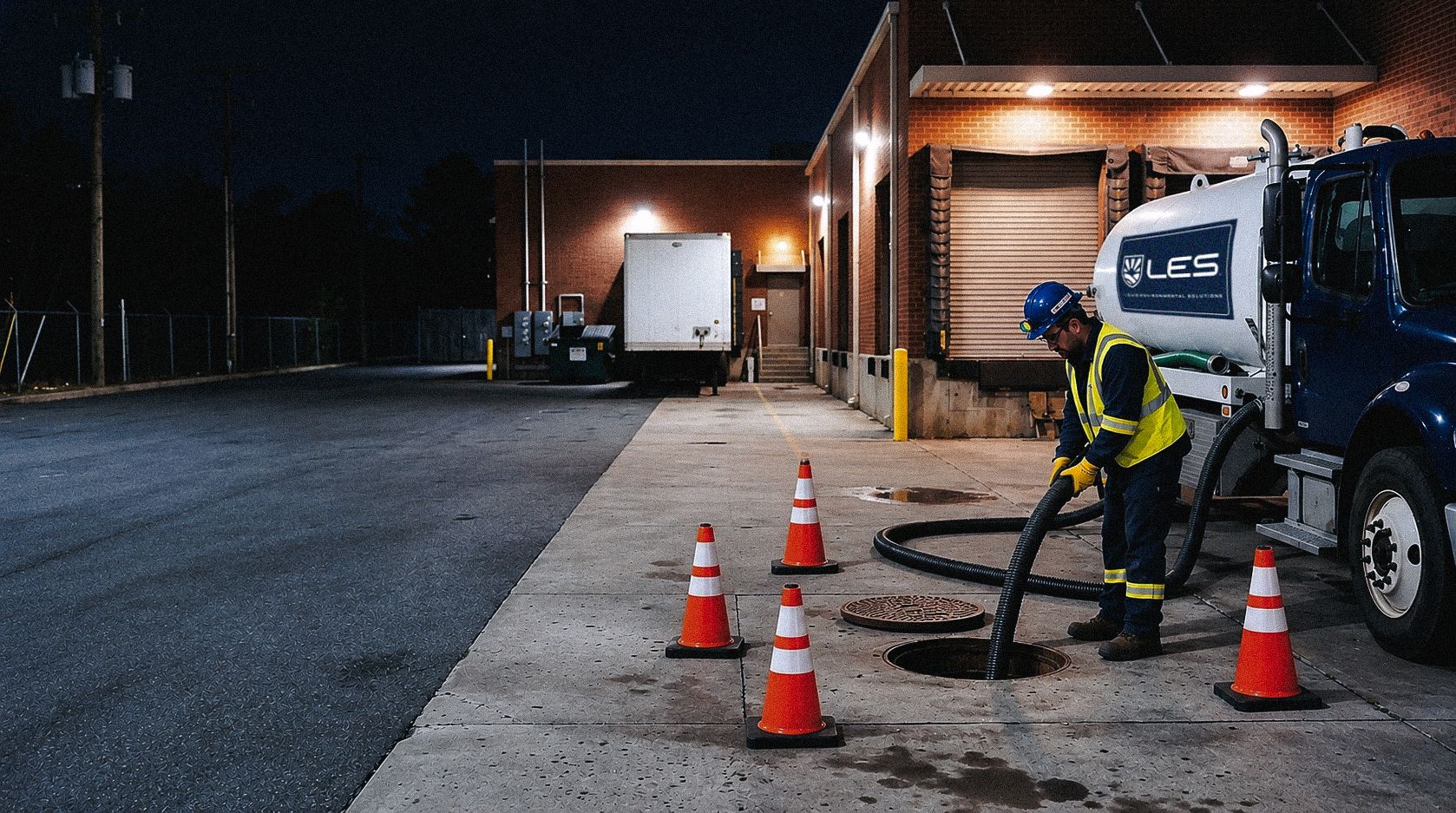
Six Waste Streams in Every Store.One Partner Accountable for All of Them.
Deli, bakery, seafood, rotisserie, the loading dock and the parking lot all make waste. Each must be collected, recorded and disposed of the right way. LES handles the liquid side of all of it.











A restaurant has one kitchen.
A supermarket has four, plus a loading dock and a parking lot full of catch basins nobody has opened since the store did.
Nobody planned the vendor list. It grew: a grease hauler first, then an oil collector, then a lot contractor once the city sent a letter. Each does its job. No one sees the whole site.


- customer locations served
- 129,500+
- facilities nationwide
- 90+
- trucks and tankers
- 1,000+
- in liquid waste
- 24+ years
- on-time service
- 95%
- of material recycled
- 94%
- recovered annually
- 525M+ gal
- regulation tracking
- FOGLaw®
Where It Comes From, and What It Costs When It Fails
Every department that makes food creates a liquid waste stream. The risks are not equal. Some failures are a hassle. One of them can close your most profitable department.
Protect Prepared-Food Sales. Cut Avoidable Costs.
A grease backup can shut down your deli, bakery or hot-food counter. Find service gaps and simplify non-hazardous liquid waste across your stores, with one partner that owns the result.
Built for Grocery: LES Services Around Your Opening Hours and Documents Every Visit for Every Regulator
The differences are in how the store runs. They are why a vendor who is good at restaurants often struggles in grocery.
Store hours
Many stores run 6am to midnight, and some never close. There is no quiet overnight window to do it all. So service has to be done one department at a time.
Close to customers
A restaurant’s grease trap is usually behind the building. A supermarket’s is often near a customer entrance, an outdoor seating area or a pharmacy pickup lane. Shoppers can see and smell any mess.
Multiple regulators
Kitchen FOG falls under the sewer district. The parking lot falls under the stormwater program. The deli falls under the health department. Three sets of rules on one property.
Shared systems
Anchor tenants often share drainage, and sometimes the interceptor itself, with the rest of the shopping center. The landlord shares the duty. Who owns what should be settled before something fails, not after.
Size of the lot
A large supermarket parking lot functions like a small watershed, directing runoff toward a limited number of catch basins. Catch basins fill with sediment and organic debris and are almost never on a maintenance schedule until they flood.
What LES Handles Across a Store
-
Grease traps & interceptors
Scheduled cleaning with a full pump-out, plus a recorded inspection every visit.
-
Used cooking oil
Sensor-tracked containers for deli and rotisserie fryers, with a rebate that grows with volume.
-
Repair, replacement & installation
Failed baffles, cracked units and traps too small for a department that has grown.
-
Drain line jetting
Preventive high-pressure cleaning of the lines where bakery and deli waste hardens.
-
Catch basin cleaning
Sediment, oil and debris removal from parking lot basins, with disposal on record.
-
Oil-water separators
At the distribution center, or where the site has a fleet wash or repair bay.
What We Do Not Handle
Said plainly, because grocery buyers ask, and it saves both sides a wasted call. LES is a non-hazardous liquid waste company.
LES handles
- Grease trap and interceptor waste
- Used cooking oil and yellow grease
- Catch basin and stormwater sediment
- Oil-water separator contents
- Non-hazardous wash and process water
- Sludge from pits, sumps and basins
LES does not
- Solid food waste and organics diversion programs
- Cardboard, plastics and single-stream recycling
- Rendering of meat and bone by-products
- General refuse and compactor hauling
- Hazardous waste of any classification
- Refrigerant and equipment servicing
One Partner, Every Store
Grocery is a multi-site business almost by definition. The vendor problem grows with every store.
LES owns the pickup, hauling, records and recycling. That’s 1,000+ trucks and tankers and 90+ facilities run by LES team members, not brokered to whoever holds the local contract. A store in Sacramento and a store in Tampa get the same recorded process, feeding the same reporting system.
One service standard
The same seven-step process at every store, done by LES team members.
One chain of custody
Every gallon tracked from pickup, on LES trucks, to an LES processing facility.
One reporting system
Service history, compliance records and recovery volumes across all your stores.
One point of contact
One company that answers for it when something goes wrong, in any market.
Sustainability Reporting That Holds Up In Your Sustainability and ESG Reporting
Most grocery chains make public waste and sustainability promises. The liquid waste part is usually the hardest to prove. The material left in someone else’s truck, and the trail ends there.
LES recovers 525M+ gallons each year and recycles 94% of what we collect for reuse. We own the chain from end to end. So that figure is recorded for each store, not guessed across a region.
- Used cooking oil turned into renewable fuel feedstock
- Water recovered and put back to good use
- Grease and food solids kept out of landfills
- Chain-of-custody records for each site, set up for ESG reporting
Every Liquid Waste Stream in the Store. One Partner.
From the deli fryer to the far corner of the parking lot. Collected, recorded and recycled by one company that owns the whole chain.