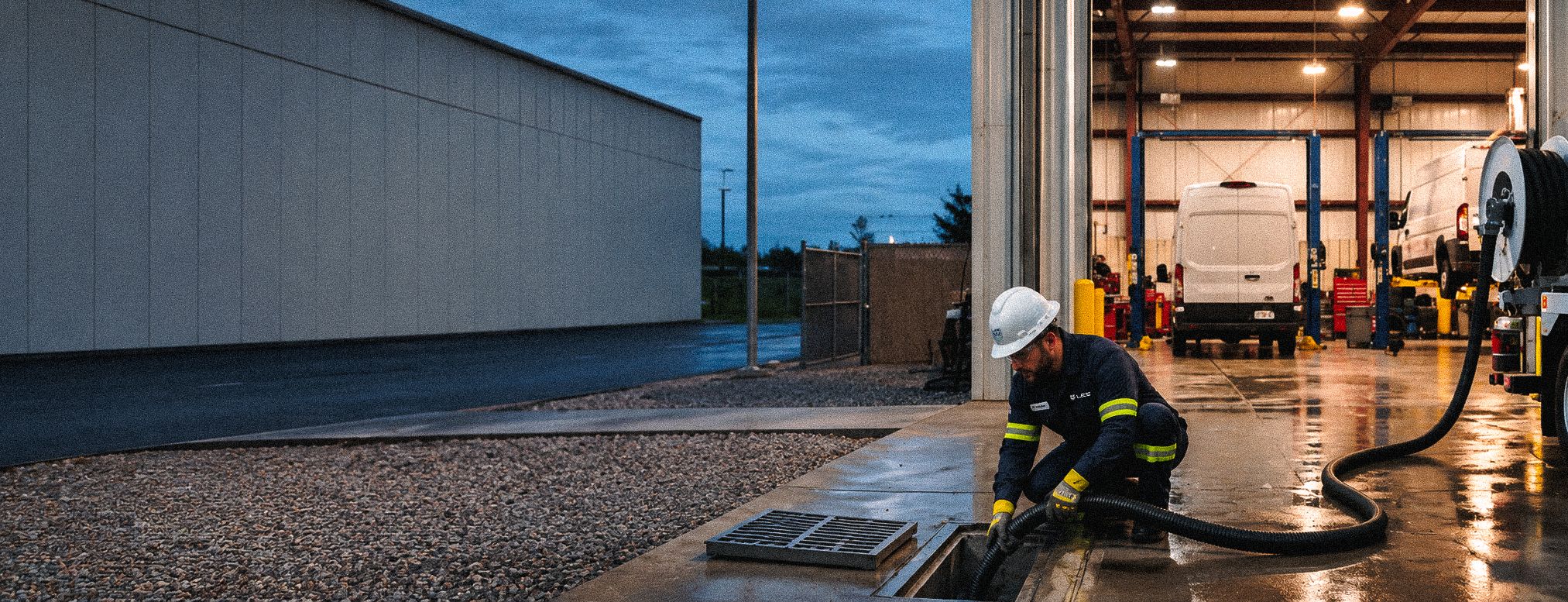
Oil Water Separator Cleaning & Grit Trap Service That Keeps Service Bays Open
Scheduled oil water separator service, documented inspection and nationwide coverage for fleets, dealerships and wash facilities.






When a separator backs up, the bay closes. LES prevents that with scheduled cleaning, a written inspection at every visit and one program for every location you run.
LES owns the trucks, the transfer sites and the recycling network. One company is responsible from your service bay all the way to reuse — not a broker, and not a chain of subcontractors.
When the Separator Backs Up, the Bay Closes
Wash water carries oil, sludge, grit and sediment into your separator. It builds up. Capacity drops.
Most sites find out when the drain stops draining.
By then it’s no longer maintenance. It’s an emergency cleanout, a closed bay and sometimes a discharge violation on top of it.
Inside the separator
One Emergency Service Can Cost as Much as a Year of Maintenance
Scheduled service removes the buildup before it gets that far. It also puts a trained technician in front of your equipment on a regular cycle. That’s how problems get found while they’re still small.
A proactive LES program means:
-
Bays stay open
Separator backups and overflows are prevented, not responded to
-
Emergency dispatches drop
Work moves onto the maintenance calendar
-
Problems surface early
While they are still a repair, not a replacement
-
Intervals match reality
Service frequency is set by actual loading, not a generic schedule
-
Budgets hold
Predictable service replaces unplanned emergency spend


- facilities nationwide
- 90+
- trucks and tankers
- 1,000+
- customer locations served
- 129,500+
- Compliance Guarantee™
- TripleLock
- coverage
- Nationwide
- of the waste we collect is recycled
- 94%
More Than a Pump-Out.Six Steps, Every Visit.
Removing the wastewater is the easy part. Here’s what else happens each time an LES truck arrives.
01Pump
Remove built-up oil, wastewater, sludge and sediment from the whole system.
02Clean
Clean every chamber and part we can reach. Not just the top layer.
03Inspect
Inspect separator parts and the drains around them for damage, wear and too much buildup.
04Flag
Write down what we find and alert your contact. Early problems don’t leave with the truck.
05Scope
When repairs are needed, LES plans the work, quotes it and manages the repair.
06Recover
Haul and process the waste through the LES recycling network, with chain-of-custody records for every gallon.
One Visit Is a Service.A Schedule Is a Program.
Most sites service separators when something goes wrong. That makes costs hard to predict and downtime hard to avoid.
With an LES program, your schedule is based on real numbers. We look at wastewater volume, how dirty it is, separator size and local discharge limits — not a generic calendar.
We record the separator’s condition at every visit and track it over time. If a separator starts wearing down over three visits, we quote the repair ahead of time. No midnight emergency calls.
Intervals set by measurement — tightened where loading demands it, relaxed where it does not
Condition trended over time — not noted once and forgotten
Repairs forecast into a budget cycle — planned work instead of emergency response
Documentation ready in advance — before an inspector asks for it
One schedule everywhere — every location on the same standard
Discharge Rules Change From Place to Place. LES Tracks Them for Every Location You Run.
Sites that produce oily wastewater face discharge limits, maintenance rules and record-keeping rules. These vary by city, county and state.
Run sites in twelve markets, and you’re managing twelve rulebooks.
FOGLaw®, the LES rule-tracking platform, watches those rules and keeps each location’s service program up to date as they change.
TripleLock Compliance™ Guarantee
We track the rules.
FOGLaw® tracks wastewater rules in the areas where you operate.
We do the service right.
Every visit follows a written service process, with records that show exactly what was done.
When LES is the cause, LES owns it.
If an LES service error results in a qualifying compliance issue or emergency service, LES covers the associated cost in accordance with the guarantee.
The result is better records, more confidence at inspection time and one partner responsible for the quality of the program.
Parr On-Site Treatment
In two specific cases, LES offers something no other provider can.
Most separator service — including most of ours — removes everything in the tank and hauls it to a permitted facility. That’s the right method. It’s what the vast majority of sites need, and it’s what LES delivers everywhere we work.
But at some sites, the amount of water being hauled is the problem. That’s where Parr changes the math.
Who it is for
-
Operations with a water reduction mandate
If you’re responsible for water use and have to prove you’ve cut it, Parr changes the math in your favor. The water stays in your system instead of being hauled out and replaced. And we record how much water stayed at every visit.
-
High-bay wash facilities
Car wash tunnels, rental car return sites and large fleet wash sites. A single site can hold tens of thousands of gallons across trench, pit, reclaim and separator tanks. At that size, the amount you haul decides how long the job takes.
What it does
- Your separatorTrench, pit, reclaim, tank
- Separated in the truckOilWaterSludge
- Hauled awayOnly the oil and sludge
Water returns to the separator, back to its working level
Parr is a patented process — US patent 7,651,624, held by LES. It separates oil, water and sludge inside a truck with several compartments during the service visit. Then it returns the water to the separator to bring it back to its working level. Only the oil and sludge are hauled away.
LES service data · 66 car wash jobs
88.5%of the volume stayed on site
- Gallons pumped743,908
- Gallons hauled away85,683
In LES service data from 66 recorded car wash jobs, 743,908 gallons were pumped and 85,683 were hauled away. That means 88.5% of the volume stayed on site.
Tell us your locations and what you want to achieve. If Parr is available and a good fit for your sites, we’ll say so. If not, the standard program gives you the same uptime, cost control and compliance results — which is what most sites need.
The Lowest Pump-Out Price Is Rarely the Lowest Cost
A cheap pump-out removes today’s wastewater and leaves tomorrow’s failure in place.
If sludge buildup, a worn baffle or a failing trench drain goes unnoticed, the next bill isn’t a service call. It’s an emergency cleanout, a repair or a violation.
- Emergency cleanout
- Repair
- Violation
Every LES service is also an inspection.
That’s what turns emergency repairs into planned maintenance.
Emergency repairs
Planned maintenance
Over the life of the system, that means:
-
Optimized intervals
Fewer unnecessary pump-outs, no overdue ones
-
Fewer emergencies
The most expensive service is the unplanned one
-
Earlier repairs
Caught while they are still small
-
Longer infrastructure life
The separator and drainage system last
-
Less vendor overhead
One provider instead of a market-by-market patchwork
Different Facilities, Different Loads, Different Intervals
A quick lube bay and a heavy equipment yard don’t produce the same wastewater. LES sets service schedules based on how fast your system really fills, not a standard schedule.
-
Tire Change Stores
Low oil volume doesn’t mean low risk. Mounting lubricants, rim cleaner and bay washdown still fill the separator — and can still lead to discharge violations.
-
Oil Change Stores
The most oil of any auto business. Fast bay turnover fills separators quickly, and a backed-up bay stops the only thing the site sells.
-
Car Washes
Grit, sand and reclaim solids fill separators and grit traps together. LES services both, so a wash bay never closes on a busy weekend.
-
Automotive Dealerships
Service drive, wash bay and detail all feed one system. LES uses the same service and records at every store in the group.
-
Rental & Delivery Fleets
Dozens of small sites, each with its own local discharge rules — including airport authorities. One LES program covers all of them to one standard.
Trucking & Logistics Terminals
Terminals don’t stop. LES schedules around you and manages wash-bay and washout wastewater without slowing you down.
-
Fleet Maintenance Facilities
Multiple bays, trench drains and wash areas on one system. Every LES visit records what we found, so your team sees problems early.
Heavy Equipment Facilities
Mud, clay and heavy sediment fill separators long before oil does. LES builds schedules around solids, not oil volume.
The Separator Is Only Part of the System
Sediment builds up across the whole drain network, not just inside the tank. LES services everything around the separator as one program:
- Trench and floor drain cleaning
- Wash-bay wastewater service
- Grit trap cleaning
- Hydro jetting
- Industrial vacuum services
- Non-hazardous wastewater hauling
- Recycling
- Repair management
Oil water separator
One program


One Program. One Standard.Every Location.
Managing separators at 50 sites shouldn’t mean 50 different service standards.
LES owns the collection, hauling, processing and recycling. When a qualified partner does the work, LES still owns the service standard, the records and the responsibility.
Your sites get the same service everywhere. Your corporate team gets one contract, one reporting platform and one point of contact.
50 sites
Same service standard
- One contract
- One reporting platform
- One point of contact
As locations open, close or are bought, they join the same program.
Oil Water Separator Service Near You
LES runs 90+ facilities and 1,000+ trucks and tankers nationwide. Find service and local rules for your area:
- Atlanta, Georgia
- Austin, Texas
- Birmingham, Alabama
- Charlotte, North Carolina
- Chicago, Illinois
- Cincinnati, Ohio
- Cleveland, Ohio
- Columbus, Ohio
- Dallas, Texas
- Denver, Colorado
- Detroit, Michigan
- Fayetteville, North Carolina
- Houston, Texas
- Jacksonville, Florida
- Kansas City, Kansas
- Knoxville, Tennessee
- Little Rock, Arkansas
- Miami, Florida
- Milwaukee, Wisconsin
- Mobile, Alabama
- Nashville, Tennessee
- New Orleans, Louisiana
- Oklahoma City, Oklahoma
- Orlando, Florida
- Phoenix, Arizona
- Port Charlotte, Florida
- Portland, Oregon
- Rio Grande Valley, Texas
- Riverside / Inland Empire, California
- San Antonio, Texas
- San Diego, California
- San Francisco Bay Area, California
- Shreveport, Louisiana
- St. Louis, Missouri
- Tacoma, Washington
- Tampa, Florida
- Winston-Salem, North Carolina
Stop Waiting for Your Separator to Tell You It Needs Service
An overflow, a slow drain or a failed inspection is a poor way to learn you need maintenance.
A 30-minute walkthrough. No cost, no obligation. LES reviews:
- Your separator's condition and how much has built up
- Whether your service schedule matches how fast it fills
- Wash-bay and drain conditions around the separator